

Software delivery by market: find your country guide
OutsourcingVN publishes thirty-three country guides, one for each delivery market you might sell or build for. Netbase serves clients in the United States, Europe and Asia-Pacific, and most Netbase projects come from clients outside Vietnam. Use this index to see which question your market raises first, then open its guide.
Submit a project See global deliveryReviewed by Huy Nguyen (David), CEO · Updated 4 Nov 2026 · 12 min read

OutsourcingVN is operated by Netbase JSC, and this index routes you to the right guide rather than repeating any of them; global delivery covers the remote-first operating model every one of the thirty-three assumes.
Contents
- Why does the first question differ by market?
- How was this list of thirty-three markets chosen?
- Which question does your market raise first?
- Compare all thirty-three markets
- Where has Netbase already delivered, by market?
- Worked scenario: one product, two markets at once
- What should you ask before scoping a cross-market build?
- What goes wrong when markets are compared generically?
- Does AI change which question comes first for a market?
- Common questions
- Find the guide for your market
Why does the first question differ by market?
Every market guide answers the same underlying questions eventually: data protection, language and script, e-invoicing, accessibility, payment methods and time zone. What differs is which one blocks a proposal first. A data protection authority with its own guidance, like France's CNIL, raises that question before anything else; a market with no dominant local regulator but a dominant local payment habit, like Nigeria's multiple payment providers, raises a different one first. Treat the first question as triage, not the whole scope: data security and compliance in outsourcing and each country guide cover the rest once the first blocker is cleared.
How was this list of thirty-three markets chosen?
Netbase serves clients in the United States, Europe and Asia-Pacific. The 2023 Netbase company profiles put the share of projects from clients outside Vietnam at 85%, and most Netbase projects continue to come from clients outside Vietnam today. These thirty-three guides cover the markets that recur most often in the questions buyers and their own users raise, so the index grows as new markets recur rather than attempting every country at once.
Which question does your market raise first?
Five conditions decide which question comes first for a given market. Find yours here, then use the comparison table below for your specific country guide.
-
Data protection decides first
when a dedicated authority or regulator governs the sector, as in the Netherlands, Germany, France, the UAE, Saudi Arabia, Singapore, Kenya, Nigeria, South Africa, Canada, Ghana, Malaysia, Switzerland, Hong Kong and Vietnam.
-
Script decides the build
when the product must render a non-English script correctly, as in the UAE, Saudi Arabia, France and Hong Kong.
-
E-invoicing format gates launch
when business buyers require a structured e-invoice, as in the Netherlands, Saudi Arabia, the Philippines, France, Malaysia and Vietnam.
-
Accessibility standard required
when public-sector or regulated buyers require a named standard, as in the UK, the Netherlands, France and Germany.
-
Payments and time zone
set the plan when local payment methods and support-hour overlap decide the checkout and helpdesk, as in Nigeria, Kenya, Indonesia, the Philippines, the United States, Ghana, Malaysia, Switzerland and Vietnam.
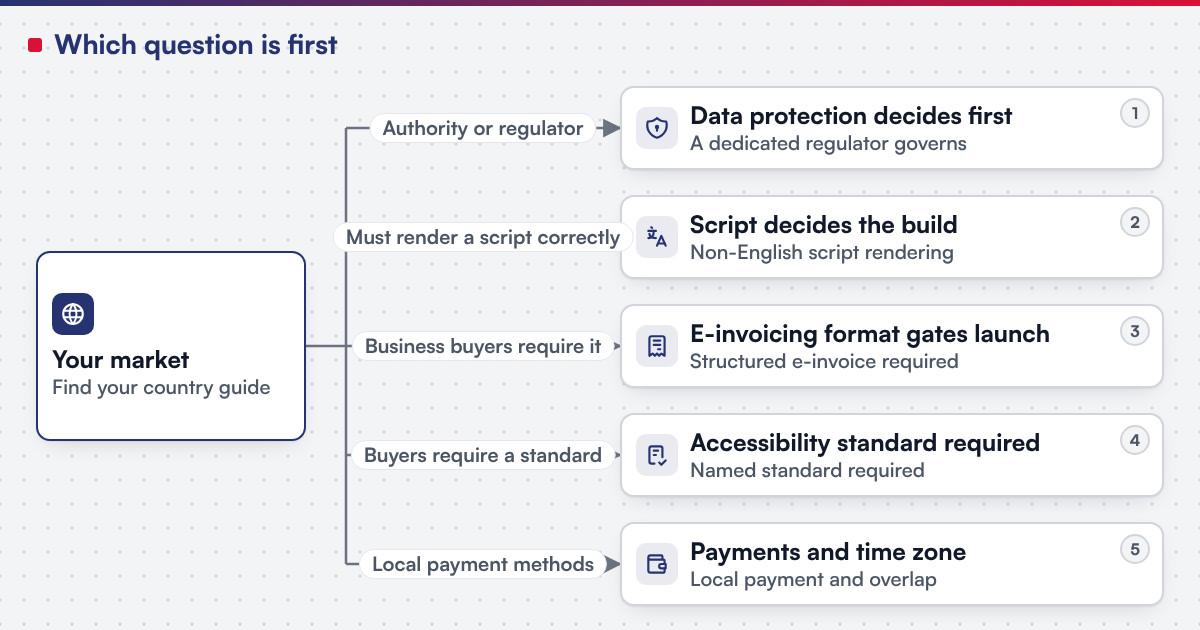 (opens the full-size diagram in a new tab)
Compare all thirty-three markets
| Market | First question to settle | Options |
|---|---|---|
| Nigeria | Which payment provider and fallback carries checkout, and how phone sign-in works | Nigeria guide |
| UAE | Arabic and English parity, and whether UAE PASS sign-in belongs in release one | UAE guide |
| Singapore | Phasing a redevelopment without stopping the business, and whether Singpass or Myinfo belongs in scope | Singapore guide |
| UK | What evidence procurement, security and accessibility reviewers will ask for | UK guide |
| Mauritius | What happens when a payment or messaging dependency fails | Mauritius guide |
| Saudi Arabia | Which system issues the tax invoice, and who accepts the Arabic and English versions | Saudi Arabia guide |
| United States | IP assignment, CCPA service-provider terms and an acceptance rhythm that uses the time difference | United States guide |
| Australia | What personal data an overseas team may see, and breach-notice timing | Australia guide |
| South Africa | A registered information officer and the local payment methods shoppers actually use | South Africa guide |
| Kenya | Data Protection Commissioner registration and M-Pesa integration | Kenya guide |
| Canada | A documented PIPEDA privacy programme and Quebec's Law 25 | Canada guide |
| Indonesia | Electronic system operator registration and QRIS payment support | Indonesia guide |
| Philippines | National Privacy Commission registration and electronic invoicing rules | Philippines guide |
| Netherlands | Who enforces data protection, and whether Peppol e-invoicing applies | Netherlands guide |
| Germany | Works-council agreement and the federal data protection act provisions on top of GDPR | Germany guide |
| France | CNIL guidance, RGAA accessibility criteria and the e-invoicing reform | France guide |
| Sweden | Who enforces GDPR at IMY, and whether BankID and Swish belong at sign-in and checkout | Sweden guide |
| Cyprus | GDPR under the Cypriot commissioner, and bilingual Greek and English acceptance for a small-market build | Cyprus guide |
| Ghana | Data Protection Commission registration and mobile money interoperability | Ghana guide |
| Malaysia | The amended PDPA, the phased MyInvois mandate and DuitNow or FPX at checkout | Malaysia guide |
| Romania | Which authority enforces GDPR, and when an RO e-Factura invoice is required | Romania guide |
| Denmark | MitID sign-in, NemHandel e-invoicing and the Bookkeeping Act's digital bookkeeping duty | Denmark guide |
| Thailand | The PDPA and its committee, PromptPay and Thai QR payments, and the Revenue Department's e-Tax Invoice system | Thailand guide |
| Qatar | The Personal Data Privacy Protection Law's cross-border provision, QCB-licensed payments and national identity sign-in | Qatar guide |
| India | The Digital Personal Data Protection Act, UPI and RBI-regulated payment rails, and GST e-invoicing through the Invoice Registration Portal | India guide |
| Colombia | Law 1581 and the SIC's database registry, DIAN e-invoicing, and PSE or Bre-B at checkout | Colombia guide |
| Spain | The AEPD's GDPR enforcement, the Verifactu invoicing-software rules and FACe e-invoicing to public buyers | Spain guide |
| Poland | UODO's GDPR enforcement, the national KSeF e-invoicing system and BLIK at checkout | Poland guide |
| Portugal | CNPD's GDPR enforcement, ATCUD and QR code invoicing rules, and MB WAY or Multibanco at checkout | Portugal guide |
| South Korea | PIPA and the PIPC, NTS e-Tax Invoice, and payment-gateway oversight under the FSC | South Korea guide |
| Switzerland | The revised FADP and the FDPIC, disclosure of personal data abroad, and QR-bill or TWINT at checkout | Switzerland guide |
| Hong Kong | The PDPO and the PCPD, cross-boundary data flows, FPS payments and Traditional Chinese interfaces | Hong Kong guide |
| Vietnam | The Personal Data Protection Law, electronic invoices under the tax administration's rules, and VietQR on the NAPAS network | Vietnam guide |
Where has Netbase already delivered, by market?
Several of these markets already carry a published Netbase record. In Nigeria, Netbase built a multi-state business directory with field-verified listings for Dey Page; the multi-state business directory record has the detail. In Saudi Arabia, Netbase delivered a bilingual Arabic and English web-to-print platform for Deyar Printing & Advertising in Riyadh; see the bilingual web-to-print platform record. In Singapore, France and the Netherlands, Netbase built web-to-print stores with online design tools for print businesses in each country, alongside a fourth store in South Korea; the four-country web-to-print record covers all four. In the United States, Netbase has worked since 2020 as offshore development and managing partner on a multi-tenant cloud ERP SaaS platform for a client that is not named; the multi-tenant cloud ERP record has the scope. For Rebelo AG in Portugal, Netbase set up a 3D preview in the online designer for boxes and other multi-sided products; the Rebelo AG 3D product preview record has the detail. Working with a local Odoo implementation partner, Netbase has consulted on and customized Odoo in Vietnam for retail store chains, a food and beverage franchise chain, manufacturers, trading and distribution companies, a warranty service network, an industrial-park purchasing centre, an energy-sector project time and cost system, a university institute and a postal-service helpdesk; these clients are not named. The Odoo implementations record has the scope. Beyond these, Netbase has also built an English-first multi-vendor marketplace for West Africa, covering buyer storefronts, vendor onboarding and seller payouts.
Worked scenario: one product, two markets at once
A SaaS company is selling the same product to a UK public-sector buyer and to users in Nigeria through a local reseller. The UK buyer's procurement team asks for accessibility and security evidence before it will shortlist the proposal; the Nigerian rollout's first blocker is which payment providers the checkout must support and what happens when one times out. Both questions are real and neither is more important in the abstract, but a single launch plan has to sequence them: accessibility evidence can be prepared in parallel with build work, while payment-provider fallback has to be designed into the checkout from the first sprint, because retrofitting it later touches the order flow. The UK guide and the Nigeria guide each give the detail; this index exists so a team selling into both does not have to rediscover that they start from different questions.
What should you ask before scoping a cross-market build?
- Which market's regulator, if any, has to approve something before launch, and what evidence does it want?
- Which payment methods are mandatory in each market, and what happens in the checkout when one is unavailable?
- Does any market require a specific language, script or invoice format that changes the data model, not just the copy?
- Who owns data residency and cross-border transfer decisions for each market your users sit in? Data security and compliance in outsourcing sets out what to settle first.
- What is the support-hour overlap for each market, and who answers when it is outside it?
What goes wrong when markets are compared generically?
- One compliance checklist for every market. Signal: the same accessibility or privacy clause appears in every market's contract regardless of whether that market's law requires it. Owner: whoever owns the brief, who should scope each market's actual regulator and standard rather than copying the strictest one everywhere.
- Payment methods added after the checkout is built. Signal: a market-specific payment provider is bolted on late and the fallback path is untested. Owner: the product owner, who should settle payment methods per market before the checkout is designed.
- Language treated as a copy problem. Signal: a right-to-left or multi-script market is scoped as translation rather than layout and data-model work. Owner: the technical lead, who should flag any non-Latin script market at the architecture stage.
- No owner for time-zone overlap. Signal: a support ticket from one market sits unanswered because nobody agreed whose hours cover it. Time-zone collaboration in Vietnam sets out how an overlap window and escalation route are agreed.
Does AI change which question comes first for a market?
No. The triage in the table above is about law, payment habits and script — decisions that stay with your advisers and product owners in every market, whatever tooling a delivery team uses. Where AI genuinely changes the picture is inside the engineering itself: Netbase's own delivery uses AI-assisted engineering under human review in every market this index covers, works with commercial and open-source AI models chosen per project, and a drafted first-pass compliance checklist or translation is still checked by the named owner the comparison table assigns to that market, not shipped straight from a model. Use this index to find the first blocking question for your market, then the data security and compliance guide for how a delivery team's own AI tooling fits inside the access and review model you already settle for human staff.
Plan the next step for your project
Common questions
No. Read the guide for the markets your buyers or users are actually in, and use the comparison table above to see which question each one raises first.
No. Netbase JSC's head office is in Hanoi, Vietnam, and delivery is remote-first from there; the country list is a delivery footprint, not an office map. Global delivery explains how a distributed team is composed and managed.
Submit a project and describe the market; the brief gets scoped against the general principles in data security and compliance and global delivery even where a dedicated guide does not yet exist.
Start with the one whose first question is hardest to reverse once build work starts, usually data protection or payment-method choice, then work through the rest in the comparison table.
No. It is ordered for comparison, not by size, difficulty or priority, and every market gets the same questions asked of it.
Talk to Huy Nguyen (David), Founder and CEO of Netbase JSC: message him on WhatsApp at +84 937 869 689 or email project@netbasejsc.com. You can also send your brief through the project request form. Say which workflow or system the project concerns and what has to stay unchanged; the first step is a discovery conversation, and scope and milestones are agreed after it.
Find the guide for your market
For how we source the claims on this page, see our methodology. The commercial route for a bounded build in any of these markets is Custom Product Engineering. OutsourcingVN is operated by Netbase JSC and is Netbase's own outsourcing-services platform; submit a project and name the markets so the proposal answers the right questions first.
Work behind this guide

This record covers phase-one scope for agency SMEs; the client and product are not named.
Keep Reading
This record separates what was delivered from a third phase that the source describes as planned.
Keep Reading
This record reports built scope on a 12-week web and mobile plan.
Keep ReadingRelated services and solutions
 Custom product engineering for a bounded release outcome
One defined release of your product, built to named outcomes and handed over with acceptance evidence.
Learn More