

Vietnam software outsourcing: a buyer's guide
Outsourcing software development to Vietnam works when the provider, the project and the governance fit; the country alone decides very little. Before you sign, check three things: who is accountable for the outcome, how the team will work across your time zone, and what you own and receive at exit. This guide shows how to test each one.
Submit a project Compare providersReviewed by David Nguyen (CEO) · Updated 6 Oct 2026 · 10 min read

OutsourcingVN is operated by Netbase JSC, a delivery company headquartered in Hanoi, so we have an interest in your decision. The guide is written to be useful whichever provider you choose. It contains no rankings, market-size figures or rate comparisons, and it applies the same checks to Netbase as to anyone else.
Contents
- Which question are you trying to answer?
- Start with the decision, not the destination
- When does a Vietnam-based team fit, and when does it not?
- Which engagement model gives you the control you need?
- How do you plan around the time difference?
- What should be settled in writing before you sign?
- Contract, language and onsite questions
- Common failure patterns
- A practical evaluation sequence
- Where Netbase fits
- Common questions
- How this guide is sourced
- Want Netbase's view on your project?
Which question are you trying to answer?
This page is the overview. Four questions have a guide of their own that goes further than the summary here.
- How do we build a defensible shortlist? Dated criteria applied equally to every provider, with the evidence that satisfies each one.
- Why do quotes for the same brief differ? The scope, team and delivery choices that make two proposals incomparable, and how to normalise them.
- What should we verify before signing? The documents and answers to request about the company, the people, security, IP and exit.
- How will we work across time zones? Designing an overlap window, written handovers and escalation around UTC+7.
- How does Vietnam compare with other sourcing locations? Vietnam vs India, Vietnam vs the Philippines, Vietnam vs Poland and Vietnam vs Latin America compare Vietnam against another country or region as a place to source from, which is a different question from the market guides above.
Start with the decision, not the destination
"Should we outsource to Vietnam?" is the wrong first question. A better one is: "What outcome do we need, and what kind of team can take responsibility for it?" Before comparing locations or providers, write down:
- the business outcome and how you will recognise it;
- the systems, users and data the project touches;
- who on your side owns decisions and acceptance;
- how much daily overlap and communication the work genuinely needs;
- the security, compliance and data-location rules you must follow;
- what must be handed back to you, and when.
With that in hand, you can test any provider in Vietnam or elsewhere against the same requirements. Without it, you end up comparing rates and CVs, which says little about delivery risk.
When does a Vietnam-based team fit, and when does it not?
A Vietnam-based team suits buyers who can work largely asynchronously, who value the continuity of a stable project team, and who will invest in a clear written scope. It also suits Asia-Pacific buyers who want substantial working-hours overlap.
It is a weaker fit if the project depends on constant real-time collaboration outside the team's working hours, needs people onsite for most of its duration, or has data-residency rules the provider cannot meet. Those constraints do not rule Vietnam out, but they must be designed for explicitly.
Which engagement model gives you the control you need?
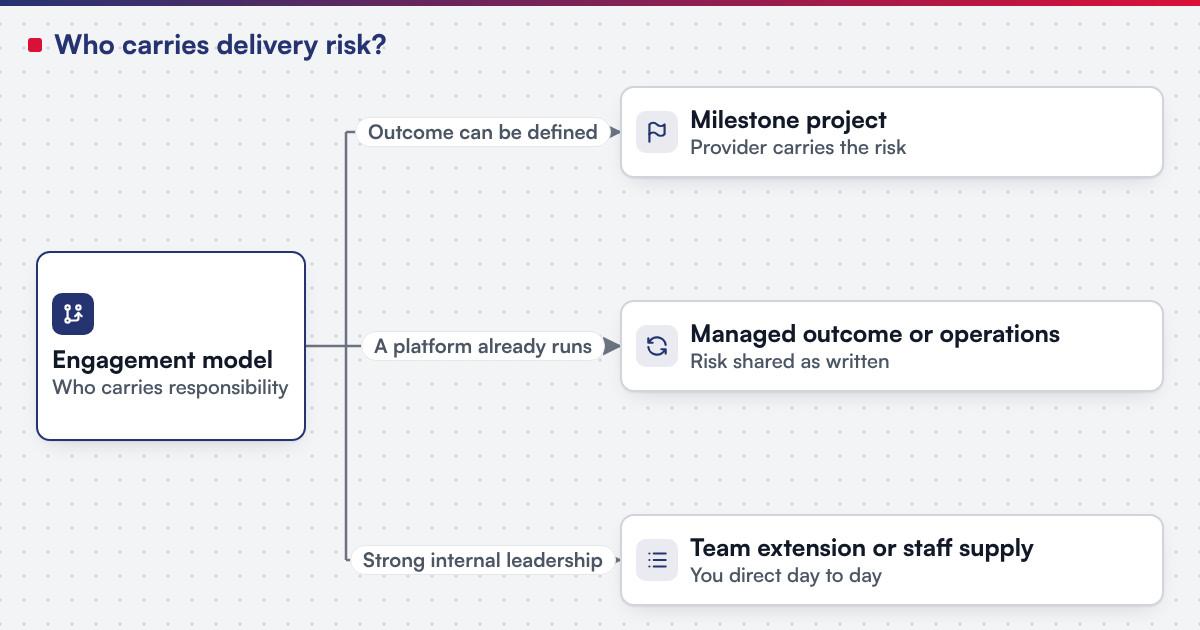
The engagement model decides who carries delivery responsibility. Many failed outsourcing relationships are a mismatch here: the buyer expected an accountable outcome but bought capacity.
| Model | Who directs the work day to day | Who carries delivery risk | Fits when |
|---|---|---|---|
| Milestone project | The provider, against a scope you approved | The provider, up to each acceptance point | The outcome can be defined and you want one party accountable for it |
| Managed outcome or operations | The provider, against agreed measures it controls | Shared, as written in the service terms | A platform already runs and needs maintenance, support or steady improvement |
| Team extension or staff supply | You | You, for most of it | You already have strong internal product and engineering leadership |
The engagement models page explains the trade-offs in more detail, and project delivery describes how milestones, change control and acceptance work in practice. A standing version of team extension, set up and governed as its own decision rather than drifting into one, is covered in the offshore development centre guide.
 (opens the full-size diagram in a new tab)
How do you plan around the time difference?
Vietnam works on UTC+7. For buyers in Asia-Pacific most of the working day overlaps. For Europe, the overlap is the European morning. For the Americas, same-day overlap is short or absent, so the project relies on written handovers, recorded decisions and a scheduled meeting window.
Ask each provider to propose a concrete rhythm: which meetings, at what local times, who attends, how decisions are recorded, and how urgent issues are escalated outside the overlap. A provider that cannot describe this clearly will improvise it later.
What should be settled in writing before you sign?
Whatever the provider's location, settle these points before delivery starts:
- Intellectual property: who owns code, designs and documents created for you, and which reusable components are licensed rather than transferred.
- Access and data: which people can access which systems and data, from where, and how access is granted, reviewed and removed.
- Subcontracting: whether any part of the work goes to a third party, and whether they are disclosed and bound by the same terms.
- Security practices: code review, version control, encryption in transit, role-based access and multi-factor authentication for administrative tools, and how incidents are reported to you. Ask which company-level certifications or attestations the provider holds, and confirm that none is being extended to your product.
- Acceptance: what evidence shows a milestone is complete, who signs it off, and what happens to defects found after acceptance.
- Continuity and exit: how the provider covers absence or turnover, and what you receive at the end: source code, credentials, documentation and a handover session.
Ask for evidence rather than assurances: a sample status report, a sample acceptance record and a standard handover checklist.
Contract, language and onsite questions
Agree the commercial model before work starts and make sure it matches the engagement model. A milestone project needs a definition of each milestone, how change requests are estimated and approved, and what happens if acceptance is delayed on either side. Ask which law governs the contract, how disputes are resolved, and whether the provider will sign your confidentiality and data-processing terms. Raise any invoicing currency or entity requirement in the first conversation rather than at signature.
Providers serving international clients agree English as the working language, but fluency and writing quality vary between individuals, not just between companies. Meet the people who will lead your project, not only the sales team, and review a real status report.
Remote-first delivery is the normal starting point for a Vietnam-based team serving a client abroad. Onsite work makes sense for discovery workshops, cutover, training, security-sensitive access or incident response; specify when, for how long and for which roles.
Common failure patterns
-
A scope written as a feature list with no acceptance criteria
- Early signal
- Milestones are "done" but nobody can say what was checked
- Who acts
- Buyer's decision owner, before the first milestone starts
-
No single decision owner on the buyer side
- Early signal
- Questions wait for days and the provider starts guessing
- Who acts
- Buyer sponsor, by naming one owner
-
Choosing on rate alone
- Early signal
- Rework and management time grow after the second milestone
- Who acts
- Buyer, by comparing total delivery cost rather than day rates
-
Undisclosed subcontracting or rotating team members
- Early signal
- New names appear in reports without notice
- Who acts
- Buyer, through the subcontracting clause
-
No agreed handover
- Early signal
- The system cannot be run or changed without the provider
- Who acts
- Both sides, by writing exit terms at the start
A practical evaluation sequence
-
Write the brief
A one-page brief with the outcome, owner, scope, constraints and timeline.
-
Screen a long list
Apply consistent criteria to every candidate; the framework for comparing software outsourcing companies sets out one approach.
-
Hold structured calls
Talk to three to five providers using the same questions.
-
Ask for a written approach
Each shortlisted provider sends milestones, team, risks and assumptions.
-
Check delivered work
Review delivered work relevant to your project and speak to a reference where the provider can arrange one.
-
Start bounded
Begin with a discovery or first milestone before committing to the full scope.
Where Netbase fits
Netbase JSC was founded in 2012 and is headquartered in Hanoi, Vietnam; it is the company's only office. Netbase serves clients in the United States, Europe and Asia-Pacific. Delivery communication is in English, project teams typically range from 3 to 30 people, and for custom development the client owns the IP created for it. Delivery is remote-first; onsite work is available on request and scoped as a separate project activity. Netbase stays accountable while teams may combine Netbase staff, approved specialists or disclosed partners, as the global delivery page describes.
On security, Netbase JSC holds ISO 27001 certification for information security management, and Netbase JSC holds a SOC 2 Type II attestation; both describe the company's own practice, not a client's product or hosting.
For a sense of how a remote milestone project runs, the classifieds platform record describes a bilingual platform delivered for a founder in six milestones over four months, with training and six months of support. It shows a delivery structure; it does not show that Vietnam suits your project. The custom product engineering service and the Work records are the places to apply the checks above to Netbase.
Plan the next step for your project
Common questions
It depends on where you sit. Vietnam is on UTC+7, so Asia-Pacific buyers share most of the day, European buyers share their morning, and buyers in the Americas share little or none. Netbase's Hanoi office hours are Monday to Saturday, 9:00-18:15 Vietnam time.
Not with providers that serve international clients, but fluency varies by person. Meet the project lead and the person who writes status reports before you sign, and read a real report. Netbase delivery communication is in English.
That is set by the contract, not the country. Ask for custom work to be assigned to you and for any reusable component to be named and licensed. For custom development at Netbase, the client owns the IP created for it.
Usually not for the whole project. Plan onsite time for discovery workshops, cutover or training where it genuinely helps, and write the roles and duration into the contract rather than assuming the provider will travel on request.
Ask for evidence rather than assurances: a sample status report, an acceptance record, a handover checklist, delivered work relevant to your project and, where possible, a reference. The due-diligence guide above lists the documents to request.
How this guide is sourced
Every statement about Netbase on this page maps to an approved claim in the OutsourcingVN claim register, backed by attested company facts or Netbase's published pages and listed under Sources with access dates. OutsourcingVN records material claims with source, owner and review date, publishes the lower figure on conflict and does not rank competitors. The advice on models, time zones and contracts is drawn from how Netbase scopes its own projects, not from a survey or market study, so read it as an operator's method rather than industry research. This guide does not decide whether a specific provider, Netbase included, suits your project. See the methodology for how claims are reviewed.
Want Netbase's view on your project?
Submit a project with the outcome, the owner and your constraints, and ask us to answer the same checks this guide sets for every provider. OutsourcingVN is operated by Netbase JSC and is Netbase's own outsourcing-services platform.
Work behind this guide

Netbase delivered a bilingual classifieds marketplace, in English and Nepali, with paid ads, search, messaging, payments and an AI filter that flags offensive content into an administrator review queue. The client is not named, and no traffic, accuracy or commercial result is claimed.
Keep ReadingRelated services and solutions
 Custom product engineering for a bounded release outcome
One defined release of your product, built to named outcomes and handed over with acceptance evidence.
Learn More