

AI-native software development in Vietnam: cost and delivery speed in 2026
AI-native software development means engineers work with AI coding agents inside a reviewed process, so drafting code, tests and documentation gets faster while discovery, integration, review and acceptance stay human-paced. For a CTO or founder comparing Vietnam teams, the gain shows up in scope, review capacity and acceptance evidence, not in a headline figure.
Submit a project See custom product engineeringReviewed by Huy Nguyen (David), CEO · Updated 13 Nov 2026 · 11 min read

This guide is for technology leaders in the US and Europe choosing a Vietnam software team in 2026, when almost every supplier says it uses AI. OutsourcingVN is operated by Netbase JSC, which sells this kind of delivery, so read it as a supplier explaining how to test suppliers, Netbase included. Two companion guides go deeper: Vietnam developer rates by role explains how to read a rate card, and what AI-assisted delivery changes in estimates walks through an estimate line by line. For what sets a project total in the first place, start with what drives Vietnam software outsourcing cost.
Contents
- What does "AI-native" mean for a software team?
- How do AI coding agents change the cost structure of a project?
- Where does delivery speed actually come from?
- How does acceleration show up in scope, review and acceptance?
- How should a CTO compare two AI-native Vietnam teams?
- A worked comparison
- How does Netbase run AI-native delivery?
- How this guide is sourced
- Common questions
- Bring the scope you want to compare
What does "AI-native" mean for a software team?
A team is AI-native when AI coding agents are part of its normal working method rather than an experiment some engineers run. In practice an engineer delegates a bounded task to an agent: write this endpoint and its tests, migrate these models, explain this unfamiliar module. The engineer reads, corrects and runs the result, and it enters the codebase only through the same review and version control as any other change.
Three things separate an AI-native team from a team that merely owns tool licences. Its tasks are written so an agent can take them: small, testable and with a clear definition of done. Its review is budgeted, because a reviewer now reads more code per day than any one person wrote. And its acceptance evidence is automatic where it can be: tests, static analysis and dependency checks run on every change, so speed in drafting does not turn into speed in shipping defects.
The AI-assisted software delivery guide covers the buyer-side controls, such as tool registers, data rules, IP and review records. This guide stays with the commercial question: what happens to cost and to calendar time.
How do AI coding agents change the cost structure of a project?
A software total is a sum of activities, and agents touch some of them far more than others. The table sorts the usual activities by how much an AI-native team can compress them.
| Activity | What AI agents change | What stays human-paced | Watch out for |
|---|---|---|---|
| Discovery and scope | Faster drafts of user stories and edge cases | Decisions by your stakeholders | Polished scope nobody signed |
| Build of well-defined features | Large share of drafting delegated | Design choices and review | Review squeezed by volume |
| Automated tests | Broader test drafts, sooner | Choosing what must be proven | Tests that assert the wrong thing |
| Integrations | Faster client code and mappings | Access, sandboxes, third-party replies | Waiting on another system's owner |
| Data migration | Faster scripts and mapping drafts | Cleaning rules and reconciliation sign-off | Data nobody has profiled |
| Environments and release | Faster pipeline and config drafts | Access approvals and release windows | Production access shortcuts |
| Review and acceptance | Checklists and test evidence prepared | Your acceptance decision | Acceptance queue becomes the bottleneck |
| Handover and support | Documentation drafted from the code | Knowledge transfer to your people | Notes no human has read |
The pattern is consistent. Work that is mostly typing against a clear specification shrinks. Work that waits on a decision, another organisation or a person's judgement does not. That is why the total software delivery cost worksheet still applies row by row: an AI-native team changes the size of some rows, not the list.
Where does delivery speed actually come from?
Speed has two parts: how fast a team produces a change, and how fast a change reaches accepted, working software. Agents mostly help with the first. The second depends on the system around the engineers.
The DORA research programme's 2025 report, "State of AI-assisted Software Development", puts it plainly: "AI's primary role is as an amplifier, magnifying an organization's existing strengths and weaknesses." The same report says the greatest returns come from a strategic focus on the underlying organisational system rather than the tools themselves. A team with clear scope, small batches and fast review gets faster with agents. A team with vague tickets and a slow acceptance loop produces more unreviewed code and waits just as long.
Measured speed-ups are also harder to pin down than marketing suggests. METR, which runs controlled studies of developer productivity, wrote on 24 February 2026 that it believes "it is likely that developers are more sped up from AI tools now — in early 2026 — compared to our estimates from early 2025", but that "our data is only very weak evidence for the size of this increase". If a research group running randomised trials will not publish a firm percentage, a supplier's percentage deserves a question: measured how, on which work?
For a buyer this has a practical consequence. Do not buy a speed-up. Buy a delivery system whose increments you can see, and judge the speed by accepted milestones.
How does acceleration show up in scope, review and acceptance?
In scope. Cheaper drafting changes what is worth building. A feature that was cut because it needed weeks of routine work may now fit in the first release, and an admin screen or an extra integration test suite may cost little. The risk runs the other way too: when building feels cheap, scope grows without a decision. Route every addition through change control, however quick it was to generate.
In review. Review becomes the constraint. A useful sign of an AI-native team is that it plans review capacity explicitly: who reviews which areas, how large a merge request may be, and how long review takes in the plan. A team that cannot answer has moved its bottleneck without noticing.
In acceptance. Your side of the project is the part agents cannot compress. If the team delivers an increment every week and acceptance takes three weeks, the calendar is set by acceptance. Write acceptance criteria before build, name one person who can say yes, and agree how long a review may take. That single change often does more for elapsed time than any tooling.
Across time zones. A Vietnam team's working day overlaps the European morning and lands outside most of the US working day. Agent-driven work makes that gap more useful when a team can turn questions answered at the end of your day into reviewed changes by your next morning, and more painful when every blocked task waits a day. The time-zone collaboration guide covers the overlap rules that make the difference.
How should a CTO compare two AI-native Vietnam teams?
-
Ask for the working method in writing
Which tasks go to agents, which never do, and how a change moves from prompt to merge.
-
Ask who reviews and how much
A named reviewer on every change, a maximum merge size and review time in the plan.
-
Map both proposals to one activity list
Use the rows in the table above; mark each as included, excluded or unstated, and note which rows each team expects agents to shorten.
-
Read the role mix, not only the headcount
An AI-native team often carries more senior review capacity and fewer people drafting; the rates-by-role guide shows how to compare two rate cards on that basis.
-
Find the human-paced rows
Discovery, integration, environments and acceptance should be estimated as if no agent existed. If they are smaller, ask why.
-
Ask for evidence from the first increment
A short paid first milestone with working software, test results and review records tells you more than any claimed percentage.
-
Check the exit
The handover package must let another team maintain the code without the original engineers or their agents.
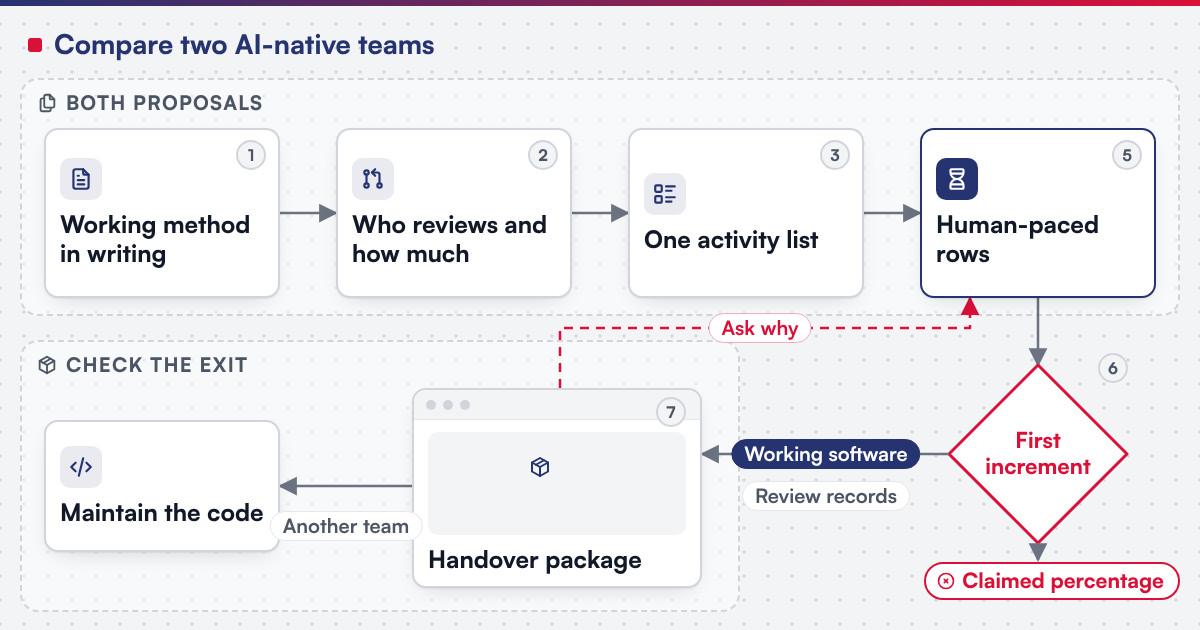 (opens the full-size diagram in a new tab)
A worked comparison
A founder in Germany wants a customer portal connected to an existing ERP and a payment provider. Two Vietnam teams respond. The example is illustrative and describes no client.
Team A's proposal is shorter in calendar time and says AI agents make the team faster across the board. Its estimate shrinks every row by roughly the same share, including ERP integration and acceptance. Team B's proposal shortens the build and test rows, keeps discovery, ERP integration and acceptance at their usual size, and adds a line for review capacity. It also proposes a two-week first increment: login, one ERP read and one payment in a sandbox.
On paper Team A looks quicker. In practice the ERP owner answers questions once a week and the founder's finance lead must accept the payment flow, so Team A's plan will slip at exactly the rows it compressed. Team B's estimate is the one that matches how the work will run. After the first increment the founder has working evidence of B's speed, and the comparison stops being about claims.
How does Netbase run AI-native delivery?
Netbase delivers remote-first from Hanoi in Agile increments with weekly reviews, using AI-assisted engineering under human review. Netbase takes new AI capabilities, coding agents included, into that working method as they mature, and keeps the same review and acceptance gates around them.
Netbase's delivery lifecycle: discovery and strategic alignment; team assembly and architecture planning; agile execution with outcome-based milestones; modular components; training and rollout; ongoing support. Agents work inside the execution stage, so discovery and acceptance keep their own time in the plan.
Project teams draw on business analysis, project management, solution architecture, development, QA and UI/UX roles. Most Netbase projects are agreed as fixed-scope contracts with an agreed total after discovery; milestone-based arrangements are also available. A fixed scope is where agent-driven speed matters most to a buyer, because the supplier carries the estimate and the buyer judges the result at each milestone. Custom product engineering is the delivery route, and AI engineering enablement is the route when your own engineers want to adopt the same method.
How this guide is sourced
The amplifier finding and the point about the organisational system come from the DORA 2025 report page. The statement on early-2026 speed-ups and the weakness of the data comes from METR's update of 24 February 2026. Netbase statements are approved claim-register entries, reviewed as the methodology describes. The portal comparison is illustrative. The guide states no rate or project total.
Plan the next step for your project
Common questions
It can reduce the drafting share of build, test and documentation work. Discovery, integration, environments and acceptance change little, so the effect on a total depends on how much of your scope is well-defined build work.
Drafting gets faster; elapsed time improves only if review and acceptance keep up. Judge speed by accepted milestones, not by claims.
Ask how it was measured and on which work. A figure without a method is not evidence, and research groups themselves report wide uncertainty.
Usually not. Scope, acceptance, IP and confidentiality stay as they are; add the tool register and data rule described in the AI-assisted delivery guide.
A short first milestone with working software, test results and review records on a real piece of your scope.
Talk to Huy Nguyen (David), Founder and CEO of Netbase JSC: message him on WhatsApp at +84 937 869 689 or email project@netbasejsc.com. You can also send your brief through the project request form. Say which workflow or system the project concerns and what has to stay unchanged; the first step is a discovery conversation, and scope and milestones are agreed after it.
Bring the scope you want to compare
Start with the outcome, the systems it touches and the person who will accept each milestone. The buyer guide to outsourcing a software project covers the wider decision, and the two companion guides on rates and estimates help you read what comes back.
OutsourcingVN is Netbase's own outsourcing-services platform. Submit a project, and a person will reply with the scope questions still open and how the first milestone could be shaped.
Related services and solutions
 Custom product engineering for a bounded release outcome
One defined release of your product, built to named outcomes and handed over with acceptance evidence.
Learn More