

Handover and exit: ending an outsourcing engagement cleanly
The end of an engagement is a deliverable like any other, and unless it is specified before work starts you will negotiate it at the worst moment. A handover is not an archive file and a goodbye email: it is source code with its history, deployment instructions, account ownership and data, proved by rebuilding it from what you received.
Submit a project How delivery worksReviewed by David Nguyen (CEO) · Updated 14 Oct 2026 · 9 min read

OutsourcingVN is operated by Netbase JSC, so read this as a delivery owner describing what you should demand, including from us. Netbase remains the contracting and delivery owner whether a team is Netbase staff, approved specialists or disclosed partners, which is also the point of this page: you are handing back from one accountable party, not collecting pieces from several. The checks work against any provider, and the Vietnam software outsourcing buyer's guide covers the rest of the decision.
Why is handover the thing nobody writes down?
Handover has no visible feature value, it feels pessimistic to discuss during a good relationship, and it is usually nobody's job. Two structural things make it worse.
The first is a scope written as a feature list, so "done" never includes the documents. The second is an engagement shaped around continuing effort rather than a bounded outcome, where there is no natural moment at which anything is handed over at all. Engagement models explains which shapes produce a clean end and which do not.
Most Netbase projects are agreed as fixed-scope contracts after discovery, and milestone-based arrangements are also available. A bounded scope helps here, because it forces someone to write down what "complete" contains.
What you should receive
A handover is not an archive file and a goodbye email. Expect all of this, and say so in the contract:
- Source code with its history, in a repository you own, rather than a single squashed import.
- Build and deployment instructions that someone who has never seen the project can follow to a running environment.
- Infrastructure and configuration: what runs where, which services it depends on, and the configuration values, with secrets rotated and transferred through a channel you control rather than pasted into a document.
- Ownership of every account created for you: domains, certificates, cloud and third-party services, app store and registry entries. Ownership matters more than access. An account in the provider's name that you happen to have a login for is not yours.
- Data, with its schema, an export in a documented format, and a restore you have actually tested.
- Design and product artefacts: design files, content and the decisions behind them.
- Test assets: automated tests that run on your machine, and the manual cases used for acceptance.
- An honest statement of the known state: open defects, deferred items, workarounds, third-party licences in use, and the things a new maintainer would otherwise discover unpleasantly.
- A recorded handover session with the people who built it, plus a named person who answers questions for an agreed period afterwards.
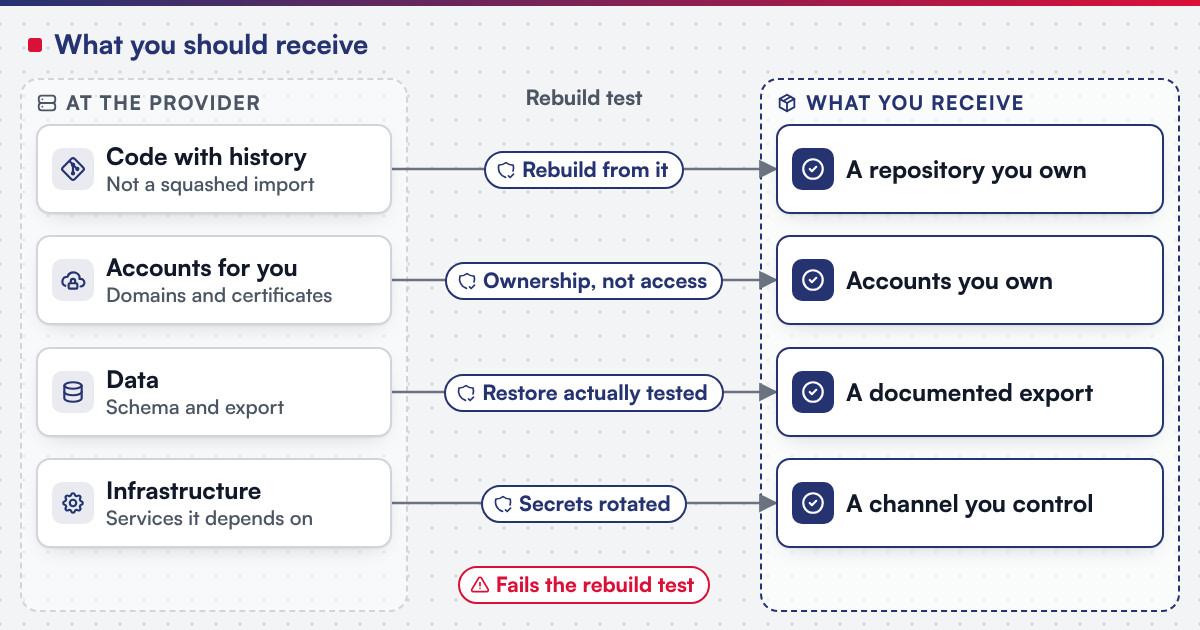 (opens the full-size diagram in a new tab)
When should each part arrive?
Not at the end. Netbase's delivery lifecycle runs from discovery and strategic alignment, through team assembly and architecture planning, agile execution with outcome-based milestones and modular components, to training and rollout and then ongoing support. Handover artefacts belong inside that sequence, not after it: architecture notes when the architecture is decided, deployment instructions when the first environment is built, data documentation when the schema settles.
Tie the acceptance of each milestone to the artefacts that milestone produced. Project delivery sets out how milestones, change control and acceptance work. A useful contract rule is that no milestone is accepted until its handover items are in your repository. It costs nothing while the relationship is good, and it is the only leverage you have when it is not.
The test that proves the handover worked
There is exactly one: rebuild the system from what you received, in an environment the provider does not control, using someone who did not build it. Run that test before the final milestone is signed off, while the team is still under contract and still remembers.
Almost every handover fails this test the first time, usually over an undocumented environment variable, a service registered to a personal account, or a build step that only ever ran on one machine. That is fine if you find it in week twelve. It is expensive if you find it a year later.
Who owns what
For custom development the client owns the intellectual property created for it, while Netbase productized modules and products are licensed rather than transferred, and the proposal identifies them before you accept it. That distinction is the one to check hardest at exit.
A licensed component is not a problem; an undisclosed one is. Ask which parts of the system you own outright, which are licensed, what the licence covers after the engagement ends, and what happens to it if the provider stops trading. Treat open-source and third-party dependencies the same way. IP ownership in software outsourcing goes through the detail.
Reducing your dependence before you need to
Exit is easy when the engagement was shaped for it. Four habits do most of the work:
- Own the accounts, the repository and the cloud subscription from day one, and let the provider work inside them.
- Ask for the runbook early and read it, rather than filing it.
- Keep at least one person on your side who can read the code and join the technical reviews.
- Revoke access on a schedule, not on sentiment. Which people can reach which systems, and how that access is removed, belongs in the contract: see data security and compliance in outsourcing.
Netbase delivery runs with weekly reviews and a named project manager, which gives you a standing place to ask an uncomfortable question: what would we need if this stopped next month? Ask it at least once a quarter, and write down the answer.
Support after handover is a choice, not a default
Netbase also offers dedicated development teams, on-demand support and fully managed delivery as secondary options. Decide deliberately which of those you want after the build, rather than drifting into an open-ended arrangement because nobody planned the alternative.
Two delivered examples show the shape, both anonymised. One classifieds platform was delivered in six milestones over four months, with training and six months of support. A WhatsApp chatbot was delivered in milestones running from design and prototype through to documentation, knowledge transfer and 30 days of support, over four to eight weeks. Those support periods were part of those projects. They are not a standing offer, and the equivalent for your project would be scoped with your own work. The Work records describe what was delivered.
Exit clauses worth writing now
Settle these in the contract before delivery starts, not in the last month:
- what the provider must deliver if either side terminates early, and on what timetable;
- the commercial basis for handover and transition work, agreed up front so it is not negotiated under pressure;
- an agreed period after final acceptance during which the provider answers questions, and what that period covers;
- who the named handover owner is on each side;
- what happens to your data and your credentials when the engagement ends, and how deletion is confirmed;
- whether any subcontractor holds anything you need, and how it is transferred.
Ask for a sample handover pack during selection rather than after signature; it is one of the checks in Vietnam outsourcing due diligence. Put the handover requirements in the brief itself, using the software project brief template, and budget for them, because transition work is real work and belongs in what the cost of Vietnam software outsourcing covers.
Taking over a system, or handing one back
The same list works in reverse. If you are moving a system away from an existing provider, ask for exactly the items above and run the rebuild test before you release the final payment. If you are bringing an inherited codebase to us, the custom product engineering service starts with an assessment of what you actually hold, which is often less than the previous contract implied. If you are unsure which of those you are doing, ask us.
Plan the next step for your project
Common questions
For custom development the client owns the intellectual property created for it. Netbase productized modules and products are licensed rather than transferred, and they are identified in the proposal before you accept it.
From the first milestone. Artefacts produced late are artefacts produced badly, and a document written after the team has moved on is written from memory.
There is no standing period. Support after delivery is scoped with the project, and Netbase offers on-demand support and fully managed delivery as separate options if you want them.
Then the value of the milestone rule becomes obvious: everything accepted so far is already in your repository, and the argument is only about the milestone in progress.
Decide who operates the system after handover
Tie the handover to project delivery, the original brief, IP terms and any rescue assessment. A bounded Custom Product Engineering scope and an ongoing Managed Operations agreement answer different questions.
The takeover and maintenance guide connects acceptance to operational ownership. Recheck legacy risks, migration reconciliation and security controls before removing the previous team's access. The Magento recovery record supports a limited technical scope, not a guarantee that every incomplete handover can be recovered.
Ask what you would receive
For how we source the claims on this page, see our methodology. If you want our answer for your project, submit a project and ask what the handover would contain before you ask anything else. OutsourcingVN is operated by Netbase JSC and is Netbase's own outsourcing-services platform.
Related services and solutions
 Custom product engineering for a bounded release outcome
One defined release of your product, built to named outcomes and handed over with acceptance evidence.
Learn More