

What drives the cost of a Vietnam software project
A quote is an answer to a scope. This guide explains how a total is assembled and how to read two quotes that look nothing alike.
Submit a project Compare engagement modelsReviewed by David Nguyen (CEO) · Updated 27 Sep 2026 · 9 min read

People search for a Vietnam software outsourcing cost benchmark hoping to find a number to anchor on. There is no honest answer in the abstract, and the country label is not what sets the total. What sets it is the outcome being built, how clearly it has been described, what it has to connect to, and who carries the risk of being wrong about any of those. This guide explains how a total is assembled, so you can read the quote in front of you instead of hunting for an average.
OutsourcingVN is operated by Netbase JSC, so we sell the kind of work this page describes. Netbase contracts and delivers as one accountable operator from its head office in Hanoi, and staffs projects from a globally sourced delivery network rather than a single labour market. The page carries no rate, no range and no currency figure, for the reason set out in the next section. Everything else applies to any provider you are considering, wherever it contracts from. For the wider decision about buying an accountable outcome, start with our buyer guide to outsourcing a software project.
Why this page carries no figures
We record every material claim with a source, an owner and a review date, we publish the lower figure when sources disagree, and we do not rank competitors. We hold no reviewed source for a rate, a range or a typical project total, so none is printed here. The methodology page sets out that rule and how to challenge it.
The second reason matters more to you. Any published range is an average over projects that have little in common with yours, and it is usually produced by someone with an interest in where the average sits. Once you have read one, a careless quote looks reasonable and a careful quote looks expensive. The drivers below travel from project to project. A number does not.
What a total is actually covering
A software total buys a body of work, not a quantity of hours. Netbase runs a delivery lifecycle of discovery and strategic alignment, team assembly and architecture planning, agile execution against outcome-based milestones, modular components, training and rollout, then ongoing support. Project teams draw on business analysis, project management, solution architecture, development, QA and UI/UX. Most providers run something similar, under different names.
That matters when you compare. A quote that names only developers has either moved analysis, testing, deployment and documentation onto your side, or buried them. Neither is wrong, but you cannot compare it with a quote that includes them until you know which. Our project delivery page describes what each stage produces.
The team behind those stages is assembled for the project rather than drawn from one pool. Netbase delivery is remote-first, and a team may combine Netbase staff, approved specialists and disclosed partners, with Netbase accountable for the result either way. The mix is chosen for role fit, overlap and continuity, and it moves the total, so ask any provider who is on the team and on what basis before you compare two numbers.
The drivers that move a total
In roughly the order they surprise people:
- Scope clarity. The largest single variable is how precisely the outcome is described. Vague requirements are not cheaper, they are simply estimated with a risk margin, and then rebuilt when the real requirement appears. Writing the brief well is the cheapest work in the project, and our software project brief template sets out the structure.
- Integrations. Each system the project must talk to adds discovery, credentials, error handling, a test environment and a party whose availability you do not control. Two integrations are not twice one; the tenth is rarely like the first.
- Data work. Migration, cleaning, mapping and reconciliation are routinely left out of a quote and then discovered mid-build. If you are replacing a system, ask explicitly who owns the data migration and what "migrated" means.
- Non-functional requirements. Availability targets, performance under load, audit trails, encryption, data residency and access controls are design decisions, not switches. Bring them up before the estimate rather than after. Our guide to data security and compliance in outsourcing covers what to specify.
- Environments and deployment. Development, test, staging and production, plus the pipeline that moves code between them, are real work. So is running them.
- Review and acceptance effort. Every milestone needs someone on your side to look at it and say yes or no. Slow acceptance costs both parties, and in a milestone contract it usually costs you in elapsed time and in the provider's replanning.
- Change control. How changes are classified, estimated and approved decides whether a mid-project decision is a visible cost or an argument.
- Handover and support. Documentation, credentials, training and a support window are line items. If they are not in the quote, they are not in the plan. See handover and exit.
- Onsite work. At Netbase, onsite work is available on request and scoped as a separate project activity. Treat any onsite expectation the same way with any provider: named, bounded and costed, not assumed.
- Build versus licence. For custom development the client owns the intellectual property created for it, while reusable modules and products are licensed rather than transferred. A quote built partly on licensed components can be smaller and faster, but you are buying different rights. Our note on IP ownership in software outsourcing explains what to check.
How the engagement model changes the shape of the total
Most Netbase projects are agreed as fixed-scope contracts with an agreed total after discovery, and milestone-based arrangements are also available. Dedicated development teams, on-demand support and fully managed delivery exist as secondary options. Each shape moves risk somewhere different.
A fixed scope with an agreed total transfers estimation risk to the provider, which is why it needs a discovery step and a tight change process. Capacity-based arrangements move that risk back to you, and are only cheaper if you have the product and engineering leadership to direct them. A total that looks lower under one model may simply be a total with less risk inside it. Our engagement models page sets out the trade-offs.
How to compare two quotes that look different
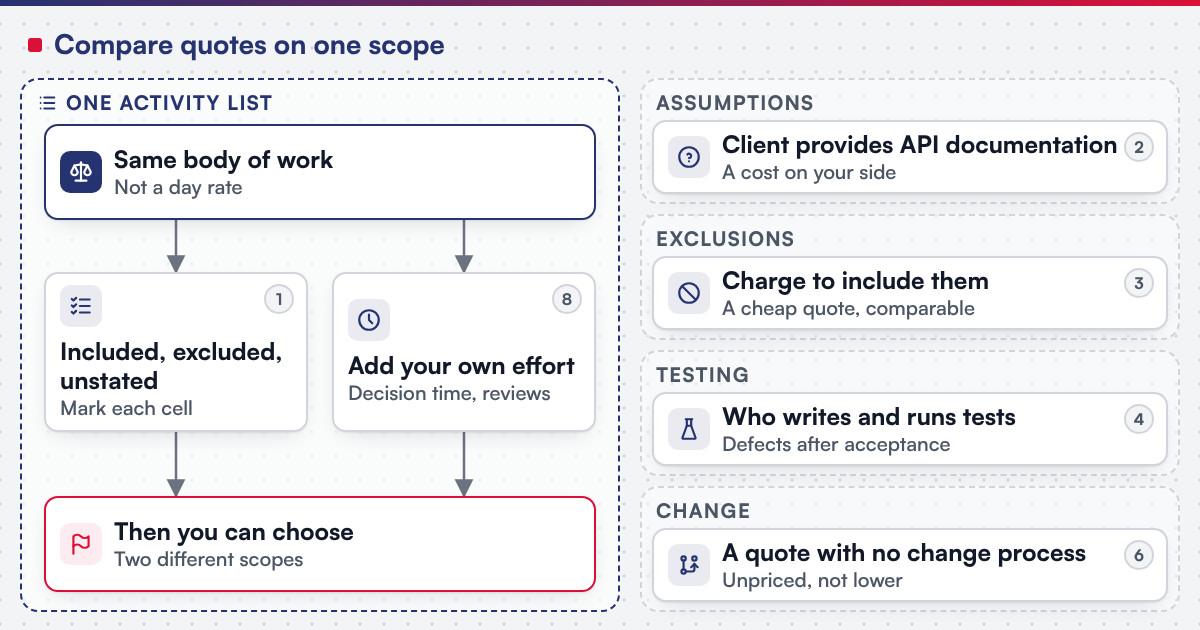
Do not normalise to a day rate. Normalise to the same body of work.
- Map both to one activity list. Discovery, design, build, testing, deployment, data migration, training, documentation, handover, warranty and support. Mark each cell as included, excluded or unstated.
- Read the assumptions. Most gaps are declared there, in the section nobody reads. An assumption such as "the client provides API documentation" is a cost sitting on your side of the line.
- Read the exclusions. Then ask what the provider would charge to include them. The answer converts a cheap quote into a comparable one.
- Find the testing. Who writes the tests, who runs them, who fixes defects found after acceptance, and for how long.
- Find the environments. Who builds them, who pays for the infrastructure, and who operates it after go-live.
- Find the change mechanism. A quote with no change process is not a lower total, it is an unpriced one.
- Find the exit. What is handed over, in what condition, and what happens to credentials and source code.
- Add your own effort. Decision time, reviews, subject-matter experts, acceptance testing and the meetings that make it work. Time-zone distance changes this more than most buyers expect, as our guide to time-zone collaboration with a Vietnam team describes.
After that exercise, two quotes usually stop looking different and start looking like two different scopes. Then you can choose.
 (opens the full-size diagram in a new tab)
When a low total should worry you
A total well below the others is information, not a bargain. It usually means one of four things: the provider has read a smaller scope than you meant, it intends to recover the difference through change requests, it has left testing and handover out, or it is buying the logo. Ask which. A provider that can explain its number in terms of the activity list is usually the safer choice, whatever the number is.
The reverse is also worth checking. A high total with no visible breakdown is just as hard to govern. Ask for the same activity list either way, and use the framework on our page about comparing software outsourcing companies to assess the rest of the provider.
What we publish and what we do not
We publish what we have delivered, at the evidence level our clients allow, in our Work records. The multi-tenant cloud ERP SaaS platform record is one anonymised example of delivered phase-one scope; it does not establish a total, a Vietnam delivery location or a benchmark for another project. We describe the services behind those records on the custom product engineering and AI workflow automation pages. We do not publish rate cards, project totals or client commercial terms, because those are set in each agreement and are not ours to publish. If you want a number, the route is a scope and a conversation, not a table on a website.
Plan the next step for your project
Common questions
A ballpark given without a scope is a guess that both sides then have to defend. We would rather spend thirty minutes on your scope and give you a number we can stand behind.
It is more predictable, not automatically safer. It is only meaningful when the scope is defined well enough to be fixed, which is why discovery comes first and why change control matters so much afterwards.
It changes one input among several. We do not promise the cheapest labour or a fixed saving, because rework, management overhead, integration surprises and slow acceptance are unaffected by where people sit, and that is where most overruns live. Check the provider and its delivery model first, with our due diligence guide.
Write a clear brief and name one decision owner on your side. Both are free and both reduce the estimate and the risk margin inside it.
Want a number for your actual scope?
Submit a project with the outcome, the systems involved and your constraints, and we will come back with a scope and a total we can explain line by line. OutsourcingVN is operated by Netbase JSC and is Netbase's own outsourcing-services platform.
Related services and solutions
 Custom product engineering for a bounded release outcome
One defined release of your product, built to named outcomes and handed over with acceptance evidence.
Learn More