

Legacy system modernization: deciding what to do, and in what order
A system is legacy when the cost of changing it is the business's main constraint, not when it reaches a particular age. Deciding what to do means answering four questions in order: is it the real constraint, do you replace or refactor it, how do you move without a single cutover, and what must be true about the data.
Submit a project See the modernization serviceReviewed by David Nguyen (CEO) · Updated 14 Oct 2026 · 11 min read

OutsourcingVN is operated by Netbase JSC, and this guide is written by a company that sells legacy application modernization projects, so read it with that interest in mind. Statements about Netbase delivery link to the published record behind them.
Contents
- What this guide covers
- What actually makes a system legacy
- Question one: is this system the real constraint?
- Question two: replace or refactor?
- Question three: how do you move without a big-bang cutover?
- Question four: what has to be true about the data?
- The four routes at a glance
- How a modernization project is bought and run
- What to demand as evidence at each stage
- A worked example, and the related published record
- Common questions
- How this guide is sourced
- Start with the assessment
What this guide covers
This page is the overview. Each question has a page of its own.
- Is this system actually the constraint? Assessing an old system on evidence: change cost, knowledge concentration, supportability, security exposure and the failure modes that would genuinely hurt.
- Do we replace it, refactor it, wrap it or leave it alone? The criteria that actually decide, scored across four routes, including the one a supplier paid to build rarely proposes.
- How do we move one piece at a time while it keeps running? Choosing the first slice, putting a seam in front of the old system, then cutting over slice by slice.
- What has to be true about the data? Profiling the old store, deciding who owns the record while both systems exist, and proving a migration reconciles.
If you read only one, read the first. The most expensive modernization projects rebuilt a system that turned out not to be the constraint.
What actually makes a system legacy
Age is a poor test. Plenty of twenty-year-old systems are cheap to run and well understood. Four properties, usually together, are what people mean by the word.
The cost of change has become the constraint. A change that should take days takes a quarter, because nobody can predict what it will break and because releasing is itself a project. Measure this one: how long a small, well-understood change takes from request to production.
Knowledge is concentrated in very few heads. The rules that matter live in code written by people who have left, and in one or two engineers who can still reason about the whole. Hiring does not fix that quickly, because the scarce skill is accumulated context, not a language.
Everything is coupled to everything. The database is the integration layer, reporting reads operational tables directly, and other systems depend on behaviour nobody documented. Coupling is the best predictor of how slowly the work will go.
You cannot get evidence out of it. No tests describe current behaviour, and no one can replay a real case and compare two implementations. Without evidence every change is an argument and every cutover is a leap. This is the most fixable of the four, and fixing it first makes the rest affordable.
None of the four is a technology. A modern stack with the same properties is a legacy system that happens to be recent.
Question one: is this system the real constraint?
Before anything is rebuilt, establish that the pain attributed to the system is caused by the system. A surprising amount of it belongs to the process around it: approvals that live in a mailbox, master data nobody owns, a report rebuilt by hand every Monday.
The evidence is cheap to gather: how long a routine change takes, how many people can make it, what fails in production and how often, which dependencies are unsupported, where private data sits, and what a day of unavailability would cost. Written down, that list usually reorders the roadmap on its own, and a technical debt assessment then ranks the individual shortcuts inside the system by business cost. Assessing legacy system risk sets out how to collect it without a long audit; where it must come from outside, a bounded technical audit sprint produces the same evidence as fixed work, and its output is a decision rather than a commitment to build.
Question two: replace or refactor?
Once a system is confirmed as the constraint, there are four honest routes, not two: rebuild it, refactor it in place, put an interface in front of it and move capabilities out one at a time, or improve the operating conditions and leave the code alone.
What decides is how often the system genuinely changes, whether the domain rules are written down anywhere, whether the data model can survive, the integration surface, the compliance obligations, who still understands it, and what happens to the business while the work runs. Replace or refactor legacy software scores all four against those criteria, and says plainly that leaving a stable system alone is often correct and is the answer least often proposed by a supplier paid to build.
Question three: how do you move without a big-bang cutover?
Assume something has to move. One step is cheaper on paper and bets the business on a single date; slices cost more total effort and never require that bet.
Slices mean choosing a first capability with low coupling and a clear boundary, putting a seam in front of the old system so traffic can be routed, running old and new side by side, comparing outputs on real cases, and cutting over one slice at a time with a rehearsed rollback. Incremental modernization without a rewrite walks through that sequence, including the part that always surprises people: who owns the record while both systems are live.
Question four: what has to be true about the data?
Data is where these projects run late. The old store holds values the current code tolerates and new code will not, duplicates that were never a problem because a human recognised them, fields reused for a second purpose years ago, and history whose retention obligation nobody has checked.
The work is profiling before design, deciding what migrates and what is archived, agreeing reconciliation rules, and naming the owner of the record while both stores exist. Legacy data migration planning covers how to do that in days rather than discovering it in a cutover window.
The four routes at a glance
| Route | What it means | When it is right | Main risk |
|---|---|---|---|
| Leave it alone | Improve monitoring, backups, access control and the release path; change nothing structural | Stable, rarely changed, and the pain is operational rather than architectural | The decision is never revisited and risk grows quietly |
| Refactor in place | Restructure the codebase, upgrade the runtime, add tests, keep the system identity | Domain rules are sound, the data model survives, the team can still work in the code | It drifts into a rewrite without anyone deciding to start one |
| Move capabilities out behind a seam | Route traffic through an interface, migrating one capability at a time | Coupling is survivable, the business cannot stop, evidence can be produced per slice | Slices stall half-finished and you own two systems |
| Replace | Build or buy a new system and retire the old one | The domain has changed, the rules are knowable, and the old data model is the problem | Undocumented behaviour found after the old system is gone |
Most real programmes use more than one row: leaving two thirds of a system alone while moving one capability out is a normal outcome, not a compromise.
How a modernization project is bought and run
Netbase's delivery lifecycle runs discovery and strategic alignment, team assembly and architecture planning, agile execution with outcome-based milestones, modular components, training and rollout, then ongoing support. Applied to a legacy system, that becomes a sequence you can hold any supplier to.
-
Assessment first, and you can stop after it
Read the code, the data and the deployment path; map dependencies; produce a migration sequence and a risk list. "Do nothing" is a valid result.
-
Characterize current behaviour
Capture what the system does today in tests and recorded cases, so parity can be checked rather than argued about.
-
Fix the scope once there is something to scope
Most Netbase projects are agreed as fixed-scope contracts agreed after discovery, and milestone-based arrangements are also available; engagement models explains the choice.
-
Migrate one capability behind a seam
Build the new path, run it beside the old one, and compare results on real or replayed cases.
-
Cut over against criteria, not a calendar
The plan names the window, the success signals, what triggers a rollback, and how long the rollback stays available.
-
Decommission and hand over
Retire the replaced part, record the performance baseline, transfer documentation and access, then agree the next capability.
Project teams draw on business analysis, project management, solution architecture, development, QA and UI/UX roles. Netbase delivers remote-first from Hanoi in Agile increments with weekly reviews, using AI-assisted engineering under human review, and stays accountable whether the work is done by Netbase staff, approved specialists or disclosed partners.
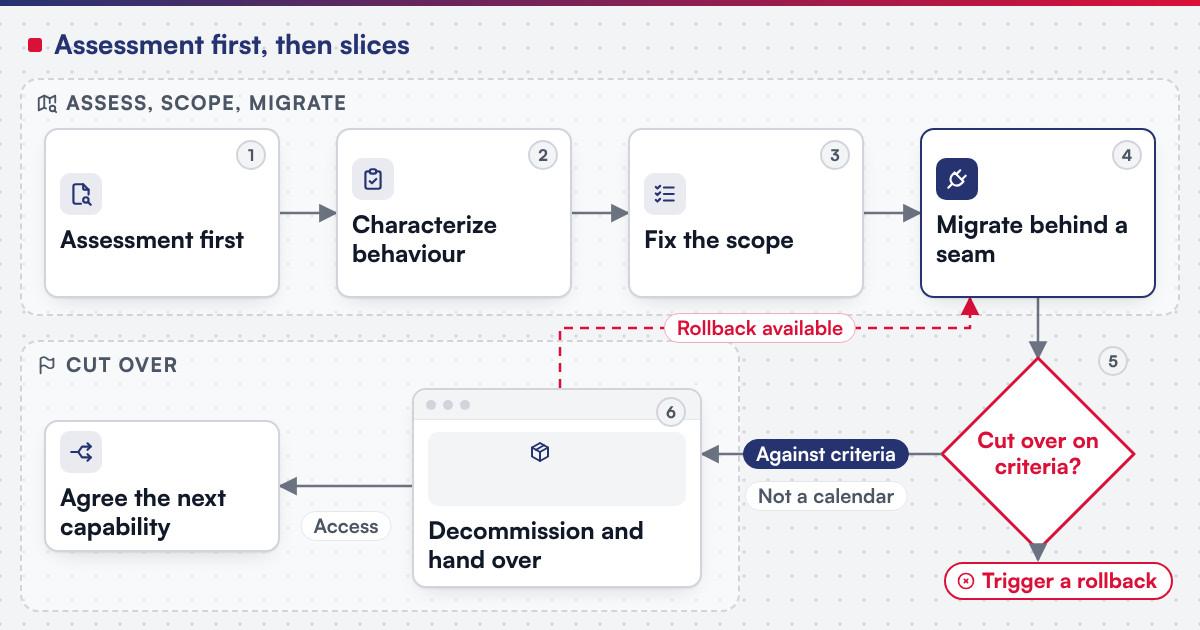 (opens the full-size diagram in a new tab)
What to demand as evidence at each stage
A supplier should hand you something checkable at every stage; a stage that produces only a status report did not happen. Project delivery sets out how milestones, change control and acceptance work.
- After assessment: a dependency map, a data ownership map, the migration sequence with its reasoning, and a list of what is still unknown. An assessment with no unknowns has not looked hard enough.
- Before the build: the characterization tests or recorded cases, and a written definition of what parity means for the first capability.
- During the build: comparison runs on real cases, with differences classified as intended or defective rather than summarised as a percentage.
- Before cutover: the rehearsed rollback, the date it was rehearsed and what happened, plus the agreed go and no-go signals.
- After cutover: the performance baseline measured before and after, observability that shows the new path failing, and a decommission plan.
- At handover: documentation, a runbook, access transfer and known limitations. For custom development the client owns the IP created for it; Netbase productized modules and products are licensed, not transferred.
Secure code review and version control, role-based access control, MFA for admin dashboards and contributors under NDA are standard practice, and NDAs and DPAs are available on request.
A worked example, and the related published record
The workflow most often behind this question is the back office, mapped in ERP and back-office operations; for an online store, use the e-commerce platform modernization checklist.
The published record closest to this cluster is long-running platform work. Since 2020 Netbase has worked as offshore development and managing partner on a multi-tenant cloud ERP SaaS platform for a client that is not named. Its first phase, from 2020 to 2023, covered CRM, real-time messaging, HR, a knowledge base, custom fields and workflows, work and project management and API integrations, on a stack that includes React and Next.js, Laravel and Strapi, PostgreSQL, MySQL, MariaDB and MongoDB on AWS. A later retail phase was planned work when that profile was written and is not presented as delivered; nothing here rests on it.
That record describes platform delivery rather than a single migration, and it carries no measured modernization outcome. Ask for any specific modernization claim in the first review; it is answered with evidence or not at all.
Plan the next step for your project
Common questions
The assessment takes weeks; a first capability usually takes months; a programme takes as long as the coupling demands. Any duration offered before the code has been read is a guess.
Partly. Running feature work and modernization through one team halves both. The usual compromise is to protect a fixed share of capacity for the migration, agreed in writing before the work starts.
Then characterization is the first milestone, not a hidden task, and the cheapest insurance against finding an undocumented rule after the old system is gone.
Not necessarily, but ask what evidence the plan produces before the cutover date. A rewrite with no parity evidence and no partial delivery is a single bet on one date.
How this guide is sourced
Every statement about Netbase here maps to a registered claim backed by attested company facts, listed under Sources below, and company claims are published only in the wording the register approves. Statements about method come from how our own teams assess and stage this work; nothing here comes from a benchmark, a survey or a third-party study. For how we source claims, see our methodology.
One limit worth stating: this guide covers business systems that still run an operation, not embedded or industrial control systems, mainframe-specific tooling, or regulated environments where a validation regime drives the design.
Start with the assessment
Write down which system blocks you, what a routine change costs today, and what access you can grant, then submit a project brief describing it. If the open question is whether the system is the real risk, ask for the assessment alone. OutsourcingVN is operated by Netbase JSC and is Netbase's own outsourcing-services platform.
Work behind this guide

This record covers phase-one scope for agency SMEs; the client and product are not named, and no usage or business result is claimed.
Keep ReadingRelated services and solutions
 Legacy application modernization, one bounded capability at a time
The code is assessed first, then one bounded capability moves at a time, with a way back.
Learn More