

How to compare software outsourcing companies in Vietnam
To compare software outsourcing companies in Vietnam, write one brief, apply the same dated criteria to every provider, ask each for the same evidence, and record why you chose. This page gives that framework, criteria version 1.0, reviewed 22 September 2026. It ranks no one, and Netbase, which operates this site, is assessed by the same rules.
Submit a project Read the methodologyReviewed by David Nguyen (CEO) · Updated 28 Sep 2026 · 8 min read

OutsourcingVN is operated by Netbase JSC. Netbase is itself a software outsourcing company in Vietnam, so this page is not neutral and does not rank or recommend competitors. It gives you a framework you can apply to any provider, including us, and records when its criteria were last reviewed.
Criteria version: 1.0. Last reviewed: 22 September 2026. Next scheduled review: March 2027.
Who is this framework for?
It is written for founders, CTOs, product leaders and procurement teams choosing an external team for a defined software or automation project, who need the choice to be defensible to colleagues. It assumes you want a provider to take responsibility for an outcome, not only to supply people. If you mainly need extra capacity under your own management, the same criteria still help, but you will weight governance and acceptance less.
Which criteria should every provider meet?
Ask every company for the same evidence. Score each criterion simply, for example "clear evidence", "partial" or "missing", and keep notes on why. Avoid combining scores into a single number early: a provider that is strong everywhere except security may still be unsuitable for your project.
| Criterion | Evidence to ask for | Warning sign |
|---|---|---|
| Relevant delivered work | Two or three projects similar in type or complexity, with scope and the provider's role described | Only logos or generic screenshots; no description of what the provider actually did |
| Delivery ownership | Named roles for product, architecture, QA and project management, and who is accountable on the provider side | Only a sales contact until contract signature |
| Governance rhythm | A sample status report, meeting cadence and escalation path | "We are flexible" with no written example |
| Acceptance and change control | How milestones are accepted, how change requests are estimated and approved, how defects are handled | Acceptance defined only as "delivered" |
| Security and access | Code review, version control, access management, encryption in transit and administrative MFA; which company-level certifications or attestations exist and what they cover | Security described only as badges, or a company certificate presented as covering your product |
| Team composition and subcontracting | Where the team works, whether any part is subcontracted, and continuity arrangements | Reluctance to say who will do the work |
| Intellectual property and exit | Contract wording on IP ownership, licensed components and the handover package | Source code or credentials held back until an unrelated condition is met |
| Communication | The people who will lead your project, their written English and the proposed overlap window | Only the sales team is available before signing |
How do you build the shortlist?
-
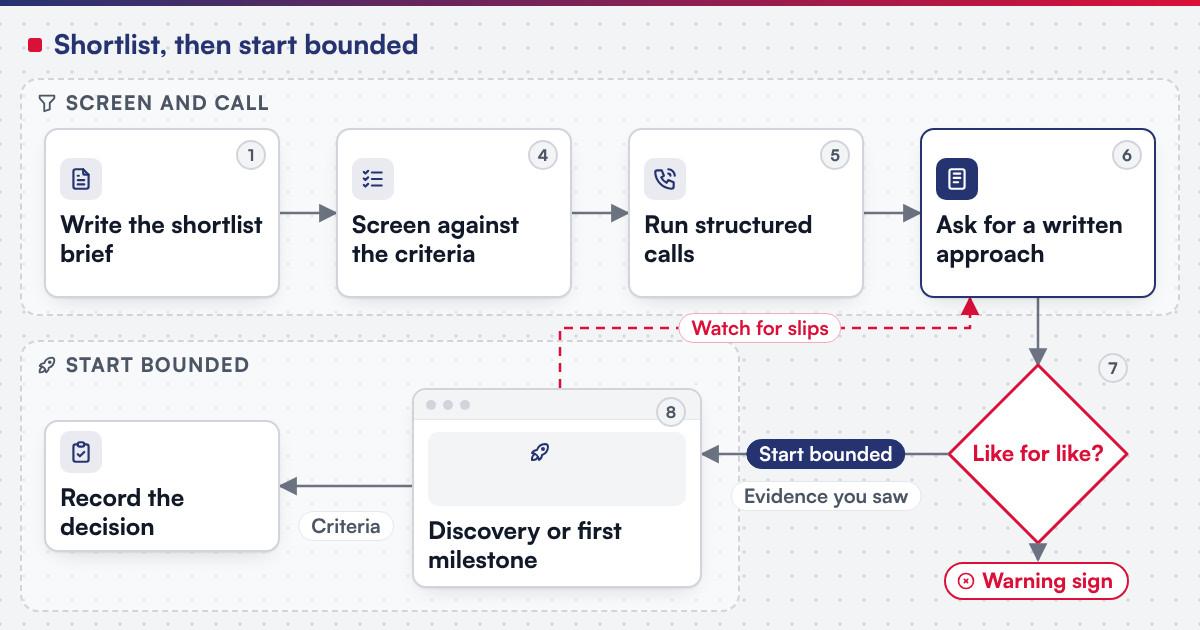
Write the shortlist brief
One page covering the outcome, the decision owner, the systems and data in scope, constraints, timeline and the overlap you need. The software project brief template uses that structure, and every provider is assessed against the same page.
-
Build a long list from sources you can check
Directories, search results, recommendations and events are leads, not evidence; paid placement, review volume and badges say little about fit. Record where and when you found each name, then read the company's own site for services, delivered work and contact details. Eight to twelve names is enough.
-
Remove the obvious mismatches
Drop companies that describe no relevant work, name no legal entity or head office, or cannot respond clearly in your working language. Confirm registration, operating history and whether the people you meet work for the company directly.
-
Screen against the criteria
Send every company the same evidence request from the table above and score the answers.
-
Run structured calls
Invite three to five companies to a call with the people who would lead your project, and ask each the same questions (below).
-
Ask for a written approach
Request proposed milestones, team roles, assumptions, main risks and what they need from you from the strongest two or three. Keep it small; a long unpaid proposal process favours sales capacity over delivery quality.
-
Compare proposals like for like
Map each one to the same list: discovery, design, build, testing, deployment, handover, warranty and support. A proposal that looks smaller may leave more work with you; the project cost guide shows how to normalise them.
-
Start bounded and record the decision
Begin with a discovery or first milestone with clear acceptance criteria, watch whether the provider raises risks early and reports slips accurately, and write down which providers you considered, the evidence you saw and why you chose one.
 (opens the full-size diagram in a new tab)
What should you ask on the call, and what does a good answer sound like?
-
Which delivered project is closest to ours, and what exactly was your role?
A named or clearly described project, the provider's specific responsibilities and what it did not do
-
Who would own architecture, quality and delivery, and can we meet them now?
Named people who join the call, not a promise to assign someone after signature
-
How would you run the first four weeks?
A concrete plan: discovery tasks, the first acceptance point and what they need from you by when
-
How do you handle a change request halfway through a milestone?
A written process with an impact estimate and your approval before work changes
-
Which people or third parties will have access to our systems and data?
A list of roles, any subcontractor named, and how access is granted and removed
-
What do we receive at the end, and how is handover run?
Source code, credentials, documentation and a handover session, independent of any support contract
-
What would make you decline this project?
Specific project types they are not suited to; a provider that can decline is one you can trust to warn you
The due-diligence guide lists the documents that back these answers up, and the time-zone collaboration guide helps you test the proposed overlap window.
Including Netbase in your comparison
If you evaluate Netbase, apply exactly the same criteria. Netbase JSC was founded in 2012 and is headquartered in Hanoi, Vietnam. It works on project-based engagements with teams of typically 3 to 30 people, and for custom development the client owns the IP created for it. The Custom Product Engineering service explains the commercial route, and project delivery explains how milestones and acceptance are run.
For the first criterion, relevant delivered work, the 4over4 print commerce record shows the kind of answer to expect: a named client, Netbase's role, and delivered scope that included a product recommendation engine and automated conversion of uploaded Adobe Illustrator files to editable SVG templates. The other Work records state the evidence level Netbase is allowed to publish for each project. We will answer the call questions above in writing, and we would rather tell you early if another type of provider suits your project better.
Plan the next step for your project
Common questions
Because the operator, Netbase, is one of them. A ranking published by a competitor cannot be neutral, so the page gives you criteria to apply yourself and names no other company.
A long list of eight to twelve names is enough to screen, three to five are worth a structured call, and two or three should be asked for a written approach. More than that rewards sales capacity rather than delivery quality.
They are useful for finding names, not for choosing between them. Paid placement and review volume say little about fit; ask each provider for delivered work similar to yours and the role it played.
The framework is criteria version 1.0, reviewed 22 September 2026, with the next scheduled review in March 2027. A change to the criteria will carry a new version number and review date on this page.
Yes. None of the criteria depend on the country; they test ownership, governance, security, IP and exit, which matter wherever the team sits.
How this framework is sourced, and its limits
The criteria are editorial: they cover evidence a buyer can request from any provider, and they mirror the checks OutsourcingVN applies to its own claims: OutsourcingVN records material claims with source, owner and review date, publishes the lower figure on conflict and does not rank competitors. No provider was included, excluded or scored to produce this page, and no external company is named. Statements about Netbase map to approved claims listed under Sources. This framework is not a legal, financial or security assessment and does not replace contract review, reference checks or technical testing. For the wider decision, read the Vietnam outsourcing buyer guide; the methodology sets out the rules for comparison content.
Want to test Netbase against this framework?
Submit a project and ask us to answer the call questions above in writing, with the evidence each criterion asks for. OutsourcingVN is operated by Netbase JSC and is Netbase's own outsourcing-services platform.
Work behind this guide

4over4 reported revenue up 82% within six months, one of six results it has published since Netbase delivered e-commerce conversion work on its print store, including a product recommendation engine and an automated conversion of uploaded Adobe Illustrator files into SVG.
Keep ReadingRelated services and solutions
 Custom product engineering for a bounded release outcome
One defined release of your product, built to named outcomes and handed over with acceptance evidence.
Learn More