

AI workflow automation: how to decide, prove and buy it
AI workflow automation is software that uses AI models to do part of a defined operating workflow while a named person stays accountable for the result. Buying well means answering five questions in order: which workflow goes first, what shape it takes, which model runs it, how it is tested, and who stays in control when it is wrong.
Submit a project See the serviceReviewed by David Nguyen (CEO) · Updated 14 Oct 2026 · 11 min read

OutsourcingVN is operated by Netbase JSC, and this guide is written by a company that sells AI workflow automation projects, so read it with that interest in mind. The method below is the one our teams use, and it applies whoever you buy from. Each statement about Netbase delivery links to its published record or is marked as anonymised client work.
Contents
- What this guide covers
- What an AI workflow automation project actually is
- Question one: which workflow goes first?
- Question two: what shape does the automation take?
- Question three: which model runs it?
- Question four: how will you know it works?
- Question five: who stays accountable?
- Four shapes this takes in practice
- How a project like this is bought and run
- What this guide will not tell you
- Common questions
- How this guide is sourced
- Start with one workflow
What this guide covers
This page is the overview. Each of the five questions has a page of its own that goes further than the summary here, and a sixth covers what an approver must see before signing off.
- Which processes should we automate first? The properties that make a workflow a sensible first candidate, the properties that disqualify one, and a scoring table you can run over a shortlist.
- Is this a workflow or an agent? The difference between a fixed sequence with AI steps inside it and a system that chooses its own steps, and what each one costs to control.
- Which model should run it? How to match a model to the task, the data location and your constraints, and how to keep that choice reversible.
- How will we know it works? Building an evaluation set out of real cases, agreeing a threshold before the build starts, and re-testing when a model or a prompt changes.
- Where does a person stay in the loop? Placing review, approval and override points where confidence, policy or impact require them, and designing screens reviewers will actually use.
- What must governance approve? Purpose, ownership, data, decision rights, audit trail, supplier dependency and exit, settled before anyone approves the build.
If you read only one of them, read the first. Most disappointing AI projects chose the wrong workflow rather than the wrong model.
What an AI workflow automation project actually is
Three things have to exist before the phrase means anything concrete.
A workflow. A sequence of steps your organisation already performs, with known inputs, the systems it touches, the exceptions it throws up, and a person who owns the outcome today. If nobody can describe the current steps, there is nothing to automate yet.
An AI step inside it. One or more points where a model classifies, extracts, drafts, answers or routes, replacing work a person currently does by reading and deciding. The rest of the workflow is ordinary software: integrations, queues, records, retries.
The controls around it. What the automation is not allowed to do, which cases it must hand to a person, what is logged, how it is paused, and how a result is investigated later. A workflow without these is a demonstration, not an operating system.
Netbase has delivered anonymised client AI projects including retrieval-based knowledge assistants, document AI and MLOps pipelines. The two records we can point to publicly are anonymised and state their own limits: a WhatsApp AI chatbot with CRM integration, and a classifieds platform whose AI content filtering detects and flags offensive content into an admin moderation dashboard. Neither record names a client, and neither publishes a result figure.
Question one: which workflow goes first?
The first candidate should be high volume, describable, tolerant of a review step, measurable, and backed by data you have the right to use. It should also have an owner who will accept or reject the result. Workflows that take irreversible actions, rest on thin data, or make regulated decisions with nobody reviewing them belong further down the list, or off it.
The honest answer is often "not yet", and sometimes "fix the process first". Automating a broken process reproduces the breakage faster and adds a model to blame. Our page on which processes to automate with AI first sets out the properties in full and gives you a table to score candidates against. Where you want that decision made as a piece of paid work rather than an internal argument, the AI workflow blueprint is the bounded engagement for it.
Question two: what shape does the automation take?
There is a real architectural choice between a workflow with AI steps inside it, where the sequence is fixed and the model fills in judgement at defined points, and an agent, where the system decides its own next step from a set of tools. The first is easier to test, easier to explain and easier to roll back. The second covers cases you cannot enumerate in advance and costs more to keep under control.
Most operating workflows we are asked about are better served by the first. The comparison, including what each shape does to your evaluation and monitoring burden, is on AI agents versus workflow automation.
Question three: which model runs it?
Netbase works with commercial and open-source AI models chosen per project. The choice follows the task, where the data may be processed, the cost profile and your own constraints. What matters more than the name of the model is that the choice is made after the evaluation set exists, tested against it, and built so it can be swapped when a better or cheaper option appears. Choosing an AI model for a business workflow covers the trade-offs, including when an on-premise or open-source model is the only viable answer.
Question four: how will you know it works?
Model output shown in a demonstration is not evidence. Evidence is a set of representative cases, including the difficult ones, with an agreed threshold for what counts as good enough, run before go-live and re-run whenever anything changes. That set is built from your real work, with private details removed, and it is owned by the process owner rather than the engineering team.
Agreeing the threshold before the build starts is the single discipline that separates projects that ship from projects that argue. Evaluating and testing AI workflows explains how to assemble the set, what to measure, and how to handle the cases where there is no single correct answer.
Question five: who stays accountable?
Someone is accountable for every result the workflow produces, whether or not the design admits it. The design should admit it. That means a defined point where a person reviews, approves or overrides, placed where confidence, policy or impact require it, and screens built with the people who will use them. On the delivery side, Netbase delivers remote-first from Hanoi in Agile increments with weekly reviews, using AI-assisted engineering under human review, and project teams draw on business analysis, project management, solution architecture, development, QA and UI/UX roles. Human-in-the-loop AI workflows covers where to place the checkpoint without turning the automation back into manual work.
Four shapes this takes in practice
| Workflow shape | What the AI step does | Where a person decides | What is measured | What we can show |
|---|---|---|---|---|
| Conversational support and qualification | Understands intent, answers from approved sources, writes the outcome into a CRM or ticket | On low-confidence, sensitive or commercial replies | Correct routing and correct record writing on the evaluation set | An anonymised WhatsApp Business chatbot with CRM synchronisation |
| Content screening and moderation | Detects and flags items for review | On every flagged item, in a moderation queue | Flag quality against a reviewed sample | An anonymised classifieds platform with an admin moderation dashboard |
| Document reading and extraction | Classifies documents and extracts fields | Before extracted data is committed downstream | Field-level correctness on held-back documents | Delivered as anonymised client document AI work; client details stay private |
| Internal knowledge assistant | Answers questions from an approved source set and shows the source | When the answer is not grounded, the question is handed on | Grounded answer rate and gap rate | Delivered as anonymised retrieval-based assistants; client details stay private |
A fuller worked example of the first row, from first message through escalation to a resolved case, is on customer support automation, continued by help desk and CRM operations. The last row is set out as a workflow of its own, with source owners, cited answers and a hand-off to experts, on the AI knowledge assistant page.
How a project like this is bought and run
Netbase's delivery lifecycle runs discovery and strategic alignment, team assembly and architecture planning, agile execution with outcome-based milestones, modular components, training and rollout, then ongoing support. Applied to an AI workflow, that becomes a sequence you can hold a supplier to.
-
Write down the workflow and the question
Plain steps, rough volume, the systems involved, a handful of easy and difficult real cases with private details removed, and who owns the result today.
-
Agree what the automation must never do
The out-of-bounds list is cheaper to write now than to discover in a pilot.
-
Build the evaluation set and the threshold
Both are deliverables in their own right, and both are yours to keep.
-
Choose the model and the integration approach against that set
Test options before committing, not after.
-
Design the control points
Where a person reviews, what they see, what they can override, and what happens when they are unavailable.
-
Build with logging, permissions, usage limits and a pause switch
Then test on the representative cases.
-
Pilot against the threshold and decide
The process owner records whether the result is good enough, needs changes, or should stop. Stopping is a legitimate outcome.
-
Hand over
Documentation, a runbook covering fallback and prompt or rule changes, access transfer and a written list of known limitations.
Each step is a milestone with named deliverables, named inputs from you and a stated acceptance test. Project delivery sets out how milestones, change control and acceptance work in practice, including how a new channel or a new document type is handled as a change request with its own evaluation cases.
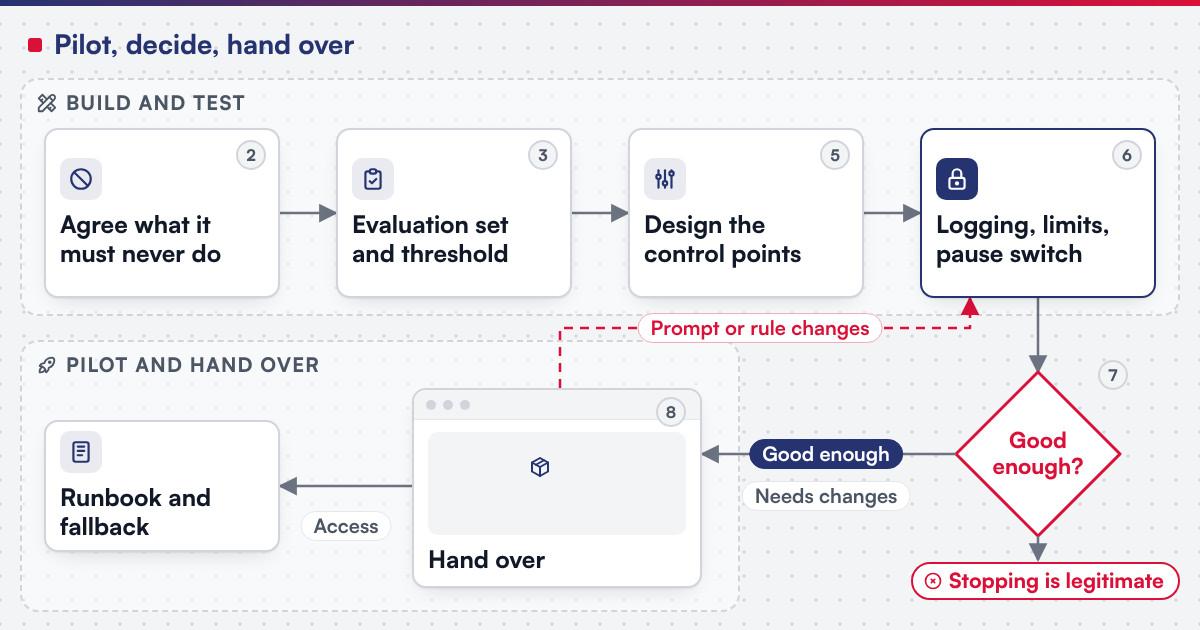 (opens the full-size diagram in a new tab)
What this guide will not tell you
It will not tell you what your project will cost, because that follows the workflow, the integrations and the evaluation burden, and any number offered before those are known is a guess. It will not promise an accuracy figure, a saving or a headcount effect, because we have not measured your process. It will not name a preferred model vendor. And for two of the four rows in the table above, the delivery is anonymised client work whose details stay private, as the table notes.
Plan the next step for your project
Common questions
No. One workflow, done properly and measured, teaches an organisation more than a strategy document, and it produces the evaluation discipline the next one needs.
No. We agree a threshold against your evaluation set and report the pilot against it. A supplier quoting an accuracy figure for a workflow it has not seen is quoting a number it cannot support.
Then the mapping work has paid for itself. The blueprint engagement exists partly to reach that conclusion cheaply.
For custom development the client owns the IP created for it, and the evaluation set, prompts, runbook and documentation are part of the handover.
The design reduces routine handling and keeps a person in control of the decisions that need one. The reviewers are involved in designing the screens they will use.
How this guide is sourced
Every statement about Netbase on this page maps to a registered claim backed by attested company facts, listed under Sources below, and the wording of company claims is published only in the form the register approves. Statements about practice are drawn from how our own teams scope and run these projects. Nothing here is drawn from a benchmark, a survey or a third-party study, so it should be read as an operator's method rather than as industry research. For how we source and review claims across the site, see our methodology.
Limits worth stating plainly: this guide covers workflows where AI does part of a defined operating process. It does not cover model training as a product, data platform builds, or research work, and it publishes no client outcome figures.
Start with one workflow
Pick the process that repeats most often and annoys the most people, write down what a correct result looks like, and submit a project describing it, the data it touches and where a person must stay in control. OutsourcingVN is operated by Netbase JSC and is Netbase's own outsourcing-services platform.
Work behind this guide

The client, sector, region and CRM product are not named, and no conversation volume or business result is claimed.
Keep ReadingRelated services and solutions
 AI workflow automation with evaluation and human control
One operating workflow automated, with an agreed way to judge it and a person on uncertain cases.
Learn More