

Choosing between an AI agent and an automated workflow
Most operating workflows should be built as a deterministic pipeline with a bounded model step inside it: software decides the route, and the model classifies, extracts, drafts or summarises one thing. An agent that chooses its own steps and tools is the right shape only when the path through the work cannot be written down in advance.
Submit a project AI workflow automationReviewed by David Nguyen (CEO) · Updated 14 Oct 2026 · 10 min read

OutsourcingVN is operated by Netbase JSC, which scopes and runs accountable project teams for buyers who would rather not build every capability internally. We are willing to build either shape, so treat this as an interested party's view, but the distinction below is the one we apply internally before we quote anything. This page is the comparison chapter of the AI workflow automation guide; the commercial route for either shape is AI workflow automation.
What are the two shapes, defined properly?
A deterministic workflow with a model step. The route through the work is fixed in software. A trigger fires, the system fetches what it needs, calls a model for one bounded task, checks the answer against a rule, and then writes to a system of record or hands the case to a person. The model is a component with a defined input and a defined output shape. It does not decide what happens next; code does. The bounded task is almost always one of four things: classify, extract, draft or summarise.
An agent. You give the system a goal and a set of tools, and it decides which tools to call, in what order, and when it has finished. The control loop is the model's own reasoning. Two runs over the same case may take different paths. Nobody had to enumerate the paths in advance; nobody can predict them afterwards either.
The dividing line is not whether a language model is involved, nor how sophisticated the system looks. It is one question: who chooses the next step, the software or the model? A workflow that calls a model five times in a fixed order is still deterministic. One model call that may pick from twelve tools and keep going until it decides it is done is an agent, even when it usually finishes in one hop.
Both shapes can be wrong in the same way, because both contain a model that can be confidently wrong. What differs is how far a wrong answer travels before something catches it.
How the two shapes compare
The comparison assumes the same model quality in both columns. Everything that differs comes from where the control loop sits.
| Dimension | Fixed pipeline with a bounded model step | Agent that chooses its own steps |
|---|---|---|
| Predictability | The same case takes the same route every time; the possible paths are finite and written down | The path is decided at run time; one case can be handled two ways on two days |
| Testability | Each step has a defined input and output, so it can be tested in isolation and end to end | You can test outcomes but not paths, so coverage is an estimate, not an enumeration |
| Typical failure mode | A step returns a poor answer and the rule around it either catches it or passes it on | A plausible detour, an early mistake compounded, a loop, or a stop short of the goal |
| Cost of a wrong step | Contained to that step, because the next action is fixed and can be gated | Unbounded until something external stops it: the wrong step chooses the following one |
| Auditability | A fixed sequence of named steps with inputs and outputs, readable by a non-engineer | A reasoning trace; reconstructing why a specific action happened takes an engineer |
| Change cost | A rule change is a code change with a regression run: small, frequent, reviewable | Behaviour changes with a prompt, a tool set or a model, and the effects are diffuse |
| What it needs from you | A described process, named exceptions, someone who can say what a correct result is | A goal that is hard to decompose, tolerance for variance, tight tool permissions |
| Running cost profile | Roughly constant per case, because the number of model calls is known | Variable per case: the number of steps is decided at run time and needs a ceiling |
Read the last two rows first. Buyers underestimate both, and both decide whether the thing survives its second year.
What each shape asks of you before it can be built
A deterministic workflow asks you to do the boring work once: describe the current steps, list the exceptions honestly, and state what a correct result looks like for a set of real cases. If nobody can write that down, the problem is not which shape to build; the workflow is not understood well enough to automate at all. The AI automation use cases page shows where that description usually already exists in someone's head.
An agent asks for something harder: tolerance. You accept that the system will sometimes reach the right outcome by a route nobody anticipated, and sometimes reach a wrong one the same way. That is fine when the work is exploratory, when a person reviews every result before it counts, or when the blast radius of a wrong action is small. It is not fine when the action writes to a customer record, sends a message, moves money or changes a production system with nobody in the path. Where a person belongs in that path is the subject of human-in-the-loop AI workflows.
When does an agent genuinely earn its place?
Agents are not a fashion to be waited out. Where enumerating the path is the expensive part, an agent pays for itself:
- Open-ended research and retrieval across many sources, where the next query depends on what the last one returned, and a person reads the result before acting.
- Triage of genuinely novel inputs, where the categories are not stable enough to enumerate and the output is a recommendation rather than an action.
- Multi-step investigation inside a read-only boundary, such as gathering context from several systems for a human decision, where every tool is a read.
- Software engineering assistance, where the work is exploratory, every change is reviewed, and version control gives a cheap undo.
Those four have something in common: the output is advisory, or reversible, or a person stands between it and anything irreversible. If you are designing an agent that writes straight to a system of record with no gate, you have rediscovered the case for a fixed pipeline.
Patterns that look like agents and are not
A large share of what is sold as agentic in 2026 is a fixed pipeline wearing a conversational interface. That is not a criticism; it is usually the right build. Three common examples:
- A chatbot with a routing step. The model identifies intent and the software chooses the branch. The conversation feels open; the execution is a finite state machine.
- A document workflow with a retry. Extract, validate, and if validation fails, try once more with a different prompt, then escalate. Two attempts is error handling, not autonomy.
- A moderation queue with a threshold. The model scores an item and code decides queue, pass or block. The judgement is the model's; the decision is the rule's.
Nothing is wrong with those systems. But judge the risk of the shape you are actually buying, not the shape in the slide.
What we have built
Netbase has delivered anonymised client AI projects including retrieval-based knowledge assistants, document AI and MLOps pipelines. In the delivered records on this site the shape is the deterministic one. The WhatsApp AI chatbot with CRM integration handles intent and conversation flow, calls an LLM API, and synchronises with a CRM for lead capture, customer data and workflow automation; the routing sits in software. The classifieds platform used AI-powered content filtering that detects and flags offensive content into an admin moderation dashboard, where an administrator decides; the tool is not named in that record.
Where a model is to choose its own tool sequence against a live system of record, we scope the work read-only first and widen its permissions only after the evaluation set passes.
How we decide which shape to quote
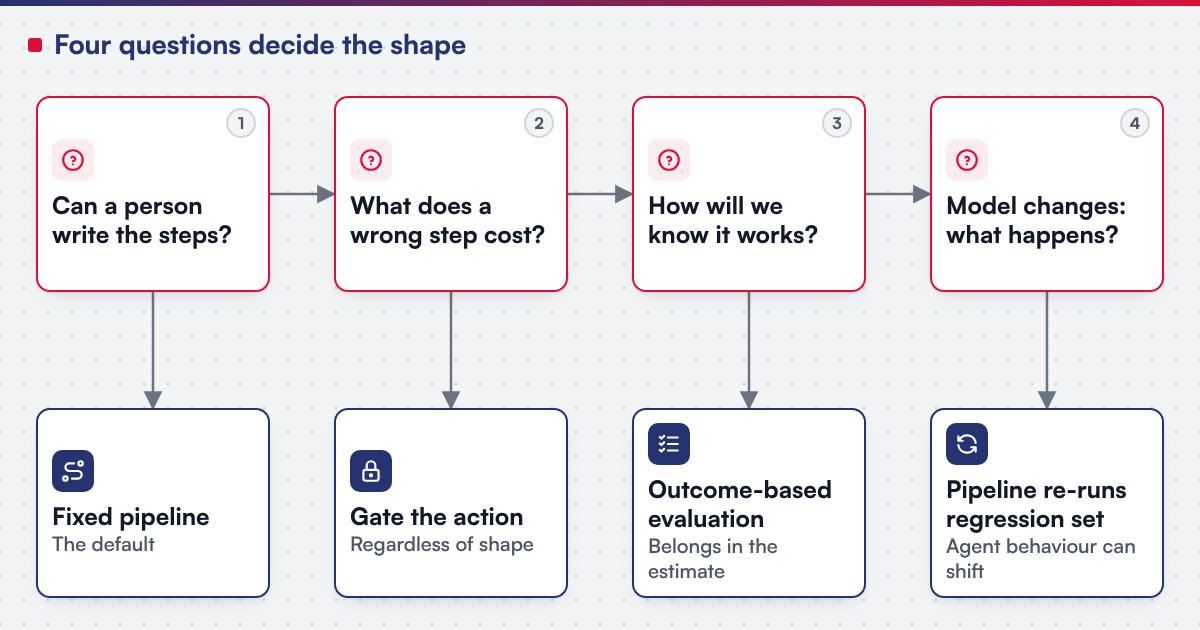
Netbase delivers remote-first from Hanoi in Agile increments with weekly reviews, using AI-assisted engineering under human review. The shape decision happens in the first increment, before any build commitment, and follows four questions.
- Can a competent person write the steps down? If yes, the pipeline is the default and the burden of proof sits with the agent.
- What does a wrong step cost, and who pays it? If the cost lands on a customer, a regulator or a balance, the action gets a gate regardless of shape.
- How will we know it works? If the paths cannot be enumerated, evaluation has to be outcome-based, which is more expensive; that belongs in the estimate, not in a later surprise. See AI workflow evaluation and testing.
- What happens when the model changes? A pipeline re-runs its regression set. An agent's behaviour can shift in ways a fixed test set misses, which is why AI model selection for business workflows is a design decision, not a procurement one.
Netbase works with commercial and open-source AI models chosen per project. The limitation of this method is that it is a judgement, not a measurement: it depends on the quality of the process description you give us, and we hold no benchmark proving a pipeline beats an agent in general. The narrower claim is testable on your own cases, which is what the evaluation milestone is for. Shape changes mid-project are handled as change requests under project delivery.
 (opens the full-size diagram in a new tab)
Plan the next step for your project
Common questions
Yes, and that is usually the cheaper order. Building the pipeline forces you to write down the steps, the exceptions and the acceptance cases, and all three are inputs an agent build would otherwise skip.
No, and this matters. The route is fixed, but a model call can still return different text for the same input. Determinism here is about control flow, not about the model's output.
Neither answer is universal. A pipeline makes a known number of model calls per case; an agent's call count is decided at run time and needs an explicit ceiling. Budget for the variance, not the average.
Say so early, keep the first version read-only or human-reviewed, and treat the output as a recommendation until you have enough real cases to describe the paths it actually takes.
No. We refuse to let a model choose its own steps against a production system of record without a gate, which is a narrower and more defensible position.
Decide the shape before you write the brief
Shape is the most expensive decision in an AI workflow project and the easiest to defer. If you are unsure, a short paid assessment under AI workflow blueprint settles it before a build is committed. For how we source the claims here, see our methodology. When you are ready, submit a project describing the process, the exceptions and what a wrong step would cost you. OutsourcingVN is operated by Netbase JSC and is Netbase's own outsourcing-services platform.
Work behind this guide

Netbase designed and built an AI chatbot on WhatsApp Business that handles intents and conversation flows and keeps lead and customer data in step with the client's CRM, delivered in milestones from prototype to knowledge transfer.
Keep ReadingRelated services and solutions
 AI workflow automation with evaluation and human control
One operating workflow automated, with an agreed way to judge it and a person on uncertain cases.
Learn More