

Which processes should you automate with AI first?
Automate a process that runs often, can be described end to end, has a definition of a correct result, tolerates a review step, sits on data you are allowed to use, and has an owner who will accept or reject the outcome. Leave alone anything irreversible, thinly evidenced, legally supervised with no reviewer, ownerless, or already scheduled for replacement.
Submit a project See the serviceReviewed by David Nguyen (CEO) · Updated 14 Oct 2026 · 9 min read

OutsourcingVN is operated by Netbase JSC, and we sell AI workflow automation projects, so treat the selection method below as an interested party's method that we are willing to be held to. It is deliberately conservative: the most expensive outcome in this field is a workflow that was never a good candidate and took nine months to prove it. This page is one of five that sit under the AI workflow automation guide.
What are the six properties of a workable first candidate?
It repeats. Volume is what makes consistency worth engineering and what gives you enough cases to test against. A process that runs twice a month will not produce an evaluation set, and it will not repay the control work around it.
It can be described. Someone can write the current steps, the systems involved and the exceptions without calling a meeting. Where the exceptions live only in one person's head, the mapping work has to happen first, and that is fine; it is a milestone, not a blocker.
A correct result can be written down. This is the property most shortlists skip. If two experienced people disagree about whether an output is right, and cannot say why, there is no way to test the automation and no way to accept it. Stable rules are ideal; stable judgement, where experts agree with each other most of the time, is workable.
It tolerates a review step. The best first candidates produce something a person can check before it takes effect: a draft, a flag, a suggested classification, a queued reply. Review is not a failure of ambition, it is what makes the first release safe enough to ship.
The data exists and you may use it. Accessible, reasonably complete, and covered by the rights and consents the purpose needs. Data rights are often the deciding factor in the design, not a formality at the end.
Someone owns it. A named process owner who will define what good looks like, sign off the evaluation set, and decide at the end of a pilot whether the result is good enough. Without that person, the project has no acceptance test and no finish line.
Which five properties should stop you?
- Irreversible action. Anything that moves money, deletes records, cancels orders or contacts a customer in a way that cannot be withdrawn. Automate the preparation, keep the action behind a person.
- Thin or unavailable data. No historical cases to test against, or cases you cannot lawfully use for this purpose. There is nothing to measure and nothing to build on.
- A regulated decision with no reviewer. Where a decision is legally supervised, the review step is the point, not an overhead. Removing it is not a scope decision that a supplier can make for you.
- No owner. A process that several departments touch and nobody owns will not produce an acceptance decision, and the pilot will end in a stalemate.
- A process about to be replaced. If the ERP migration lands next quarter, automating the outgoing process buys a few months of benefit and a rewrite. Wait.
One of the anonymised portfolio records we publish illustrates the last point honestly: in a multi-tenant cloud ERP engagement, a further retail phase was planned work when the profile was written and is not presented as delivered. Planned is not delivered, on our side or yours.
Score the shortlist
Score each candidate against the six tests, out of a possible twelve.
| Test | 0 points | 1 point | 2 points |
|---|---|---|---|
| Volume | Runs a few times a month | Runs most days | Runs many times a day |
| Describability | Nobody can write the steps | Steps exist, exceptions are folklore | Steps and exceptions are documented |
| Definition of correct | No agreed definition | Experts decide case by case | A correct result can be written and checked |
| Review tolerance | The output acts immediately and irreversibly | A sample can be reviewed after the fact | Every output can be reviewed before it takes effect |
| Data | Missing, or rights unclear | Exists but scattered across systems | Accessible, and you have the right to use it |
| Ownership | No single owner | An owner exists but cannot commit time | A named owner will accept or reject the result |
How to read the total. Nine or more, with no zero on definition of correct, data or ownership: a credible first candidate. Six to eight: worth a mapping milestone before anything is built. Below six, or any zero on those three tests: not this one, not yet. A zero on definition of correct, data rights or ownership is disqualifying whatever the total says, because each of those makes the project untestable, unlawful or unacceptable rather than merely difficult.
Run the exercise
-
List candidates from the work, not from the technology
Ask each team which task they would hand over tomorrow. Aim for eight to twelve, written as processes rather than as tools.
-
Write one sentence per candidate
What goes in, what comes out, who acts on it. If the sentence is hard to write, that is already a describability score.
-
Score all of them in one sitting, with the process owners present
Scoring alone produces optimism; scoring together produces argument, which is the useful part.
-
Strike anything with a disqualifying zero
Record why, so the same candidate is not proposed again next quarter without the underlying problem being fixed.
-
Take the top two and cost the control work, not just the build
Review screens, logging, exception handling and the evaluation set are most of the effort in a first project.
-
Pick one
Not three. The first project is also how the organisation learns to evaluate, review and accept this kind of work.
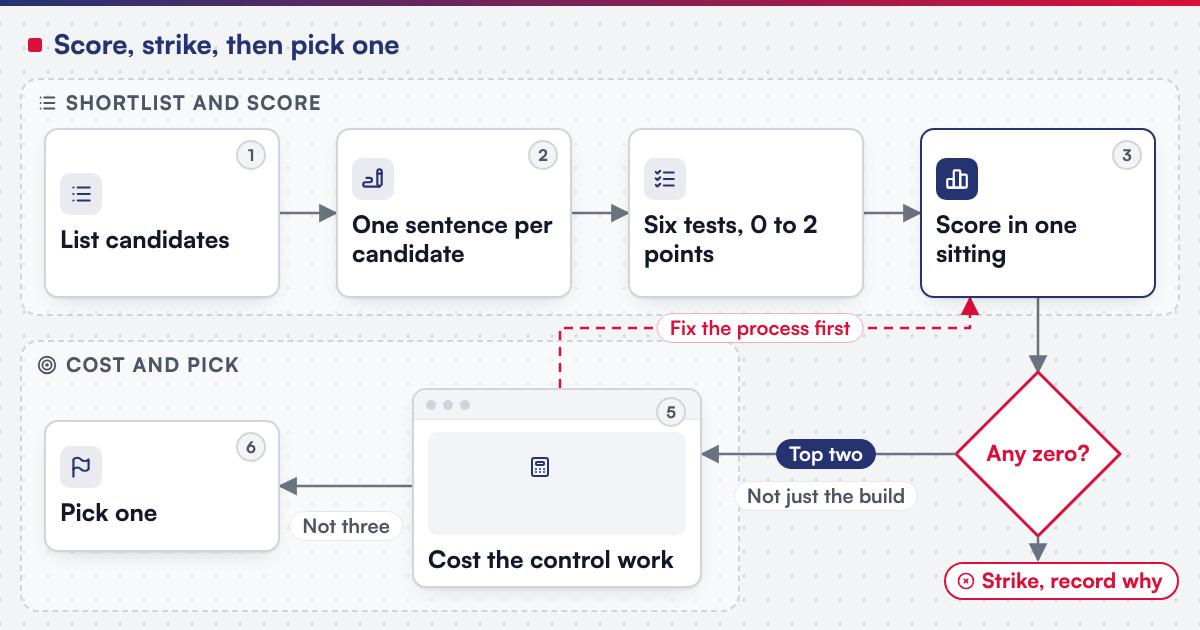 (opens the full-size diagram in a new tab)
A worked shortlist
Four candidates, scored the way a real session goes.
Inbound support triage. High volume, describable, a correct routing decision can be written down, every reply can be reviewed before sending, the ticket history is available and owned by a support lead. Scores eleven. This is the archetypal first candidate, and the full workflow is walked through on customer support automation.
Screening user-submitted listings. High volume, a flag is reviewable by definition, and the moderation queue gives you both the data and the reviewer. Scores ten. The anonymised classifieds platform record covers AI content filtering that detects and flags offensive content into an admin moderation dashboard, which is exactly this shape.
Supplier invoice matching. Good volume and a clear correct answer, but the action is a payment. Scores nine only if the automation stops at a proposed match that a person approves. Automating the payment itself would score zero on review tolerance.
Deciding customer credit limits. Regulated, supervised, and the request was explicitly to remove the reviewer. Scores zero on review tolerance and is struck, regardless of how attractive the volume looks.
When the answer is "not yet" or "fix the process first"
Both of these are real outcomes and neither is a failure. "Not yet" usually means the data is not accessible, the rights are unresolved, or the system this process runs on is being replaced. "Fix the process first" means the current steps are inconsistent enough that automating them would encode the inconsistency and give it an air of authority. A process with four undocumented exception paths does not need a model; it needs a decision about which of the four is correct.
Netbase's delivery lifecycle begins with discovery and strategic alignment for this reason. Where you would rather buy that decision as a bounded piece of work than argue it internally, the AI workflow blueprint exists to produce the shortlist, the scoring and a recommendation, including a recommendation not to proceed.
Once a candidate is chosen
Three decisions follow immediately, and each has its own page. Decide whether the work is a fixed sequence with AI steps or a system that chooses its own steps, on AI agents versus workflow automation. Build the evaluation set and agree the threshold before anything is built, on evaluating and testing AI workflows. Place the review point where confidence, policy or impact require it, on human-in-the-loop AI workflows. The model choice comes after those, not before: Netbase works with commercial and open-source AI models chosen per project.
From there it is ordinary milestone delivery; see project delivery for how acceptance is governed.
Plan the next step for your project
Common questions
Usually not. Start with the one that scores highest, which is rarely the biggest. The first project buys you an evaluation habit as much as a working workflow.
Then the honest recommendation is to fix a process or unblock data access before automating anything. Netbase has delivered anonymised client AI projects including retrieval-based knowledge assistants, document AI and MLOps pipelines, and each began from a process that scored well.
No, and the attempt is where budgets disappear. Map it first; mapping is a milestone with a deliverable, and it often changes the answer.
You need enough real cases to build an evaluation set, with private details removed. Without them there is nothing to test against and nothing to accept.
One, until the first has been through a pilot and an acceptance decision. The second is much faster, because the review habits, logging and thresholds already exist.
How this page is sourced
The selection tests above come from how Netbase teams scope this work: remote-first from Hanoi in Agile increments with weekly reviews, using AI-assisted engineering under human review. Statements about Netbase map to registered claims backed by attested company facts, listed under Sources, and are published only in the wording the register approves. See our methodology for how claims are reviewed.
What this page does not contain: benchmark data, industry adoption rates, saving estimates or any figure about how well a scored candidate will perform once built. The scoring table is a structured judgement, not a validated instrument. Candidates in the worked shortlist are illustrative compositions, not client accounts.
Pick one process and describe it
Score your shortlist, take the winner, and submit a project describing the process, its volume, the systems it touches and where a person must stay in control. If the honest answer turns out to be "not yet", we would rather say so at the start. OutsourcingVN is operated by Netbase JSC and is Netbase's own outsourcing-services platform.
Work behind this guide

Netbase delivered a bilingual classifieds marketplace, in English and Nepali, with paid ads, search, messaging, payments and an AI filter that flags offensive content into an administrator review queue. The client is not named, and no traffic, accuracy or commercial result is claimed.
Keep ReadingRelated services and solutions
 AI workflow automation with evaluation and human control
One operating workflow automated, with an agreed way to judge it and a person on uncertain cases.
Learn More