

How to write a software project brief that gets a useful proposal
One page, written once, sent to everyone. The structure below is what a provider needs in order to propose something you can actually compare.
Submit a project See how delivery runsReviewed by David Nguyen (CEO) · Updated 27 Sep 2026 · 8 min read

Most weak proposals are answers to weak briefs. When a provider is given a feature list and a deadline, it can only reply with a feature list and a number, and you end up comparing documents that describe different projects. A good brief is short, specific about the outcome and honest about what is still unknown. It is the cheapest hour you will spend on the project.
OutsourcingVN is operated by Netbase JSC. We read briefs for a living, so this page is written from the receiving end: it describes what makes a brief answerable, not what makes it impressive. Use it with any provider you are approaching. For the wider decision about buying an accountable outcome from a remote-first team, start with our buyer guide to outsourcing a software project.
What a brief is for
A brief does three jobs. It lets a provider decide whether to bid at all, which saves everyone time. It gives every provider the same starting point, so the proposals you receive are comparable. And it forces you to agree internally on the outcome and the decision owner before an outside party starts asking.
It is not a specification. You are not describing how the system works; you are describing what has to be true when it is finished, and what constrains the route there.
The structure, section by section
-
The outcome in two sentences
What will be different for the business or the user when this is done. Not the features: the change. If you cannot write this, the project is not ready, and a discovery step is the honest first purchase.
-
Why now
The event driving the timing: a contract ending, a system being retired, a regulation, a funding milestone. This tells a provider which constraints are real.
-
Context
What exists today, in plain terms. The current system, who uses it, roughly how many of them, and what it runs on. Two paragraphs is usually enough.
-
Scope
What you want built, as capabilities rather than screens. Then, just as important, what is explicitly out of scope for this phase.
-
Systems and integrations
Everything the work must connect to, with who owns each one and whether documentation exists. This single list changes proposals more than any other, as our page on what drives project cost explains.
-
Data
What data exists, where it lives, whether it needs migrating or cleaning, and who can answer questions about it.
-
Constraints
Technology you must keep, hosting or data-residency rules, accessibility obligations, security requirements, procurement rules and anything your legal team will insist on. Security and compliance constraints belong here, not in a late surprise; see our guide to data security and compliance in outsourcing.
-
The decision owner
One named person on your side who can approve scope, accept milestones and unblock questions, and roughly how much of their week this has. A brief with no owner produces a proposal with a large risk margin.
-
Timeline and fixed dates
Separate the date you would like from the date that is immovable, and say which is which.
-
Budget or budget range
If you have an approved envelope, say so. It is not a weakness; it lets a provider propose a shape that fits rather than one you will reject.
-
How you will choose
The criteria and the dates of your selection process. Providers respond better to a process they can see.
-
What you expect to own at the end
Source code, documentation, credentials, environments, and any licensed components you are willing to accept. Our notes on IP ownership and handover and exit cover the wording.
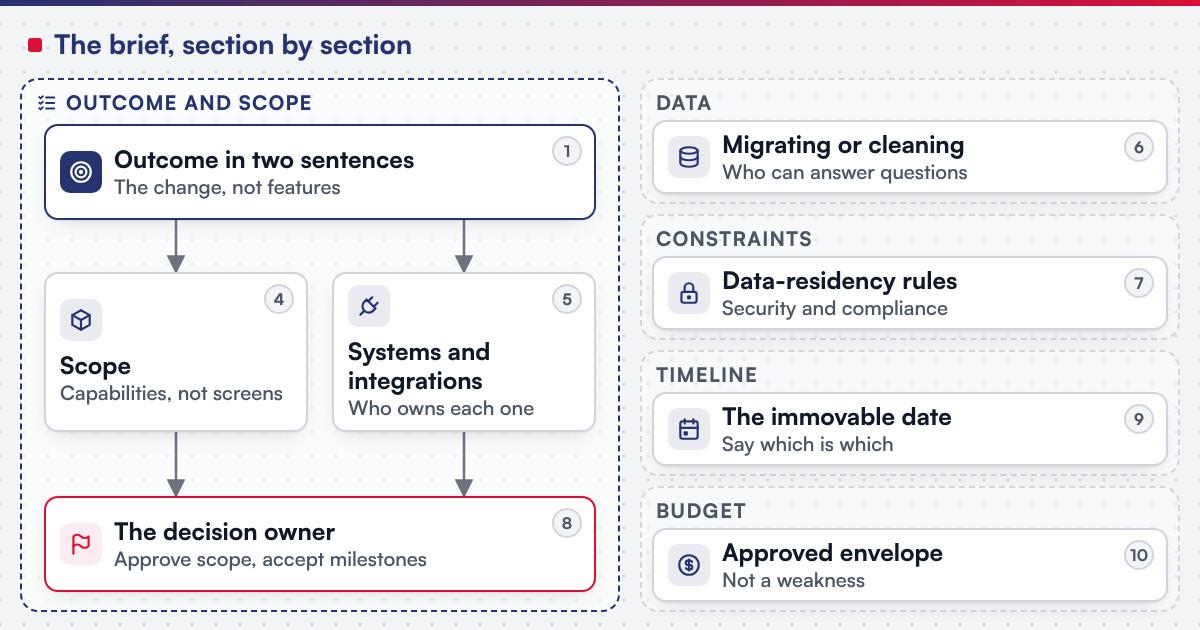 (opens the full-size diagram in a new tab)
A copyable outline
Paste this, fill it in, delete what does not apply:
- Project name and one-line summary
- Outcome: what will be true when this is done
- Why now: the driving event and any hard date
- Today: current system, users, technology
- In scope: capabilities, as a short list
- Out of scope: what this phase deliberately excludes
- Integrations: system, owner, documentation available or not
- Data: sources, volumes, migration or cleaning needed
- Constraints: technology, hosting and residency, security, compliance, procurement
- Decision owner: name, role, availability
- Other people involved: subject-matter experts and their availability
- Timeline: desired date, immovable date
- Budget: approved envelope or range, or "to be advised by proposal"
- Selection: criteria, steps, dates
- At handover we expect: deliverables and ownership
- Open questions: what you do not know yet
That last line matters more than it looks. A brief that admits three unknowns gets a better proposal than one that pretends there are none, because the provider can plan for them instead of discovering them.
How much detail is enough
Aim for one to three pages. Enough that a provider can judge feasibility and risk; not so much that you have pre-designed a solution and removed the provider's ability to improve it. If you have a longer specification, attach it and keep the brief short, saying which parts of the specification are settled and which are proposals.
Write it in the working language of the engagement. Netbase delivery communication is in English, which is also how proposals and status reports are written, and that is the norm across most international providers. If key documents exist only in another language, say so early, because translation and interpretation are project work.
Where a real-time conversation is needed to settle something, plan for it deliberately rather than assuming it will happen. The Hanoi office works Monday to Saturday, 9:00 to 18:15 Vietnam time, which is UTC+7, and our guide to time-zone collaboration explains how overlap is usually arranged.
Common mistakes
- A feature list with no outcome. It produces a quote for building the list, whether or not the list solves the problem.
- No named decision owner. Everything slows down and the estimate grows to cover the delay.
- Hidden integrations. They surface in week three and change the plan.
- A deadline with no reason. Providers cannot tell which dates to design around.
- Sending different briefs to different providers. The proposals then cannot be compared, which defeats the exercise. Our comparison of software outsourcing companies depends on a single brief going to everyone.
- Asking for a fixed total on an undefined scope. Something has to be defined before it can be fixed. Most of our projects are agreed as fixed-scope contracts with an agreed total after discovery, and milestone-based arrangements are also available, which is a deliberate sequence rather than a formality. The engagement models page explains the options.
What happens after you send it
At Netbase, a brief enters a lifecycle that starts with discovery and strategic alignment, then team assembly and architecture planning, before any build work is agreed. Requests sent through the OutsourcingVN contact and project request forms are emailed to our project and sales mailboxes and stored in the site administration database, and a person reviews every project brief and replies within two business days, Monday to Saturday, Vietnam time. You can also reach us through the contact page.
Expect the first reply to contain questions. A provider that returns a number without asking anything has either done this exact project before, which they should say, or has not read the brief. Our project delivery page describes what happens after a proposal is accepted, and our Work records show the kind of scope we have delivered, with the limitations stated. The custom product engineering and AI workflow automation pages describe the two services those records sit under.
Before you send the brief, it is worth running the provider itself through our due diligence checklist. The methodology page explains how we source and review everything published here.
Plan the next step for your project
Common questions
No. A brief describes the outcome and the constraints. If a specification is needed, writing it is usually the first milestone, and it is better done with the team that will build the system.
Say so, and give the decision you are trying to reach instead. A provider can propose a bounded first step that produces an estimate you can take to your board.
Yes. It is the only way the replies mean anything, and it takes no extra effort.
Yes. Send the outline first without the confidential parts, and we will put the agreement in place before you send the rest.
Use the brief throughout the project
The brief becomes a decision record in project delivery, not a document that stops at procurement. Before a Custom Product Engineering scope is agreed, settle IP ownership, the handover package and the trigger for a rescue assessment if access or acceptance stalls. The marketplace mobile app record can prompt scope questions; it does not replace requirements or prove results for a new product.
Have a brief ready?
Submit a project using the outline above, and a person will read it and reply with questions or an approach. OutsourcingVN is operated by Netbase JSC and is Netbase's own outsourcing-services platform.
Related services and solutions
 AI workflow automation with evaluation and human control
One operating workflow automated, with an agreed way to judge it and a person on uncertain cases.
Learn More