

Software change control: decide every change before anyone builds it
Software change control is the rule that no request alters agreed scope, budget or schedule until it has been logged, classified, sized and approved by a named person. Keep one change log, sort each request into a defect, clarification, swap or addition, and apply decision rules agreed at the start, so a yes or no takes days, not weeks.
Submit a project See Custom Product EngineeringReviewed by Huy Nguyen (David), CEO · Updated 14 Oct 2026 · 9 min read

Contents
- Why do unmanaged changes break budgets?
- What goes in a change log?
- Which decision rules keep changes moving?
- Worked scenario: four requests in one milestone
- What does the Netbase record show about phase boundaries?
- Which questions should you ask a supplier about change?
- How does change control break down?
- Does an AI coding agent's suggestion need change control too?
- How this guide is sourced and where it stops
- Common questions
- Bring your change rules
Why do unmanaged changes break budgets?
Change is normal in software. Users see a working screen and realise what they actually need; a regulation shifts; a competitor launches something. The damage comes not from change but from change that is agreed in a chat message, built without an estimate and discovered at invoice time. Each small request looks free on its own. Twenty of them move a launch date by a month, and nobody can say which decision caused it.
Change control does not exist to say no. It exists so that each yes has a known effect on money, time and risk, and so that the buyer, who owns the budget, makes the call rather than whichever developer happened to read the message. The project delivery page names change control as one stage of a Netbase project; this guide gives the working tools behind it.
What goes in a change log?
OutsourcingVN is operated by Netbase JSC, which runs change control on its own projects, so read the log as a supplier's tool that works equally well for buyers managing any supplier. Every change request, however small, gets one row.
| Field | What to record | Example |
|---|---|---|
| CR number and date | Sequential ID and the date raised | CR-014, 3 March |
| Raised by | Name and role | Sales director |
| Request | The change in the requester's own words | "Let customers save a quote and come back to it" |
| Classification | Defect, clarification, swap or addition | Addition |
| Affected items | Scope rows, criteria and milestones touched | Quote form, AC-11, milestone 3 |
| Impact | Effort, schedule, cost, security, other milestones | Four extra days; milestone 3 moves by one week |
| Options | At least two ways to respond | Build now; defer to phase 2; build a lighter version |
| Decision and approver | Approved, rejected or deferred, and by whom | Deferred, product owner, 6 March |
| Status | Open, sized, decided, built, accepted | Decided |
The classification column does most of the work. A defect fails an agreed acceptance criterion and is fixed inside the current scope. A clarification confirms what an existing criterion meant and changes nothing. A swap replaces one in-scope item with another of similar size. An addition is new scope and always needs sizing and approval.
Which decision rules keep changes moving?
Agree these rules before the first milestone starts, and write them into the project agreement or milestone schedule.
-
Nothing is built from an unlogged request
A developer who receives a request by chat logs it and waits.
-
The supplier classifies within an agreed number of working days
and states its reason, so a defect is never quietly converted into a paid change or the reverse.
-
Defects and clarifications need no commercial approval
; the project manager records them and they proceed.
-
Swaps need the product owner's approval
and a one-line note of what leaves scope.
-
Additions need a written estimate and approval by the budget owner
above an agreed size; below it, the product owner decides.
-
Every decision records options, not only yes or no
Deferral to a later phase is often the best answer.
-
Approved changes update the scope map, the acceptance criteria and the plan on the same day
A change that lives only in the log will be forgotten at acceptance.
-
Review the log at every weekly meeting
and total the approved effect on schedule and cost, so drift is visible while it is small.
The same discipline appears in security practice. NIST SP 800-128, its guide to security-focused configuration management, treats controlling and analysing changes to a system's configuration as a core activity, because unreviewed changes are where risk enters. Scope works the same way.
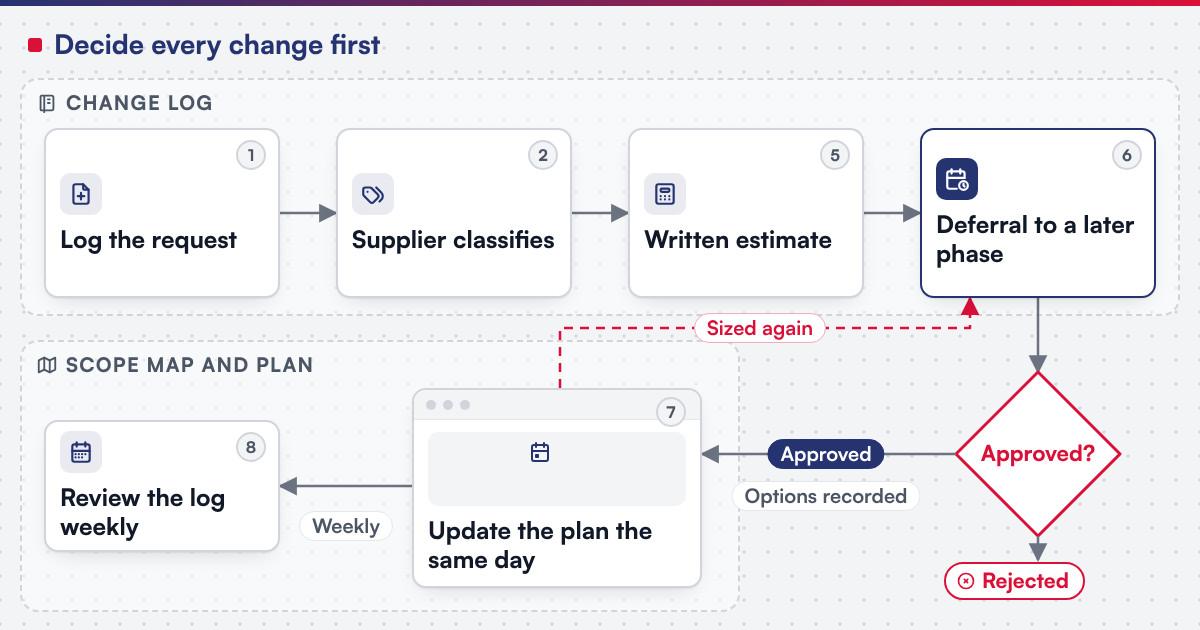 (opens the full-size diagram in a new tab)
Worked scenario: four requests in one milestone
A training company is three weeks into a milestone that delivers course booking and payment. Four requests arrive:
- CR-011, "The booking confirmation shows the wrong time zone." The supplier checks criterion AC-05, which says times appear in the learner's local zone. It is a defect, fixed inside the milestone scope.
- CR-012, "Does 'group booking' mean up to ten or up to twenty?" The criterion says ten. It is a clarification, recorded and closed.
- CR-013, "Replace the PDF invoice with an emailed receipt." Both are similar in size, and the finance lead prefers the receipt. It is a swap, approved by the product owner.
- CR-014, "Add a waiting list when a course is full." New scope. The supplier sizes it at one extra week and offers two options: add it to this milestone and move the date, or schedule it in the next milestone. The budget owner chooses the next milestone.
Four requests, four different outcomes, and the milestone date moves by zero days because only one request was new scope and it was deferred deliberately.
What does the Netbase record show about phase boundaries?
Since 2020 Netbase has worked as offshore development and managing partner on a multi-tenant cloud ERP SaaS for a US client who is not named. Phase 1, from 2020 to 2023 and aimed at agency SMEs, covers CRM, real-time messaging, HR, knowledge base, custom fields and workflows, work and project management and API integrations. A retail phase 2 was planned work when the profile was written and is not presented as delivered. The cloud ERP record shows a long engagement where new ambitions become a named later phase rather than silent growth inside the current one.
Commercially, most Netbase projects are agreed as fixed-scope contracts after discovery; milestone-based arrangements are also available. Under a fixed scope, a change log is what keeps the fixed part meaningful. Netbase delivery runs with weekly reviews and a named project manager, and its lifecycle includes agile execution with outcome-based milestones, which gives the log a regular review point. The total software delivery cost guide covers how approved changes fit into the full cost picture.
Which questions should you ask a supplier about change?
- How do you classify a request, and how fast? Ask for the categories and the turnaround in writing.
- Who on my side can approve what? Agree the product owner and budget owner roles, and the size above which the budget owner must decide.
- Will you show me the running total of approved changes? It should appear at every weekly review.
- What happens to acceptance criteria when a change is approved? They should be updated the same day; the acceptance criteria guide explains how.
- Can a change be deferred to a later phase without penalty? A good answer describes how deferred items are carried forward.
- How do you handle urgent production changes? Emergency fixes need a faster path, logged after the fact.
How does change control break down?
- Verbal approvals. A "yes" on a call is logged by nobody. Confirm every decision in writing the same day.
- Every request treated as a change. Billing defects as new scope destroys trust; classify honestly.
- Every request treated as a defect. Absorbing additions silently destroys the schedule.
- No budget owner in the loop. The product owner approves additions nobody funded.
- The scope map left stale. After a few approved changes, nobody knows what the contract covers; update the scope boundaries with each decision.
- Changes that carry new risk go unrecorded. A late integration or data change belongs in the project risk register as well as the log.
Does an AI coding agent's suggestion need change control too?
Nothing in the log above cares whether a request came from a person or an AI coding agent; an out-of-scope proposal still needs a classification and an approver before anyone builds it. AI-assisted software delivery is the fuller picture of what a supplier's AI tool use changes for a buyer. For a client whose own engineers are learning to work this way, AI engineering enablement is the coached engagement that wires an agent's proposals into this same log from the first week, with sign-off on the resulting practice covered separately by AI workflow governance questions.
How this guide is sourced and where it stops
This guide combines NIST SP 800-128 on configuration change control with Netbase records approved in the OutsourcingVN claim register: the delivery lifecycle, weekly reviews, the contracting model and the cloud ERP engagement with its planned phase 2. The methodology explains how records are sourced. The cloud ERP record describes scope and phases; it does not publish a change log, a number of change requests or any schedule or cost figure, and this page claims none. The training-company scenario is illustrative, not a client project. Contract terms for changes are set in each project agreement.
Plan the next step for your project
Common questions
A defect is work that fails a criterion both sides agreed. A change request asks for something the agreed criteria do not cover. The written acceptance criteria decide which it is.
No change is too small to log; small ones are simply quick to decide. The log is how many small changes stay visible as one total.
Not on the change itself. It should continue the approved work and start the change only after a decision, unless both sides agree an emergency path.
Yes, and it is often the cheapest route. Deferred requests stay in the log with status "deferred" and are sized again when that milestone is planned.
The supplier's project manager usually maintains it, and the buyer's product owner reviews it weekly. Both should be able to see the same version at any time.
Bring your change rules
Agreeing the log fields and decision rules before a contract takes an hour and saves weeks later. Custom Product Engineering projects run with change control from the first milestone.
OutsourcingVN is Netbase's own outsourcing-services platform. Submit a project with your brief and how you expect to approve changes, and a person will reply with a proposed change process for it.
Work behind this guide

This record covers phase-one scope for agency SMEs; the client and product are not named, and no usage or business result is claimed.
Keep ReadingRelated services and solutions
 Custom product engineering for a bounded release outcome
One defined release of your product, built to named outcomes and handed over with acceptance evidence.
Learn More