

Software project risk register: find delivery risks before kickoff
A software project risk register lists the events that could stop the project reaching its outcome, each scored for likelihood and impact, with a named owner, an early-warning trigger and a planned response. Build it during discovery, before the contract, from the scope, the people, the systems and the data, then review it every week.
Submit a project See Custom Product EngineeringReviewed by Huy Nguyen (David), CEO · Updated 28 Sep 2026 · 9 min read

Contents
- Why build the register before the project starts?
- What does a risk register contain?
- How do you build the register?
- Worked register: a marketplace connecting to a legacy ERP
- What does a Netbase record show about investigating before committing?
- Which questions should you ask a supplier about risk?
- Why do risk registers fail?
- How this guide is sourced and where it stops
- Common questions
- Bring your top five risks
Why build the register before the project starts?
A risk found before kickoff costs a sentence in the proposal: a dependency with a date, an assumption with a check, a milestone reordered so the uncertain part goes first. The same risk found in month three costs a delayed launch, a rushed workaround or a dispute about who should have known. The register is how the uncertain parts of a project get priced into the plan instead of discovered in it.
It also changes the conversation with a supplier. A supplier that lists its own risks up front, including the ones on its side, is telling you how it thinks. A proposal with no risks at all has not looked.
This page is about a new project that has not started. Two neighbouring guides cover other situations: the legacy system risk assessment examines an existing system you already run, and the project rescue assessment examines a project that is already failing.
What does a risk register contain?
OutsourcingVN is operated by Netbase JSC, which builds registers like this on its own projects, so read the format as a supplier's working format; it transfers to any supplier. One row per risk:
| Field | What to write | Example |
|---|---|---|
| ID and category | Short ID; scope, people, technology, data, third party or security | R-03, third party |
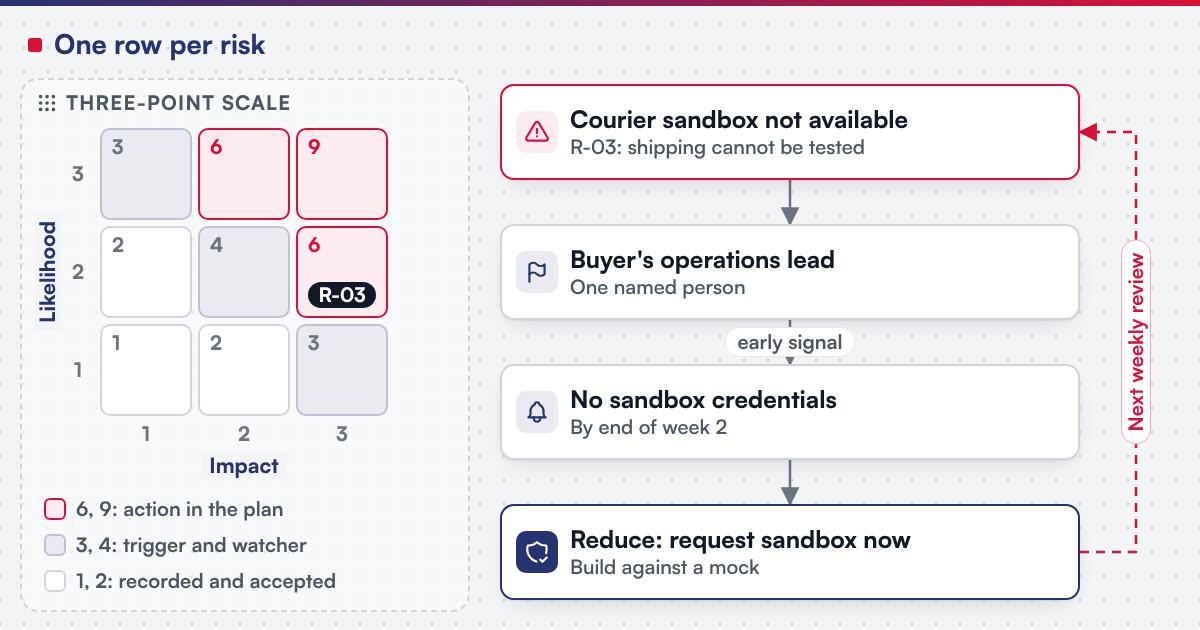
| Risk event | "If X happens, then Y" | If the courier API sandbox is not available by week 4, then shipping integration cannot be tested |
| Likelihood (1-3) | 1 unlikely, 2 possible, 3 likely | 2 |
| Impact (1-3) | 1 minor, 2 delays a milestone, 3 threatens the outcome | 3 |
| Score | Likelihood multiplied by impact | 6 |
| Owner | One named person who watches it | Buyer's operations lead |
| Trigger | The early signal that it is happening | No sandbox credentials by end of week 2 |
| Response | Avoid, reduce, transfer or accept, with the action | Reduce: request sandbox now; build against a mock in the meantime |
| Status and review date | Open, watching, occurred, closed | Watching, next weekly review |
A three-point scale is deliberate. Finer scales invite false precision on a project that has not started. Scores of 6 and 9 get an action in the plan; 3 and 4 get a trigger and a watcher; 1 and 2 are recorded and accepted. NIST SP 800-30 Rev. 1, its guide to conducting risk assessments, uses the same basic structure of likelihood and impact combined into a level of risk, which is why the model travels well between security and delivery work.
 (opens the full-size diagram in a new tab)
How do you build the register?
-
Walk the scope map row by row
Every dependency and assumption in the scope boundaries guide is a candidate risk.
-
Ask each role what it fears
The product owner, a developer, the person who owns the data and the person who will support the system each see different risks.
-
Write each risk as an event with a consequence
"Integration risk" is a topic; "if the ERP rejects bulk writes, then order sync fails" is a risk.
-
Score likelihood and impact on the three-point scale
, together, in one session.
-
Name one owner per risk
, on whichever side can act first.
-
Set a trigger you can observe
, such as a missed date, an error count or a test result.
-
Choose a response and put the action into the plan
Reordering milestones so the riskiest integration is proven first is often the strongest response.
-
Review weekly and when anything changes
Close risks that have passed, and add new ones as soon as they appear, including any that arrive with an approved change request.
Worked register: a marketplace connecting to a legacy ERP
A wholesaler plans a buyer marketplace that reads stock and writes orders to a fifteen-year-old ERP. The discovery session produces nine risks; the top four are:
-
R-01
- Risk event
- If the ERP cannot accept orders through an interface, then orders must be keyed by hand
- L
- 2
- I
- 3
- Score
- 6
- Owner
- Supplier technical lead
- Response
- Reduce: a one-week spike in milestone 1 to prove order writing
-
R-02
- Risk event
- If product data has duplicate codes, then catalogue import fails
- L
- 3
- I
- 2
- Score
- 6
- Owner
- Buyer data owner
- Response
- Reduce: buyer cleans codes before milestone 2; import report lists rejects
-
R-03
- Risk event
- If the only person who knows the ERP leaves, then integration stalls
- L
- 1
- I
- 3
- Score
- 3
- Owner
- Buyer IT manager
- Response
- Reduce: record two walkthrough sessions in week 1
-
R-04
- Risk event
- If admin accounts are shared during testing, then access cannot be traced
- L
- 2
- I
- 2
- Score
- 4
- Owner
- Supplier project manager
- Response
- Avoid: named accounts with MFA from day one
Because R-01 scored 6 and threatened the outcome, the plan moved the integration spike to the first milestone. If the spike fails, the buyer learns it in week two, not at launch.
What does a Netbase record show about investigating before committing?
For an existing client store, Netbase scoped a three-phase recovery of a compromised Magento site. The first phase is investigation and security scanning with cause analysis, a full source-code and database malware scan, server log, permission and abnormal-file checks and a damage assessment, delivering an infected-file report and a recovery plan. Cleaning, recovery and hardening follow that report, typically 6 to 13 days in total depending on the damage, and full recovery is never guaranteed. The Magento recovery and hardening record is a recovery, not a new build, but it shows the same principle a risk register serves: investigate the unknowns first, then commit to the plan.
Security risks belong in the register from the start. At Netbase, security practices include secure code review and version control, role-based access control, MFA for admin dashboards, contributors under NDA, and NDAs and DPAs on request; the data security and compliance guide lists the questions to settle before a supplier touches your data.
Netbase's delivery lifecycle opens with discovery and strategic alignment and then team assembly and architecture planning, which is where a register is drafted, and delivery runs with weekly reviews and a named project manager, which is where it is kept alive. Most Netbase projects are agreed as fixed-scope contracts after discovery; milestone-based arrangements are also available, and the risks found in discovery shape which fits. The project delivery page shows where the register sits alongside milestones and acceptance.
Which questions should you ask a supplier about risk?
- What are the five biggest risks you see in my project? A specific answer shows the supplier has read the brief.
- Which of those risks are on your side? Staffing, knowledge concentration and unfamiliar technology count.
- Which risk would you prove first, and how? Look for a spike or prototype early in the plan.
- Who owns each risk, by name? "The team" is not an owner.
- How often will we review the register, and where will I see it? Weekly, in a shared document, is a sound default.
- What would make you advise not starting? An honest supplier has a stop condition.
Why do risk registers fail?
- Written once for the proposal and never opened again. A register reviewed weekly is a management tool; one filed at signature is decoration.
- Topics instead of events. "Performance" cannot be owned or triggered.
- Every risk scored high. When everything is critical, nothing gets action. Force a ranking.
- Owners with no power to act. The owner must be able to trigger the response.
- Buyer-side risks left out. Late decisions, unavailable reviewers and unclean data are often the largest risks, and they sit with the buyer.
- No link to the plan. A high-scoring risk with no action in any milestone is an accepted risk that nobody accepted.
How this guide is sourced and where it stops
This guide combines NIST SP 800-30 Rev. 1 on risk assessment with Netbase records approved in the OutsourcingVN claim register: the delivery lifecycle, weekly reviews, the contracting model, security practices and the scoped Magento recovery. The methodology explains how records are sourced. The Magento record is a recovery scope for an existing store, not a new-build risk register, and Netbase publishes no statistic on risks identified, avoided or realised; this page claims none. The wholesaler register is illustrative, not a client project.
Plan the next step for your project
Common questions
Usually between ten and thirty for a mid-sized build. Fewer suggests nobody looked; many more suggests topics are being listed instead of events.
The supplier's project manager usually maintains it, with the buyer's product owner as co-owner. Each risk still has its own named owner.
No. A risk may happen; an issue has happened. When a risk occurs, close it in the register and open it as an issue with an action and a date.
Yes, at least at summary level, so they compete for attention with delivery risks. A detailed security assessment can live in its own document and be referenced from the register.
Merge them. Differences in scoring are useful: they show where the two sides see the project differently, and that conversation is worth having before kickoff.
Bring your top five risks
A short list of the risks that worry you most is one of the most useful things a brief can contain. Custom Product Engineering projects start with a register built in discovery and reviewed weekly.
OutsourcingVN is Netbase's own outsourcing-services platform. Submit a project with your brief and the risks you already see, and a person will reply with the ones they would test first.
Work behind this guide

For an existing client store running Magento that had been compromised, Netbase scoped a three-phase recovery: investigate and assess, clean and restore, then repair and harden.
Keep ReadingRelated services and solutions
 Custom product engineering for a bounded release outcome
One defined release of your product, built to named outcomes and handed over with acceptance evidence.
Learn More