

Software project scope boundaries: map the edges before you sign
A software project scope boundary is the written line between work the supplier will deliver and everything else: exclusions, assumptions, dependencies the buyer or a third party owns, and phases deferred to later. Draw it as a scope map, one row per edge, each with an owner and a test that shows which side of the line an item sits.
Submit a project See Custom Product EngineeringReviewed by Huy Nguyen (David), CEO · Updated 14 Oct 2026 · 10 min read

Contents
- Why is a feature list not a scope?
- What does a scope map contain?
- How do you draw the boundary?
- Worked scenario: a bilingual booking portal
- What do Netbase records show about drawing the line?
- Which questions should you ask a supplier about scope?
- Where do scope boundaries usually fail?
- How this guide is sourced and where it stops
- Common questions
- Take your scope map to a proposal
Why is a feature list not a scope?
A feature list says what will exist. A scope says what will exist, what will not, what is being assumed about the world around it, and who has to act for the work to finish. Two suppliers can read the same list of twenty features and quote two very different projects, because each silently fills the gaps differently: one assumes the buyer supplies product photography and translated copy, the other assumes it builds an import tool for both.
Most scope disputes are not about the features that were written down. They are about the edge cases nobody wrote down: the second language, the data that has to come from the old system, the payment provider account that has to be opened in the buyer's company name, the admin report that was "obviously" included. A boundary exists to make those edges explicit while they are still cheap to argue about.
The software project brief template collects the whole brief: outcome, users, systems and budget owner. This page covers one part of it in depth, the line around the work.
What does a scope map contain?
OutsourcingVN is operated by Netbase JSC, which quotes and delivers custom software projects, so treat this map as a supplier's working tool; it serves just as well when you compare several suppliers. Every item that could be argued about gets one row and exactly one category.
| Category | Meaning | Example row | Owner | Test that places it |
|---|---|---|---|---|
| In scope | The supplier builds and delivers it | Listing search with category and location filters | Supplier | It appears in a milestone with acceptance criteria |
| Excluded | Explicitly not delivered in this contract | Native mobile apps | Nobody in this contract | Named in the exclusions list |
| Buyer dependency | The buyer must provide it for work to proceed | Payment provider merchant account, opened by the buyer | Buyer, named person | Has a due date tied to a milestone |
| Third-party dependency | An outside party must act | SMS gateway approval of sender ID | Named third party, chased by the buyer | Has a fallback if it is late |
| Assumption | Believed true; the plan changes if it is not | Existing product data exports cleanly to CSV | Whoever checks it, by a date | Has a check and a consequence if false |
| Deferred phase | Wanted, but deliberately left for a later contract | ERP integration | Buyer decides later | Labelled as planned, not included |
Two rules keep the map honest. First, "to be confirmed" is not a category: an unresolved item is either an assumption with a check date or it stays out. Second, every exclusion should be written in the buyer's words, because the buyer is the one who will later expect it.
How do you draw the boundary?
-
Start from the outcome, not the features
Write the one sentence the project must make true. GOV.UK's service manual, describing the discovery phase, stresses understanding the problem to solve and the constraints on changing the service before choosing a solution; boundaries drawn around a solution drift, boundaries drawn around a problem hold.
-
List every candidate item
Include the things you suspect are out, such as data migration, content entry, hosting accounts, analytics and legal pages.
-
Place each item in exactly one category
of the map above.
-
Name the buyer dependencies with dates
An access request, a design approval or a sample data set without a date is how a milestone stalls.
-
Write the exclusions list as a standalone section
of the proposal, not as scattered "not included" notes.
-
Mark deferred phases in plain words
"Phase 3, planned, not part of this contract" leaves no room for a reader to infer delivery.
-
Tie every in-scope row to a milestone and an acceptance test
If an item cannot be tested, the boundary around it is still vague; the acceptance criteria guide shows how to write the test.
-
Agree what happens when the line moves
Scope will change; the map only protects the budget when a change-control process decides every move.
Worked scenario: a bilingual booking portal
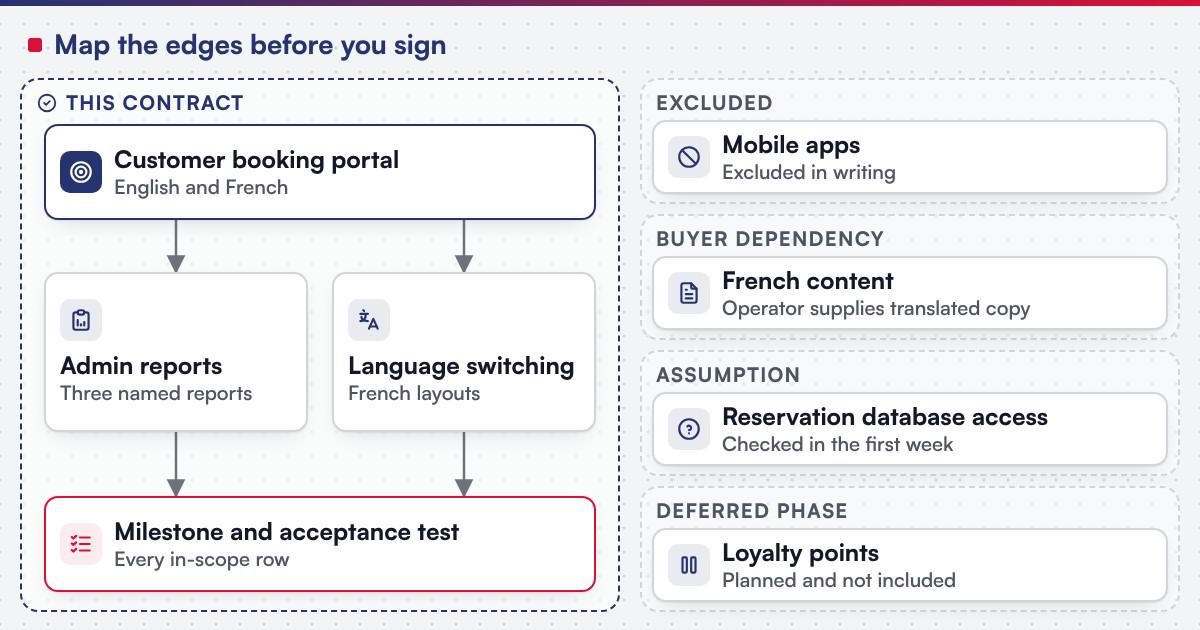
A tour operator wants a customer booking portal in English and French, connected to its existing reservation database. The first draft brief lists fourteen features. Drawing the scope map takes two working sessions and moves several items:
- French content was assumed to be the supplier's job. It becomes a buyer dependency: the operator supplies translated copy, and the supplier builds the language switching and French layouts. The due date is set two weeks before the content milestone.
- Reservation database access becomes an assumption with a check: the supplier confirms in the first week that the database exposes the fields the portal needs. If it does not, a separate integration milestone is quoted.
- Mobile apps are excluded in writing, because the sales team had mentioned them in an early call.
- Loyalty points move to a deferred phase, labelled planned and not included.
- Payment gateway account is a buyer dependency, opened in the operator's name so the operator keeps control of it.
- Admin reports are in scope, but limited to three named reports, each with a sample layout attached.
The final contract covers fewer features than the first brief, and nobody is surprised at acceptance.
 (opens the full-size diagram in a new tab)
What do Netbase records show about drawing the line?
Two Netbase records show a boundary drawn and kept. For a founder who is not named, Netbase delivered a bilingual English and Nepali classifieds platform covering requirements, design, a Laravel backend with REST APIs, OTP accounts, paid ads, search, ratings, messaging, event ticket ads, blog and forum, payments, multi-language SEO and AWS deployment. It was delivered in six milestones over four months with training and six months of support. The classifieds platform record shows how a long scope becomes manageable when each part belongs to a milestone.
For Deyar Printing & Advertising in Riyadh, Netbase scoped and built a bilingual Arabic and English web-to-print platform in phases, from discovery and launch to production operations. The AI design and pre-press suite, ERP integration and ZATCA e-invoicing were planned third-phase work and are not presented as delivered. The bilingual web-to-print record is a clean example of a deferred phase written down as such.
Commercially, most Netbase projects are agreed as fixed-scope contracts after discovery; milestone-based arrangements are also available. Netbase's delivery lifecycle runs from discovery and strategic alignment through team assembly and architecture planning, agile execution with outcome-based milestones, modular components, training and rollout, to ongoing support, and delivery runs with weekly reviews and a named project manager. The project delivery page explains how those stages carry the scope from proposal to handover.
Which questions should you ask a supplier about scope?
- What have you assumed that I have not written? A careful supplier lists its assumptions unprompted.
- Which items in my brief did you leave out, and why? The answer shows whether the supplier read the brief or matched keywords.
- What do you need from me, by when? Expect a dated list of buyer dependencies.
- Where does data migration start and stop? Ask who cleans, maps, imports and checks old data.
- Which accounts will be opened, and in whose name? Hosting, domains, app stores and payment providers should belong to the buyer.
- Who owns what you build? For Netbase custom development the client owns the IP created for it, while Netbase reusable modules and products are licensed, not transferred; final terms sit in each project agreement. The IP ownership guide covers the questions to settle.
- What is the first thing you would cut if the timeline had to shrink? A supplier who can answer has already ranked the scope.
Where do scope boundaries usually fail?
- Integrations described by name only. "Connect to the CRM" hides the direction of sync, the fields and error handling. Give each integration its own row.
- Content and data treated as nobody's job. Copy, images, translations and migrated records are work; assign them.
- Non-functional needs left implicit. Accessibility level, supported browsers, languages and expected load belong in the map.
- Deferred phases described in the future tense of a sales call. Write "planned, not included".
- Environments and accounts forgotten. Staging servers, test accounts and third-party sandboxes need an owner.
- The map frozen at signature. New risks appear during delivery; the project risk register is where a boundary item that looks shaky gets tracked.
How this guide is sourced and where it stops
This guide combines the GOV.UK service manual's description of discovery with Netbase records approved in the OutsourcingVN claim register: the delivery lifecycle, weekly reviews, the contracting model, IP ownership, the classifieds platform and the Deyar platform with its planned third phase. The methodology explains how records are sourced. Netbase's published delivery record covers the two projects named here, among others; it contains no measured result for scope accuracy or dispute rates, and this page claims none. The scenario is illustrative, not a client project. Legal wording of contracts belongs to your own adviser.
Plan the next step for your project
Common questions
Detailed enough that every item a reasonable person might expect has a row and a category. A small project may need twenty rows; a platform may need a hundred. Precision matters more for integrations, data and anything customer-facing.
Yes. What is obvious to the supplier is often not obvious to the buyer's sales team, finance team or end users. An exclusion costs one line to write and can save a dispute.
That is what discovery is for. Update the map at the end of discovery and sign the delivery contract against the updated version, not the first brief.
The buyer's product owner and the supplier's project manager own it jointly, and both sign each revision. One of them should keep the single authoritative copy.
It can be described and estimated as a separate option, but it should stay outside the current contract until the buyer decides, so nobody reads it as committed work.
Take your scope map to a proposal
A scope map turns into a proposal quickly when it arrives with its dependencies dated and its deferred phases labelled, the groundwork for the statement of work a supplier will sign. Custom Product Engineering is the route for a bounded build against that map.
OutsourcingVN is Netbase's own outsourcing-services platform. Submit a project with your draft scope map or brief, and a person will reply with the questions still open on its boundary.
Work behind this guide

Netbase delivered a bilingual classifieds marketplace, in English and Nepali, with paid ads, search, messaging, payments and an AI filter that flags offensive content into an administrator review queue. The client is not named, and no traffic, accuracy or commercial result is claimed.
Keep Reading
This record separates what was delivered from a third phase that the source describes as planned, and it claims no result for either.
Keep ReadingRelated services and solutions
 Custom product engineering for a bounded release outcome
One defined release of your product, built to named outcomes and handed over with acceptance evidence.
Learn More