

Working across time zones with a Vietnam delivery base
Remote-first milestones are the default, the delivery base and the working day are set in Hanoi on UTC+7, and specialists can be added from elsewhere when a scope needs them. What decides whether that feels smooth or slow is the rhythm you design at the start.
Submit a project How we deliverReviewed by David Nguyen (CEO) · Updated 6 Oct 2026 · 10 min read

OutsourcingVN is operated by Netbase JSC, which scopes and runs accountable project teams for buyers who would rather not build every capability internally. Netbase remains the contracting and delivery owner whether the team is Netbase staff, approved specialists or disclosed partners, and it serves clients in the United States, Europe and Asia-Pacific. We therefore have an interest in your decision, but the design advice below applies whoever you buy from. For the wider set of checks, start with the Vietnam software outsourcing buyer's guide.
What UTC+7 means for your working day
Vietnam runs on UTC+7 and does not use daylight saving time. The Hanoi clock stays where it is all year, so the distance to Europe and North America changes twice a year when those countries move theirs. Put the gap in a shared calendar rather than trusting anyone to hold it in their head.
The Hanoi office works Monday to Saturday, 9:00 to 18:15 Vietnam time (UTC+7), and support coverage follows those days. That is roughly 02:00 to 11:15 UTC, and everything below follows from that window.
- Asia-Pacific. Singapore, Bangkok, Jakarta and Kuala Lumpur sit within an hour of Hanoi, so most of the working day is shared. For Japan, Korea and eastern Australia the shared hours are the Hanoi morning and your afternoon.
- Europe. The shared hours are the European morning, running into the early afternoon in Hanoi, and the window is a little wider for central Europe than for the UK. It is comfortably enough for a daily call if you want one.
- North America. The Hanoi day ends around breakfast time on the US East Coast, so an early call there can catch the end of it. For the West Coast there are no shared hours inside normal business hours on either side; a live call means someone's evening or someone's early morning.
Netbase's head office in Hanoi is the company's only office. Distributed specialists join a project when the scope needs a skill, but they are a capability decision rather than a coverage model, and nothing here should be read as follow-the-sun delivery. Saturday is a working day in Hanoi and Sunday is not, which is useful for a weekend cutover planned from Europe or the Americas and a trap if you assume the same calendar on both sides. Agree the public-holiday calendar for both countries in writing before the first milestone date is fixed.
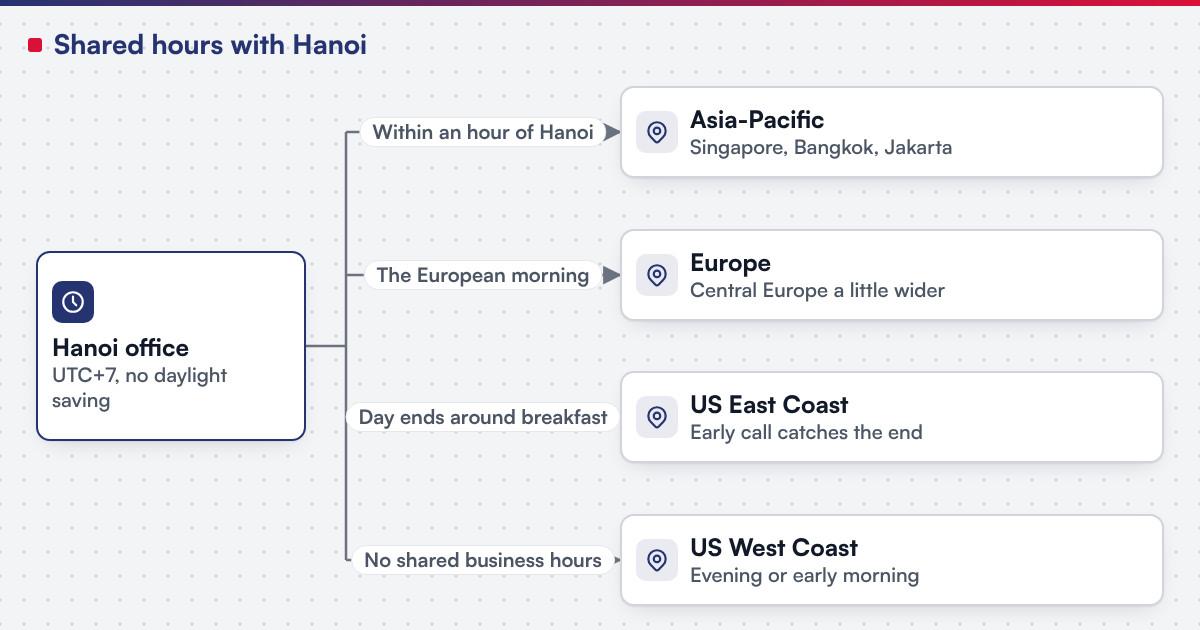 (opens the full-size diagram in a new tab)
Decide how much shared time the work actually needs
Buyers often ask for the largest possible overlap and then use almost none of it. The narrower question is more useful: which decisions genuinely cannot wait a day?
- Live pairing, user research sessions and incident response need real shared hours.
- Work with a clear written scope and a single decision owner on your side usually does not.
- Work where your approval is the bottleneck needs your availability fixed, not the team's extended.
The engagement model changes the answer. If you buy a bounded outcome, the delivery owner absorbs most of the coordination; if you direct the work day to day, you carry it. Our engagement models page sets out that trade-off, and the project outsourcing versus staff augmentation comparison works through it in more depth for a bounded piece of work versus directed headcount. It also shows up in the budget, because a rhythm built on live calls consumes management time on both sides, which is part of what the cost of Vietnam software outsourcing actually contains.
Design the window rather than hoping for one
Netbase delivers remote-first and stays accountable for delivery however the team is composed. Contributors are chosen for role fit, delivery evidence, language, time-zone overlap, availability, continuity and security requirements rather than nationality. What that does not buy you is round-the-clock coverage: it is not offered by default, extended hours are not implied by the office hours above, and no response time is promised on this page. Where a project needs more overlap than the Hanoi working day supports, that is something to define and agree in the contract, not something to infer from a location.
What a workable window looks like once it is written down:
- the hours, in both local times, when both sides will be available for calls and decisions;
- which meetings happen inside it, who attends, and who decides when an attendee is missing;
- how a decision is recorded so the other side can act on it without another call;
- the response and acceptance windows you need, stated as commitments in the contract rather than inferred from office hours;
- the escalation contact on each side, agreed before any production access is granted.
The global delivery page describes how this is set up on our side.
Write for the other side of the clock
Delivery communication with Netbase is in English. That matters less than how much of the work is written down. In a distributed project the written record is the project: a decision that exists only in a call is a decision the other half of the team does not have.
Three habits carry most of the load.
- A brief that answers questions in advance. Ambiguity that would cost a two-minute conversation in an office costs a day across time zones. The software project brief template covers what to settle before the team starts.
- End-of-day handovers. A short written note on what moved, what is blocked and what needs an answer, posted at the end of each side's day, is worth more than a daily call.
- Questions that can be answered asynchronously. "Which of these three options do you want, and by when?" beats "can we discuss the login flow?"
Reviews, decisions and escalation
Netbase delivery runs in Agile increments with weekly reviews and a named project manager. Put the review inside the shared window and treat it as the decision point, so risks, change requests and acceptance are settled there rather than drifting between emails. Project delivery explains how milestones, change control and acceptance work.
Between reviews, escalation is what you are really insuring against. Agree what counts as urgent, who is contacted, and what happens once the Hanoi day is over. If the answer is that nothing happens until 9:00 Vietnam time, that may be perfectly acceptable, but you should know it before an incident rather than during one. The remote software delivery governance guide sets out the weekly cadence, reporting and escalation route in full once the overlap window above is agreed.
Access and security in the hours nobody is watching
Distance changes who can reach your systems and when. Decide which environments the team may access outside your own working hours, whether someone on your side must be present for production changes, and how access is granted, reviewed and removed. Where contributors work from more than one country, the same questions apply to each of them. These are contract questions rather than scheduling ones: see data security and compliance in outsourcing for the full list, and IP ownership in software outsourcing for who owns what the team produces in those hours.
Before you sign, test the answers rather than the calendar. The checks in Vietnam outsourcing due diligence include asking for a real status report and a real escalation record.
When travel or extended hours is the right answer
Remote-first is not remote-only. Onsite work is available on request and scoped as a separate project activity, and it earns its cost for discovery workshops, cutover, training and incident response, where being in the room removes days of back-and-forth. It is not a substitute for a working rhythm and it is not a standing arrangement: purpose, dates, roles and responsibilities are written into the statement of work each time.
If your project genuinely needs hours beyond the office window, define them and agree them in the contract before you depend on them. A provider that agrees to "whatever you need" in a sales call has told you nothing.
Signs the rhythm is not working
- Decisions routinely wait more than one working day on either side.
- The same question is asked in three channels because nobody knows where answers live.
- Meetings are scheduled to catch up rather than to decide.
- One side is consistently meeting outside its own working hours.
- Status arrives as a demonstration rather than as a written record you can check on your own schedule.
Each of these is fixable by changing the rhythm. None of them is fixed by moving the project to a different country.
Plan the next step for your project
Common questions
No. The point of agreeing a window is that both sides commit to a small, predictable slice of shared time and work asynchronously around it.
Netbase's core delivery capability is based in Vietnam and its Hanoi head office is the company's only office, but a team may also include Netbase-managed specialists in other locations, disclosed partners and your own people. Netbase stays accountable for delivery in every case.
The Hanoi office works Monday to Saturday, 9:00 to 18:15 Vietnam time, and support coverage follows those days. What that means for your project is agreed with the project, not assumed.
Response and acceptance windows are agreed per project and written into the contract. We do not publish a standing response time, and it is worth being wary of any provider that publishes one before knowing your project.
Round-the-clock coverage is not offered by default. If a project needs extended hours, they are defined and agreed in writing before they are relied on.
Connect overlap to the delivery agreement
The broader global delivery plan should state who can make decisions during the overlap window. Compare engagement models, include review time in the total delivery worksheet, and agree data and access boundaries. A longer overlap cannot compensate for unclear ownership or permissions. Where the overlap needs to hold for a standing team rather than one project, dedicated development teams and the offshore development centre guide cover how that governance is set up to run for years.
Plan the rhythm before the first milestone
For a bounded product outcome, see Custom Product Engineering. The multi-tenant cloud ERP SaaS platform record is an anonymised record of delivered phase-one scope; it does not establish a Vietnam delivery location or the day-to-day working pattern for another project. For how we source the claims on this page, see our methodology. When you are ready, submit a project and tell us where your team, your users and your decision makers sit. OutsourcingVN is operated by Netbase JSC and is Netbase's own outsourcing-services platform.