

Project outsourcing vs staff augmentation: who carries the risk, who directs the work
Choose project outsourcing when you can describe the result and want a provider to own delivery risk until acceptance. Choose staff augmentation when you have the management capacity to direct extra people yourself and the work is an open-ended backlog. Managed outcomes sit between them, for live systems that need continuing, provider-planned improvement.
Submit a project Compare engagement modelsReviewed by Huy Nguyen (David), CEO · Updated 14 Oct 2026 · 10 min read

OutsourcingVN is operated by Netbase JSC, which sells project delivery first, so read this comparison as written by a supplier with a preferred model. The criteria below work for any provider, and the page says where staff augmentation is the better answer.
Contents
- What is the real difference between the models?
- Which model fits your work?
- Worked scenario: a marketplace founder deciding how to build
- How does Netbase apply these models?
- What legal and tax questions change with the model?
- What should you ask each type of provider?
- What goes wrong with each choice?
- How this comparison is sourced and where it stops
- Common questions
- Choose the model before the provider
What is the real difference between the models?
The difference is not where the people sit or how they are paid. It is who is accountable when the work is late or wrong, and who decides what gets built next.
| Criterion | Project outsourcing | Staff augmentation | Managed outcomes |
|---|---|---|---|
| What you buy | An accepted result against written scope | People's time and skills | Progress against objectives per review period |
| Who directs daily work | The provider's delivery lead | Your managers | The provider, within objectives you approve |
| Who carries delivery risk | Mostly the provider, until acceptance | Mostly you | Shared, per objective |
| Management load on your side | Product decisions and acceptance | Full line and technical management | Objective setting and period reviews |
| How change is handled | Written change control with impact | You reprioritise the backlog | Objectives revised in writing |
| What you hold at the end | Accepted system, documentation, handover | Whatever the team produced and documented | System plus a current handover pack |
| Typical exit | Final milestone accepted | Notice period | Final review and handover |
Staff augmentation is the right choice more often than suppliers admit. If you already run a capable engineering organisation with clear practices and you need two more developers on a product you understand well, adding people under your own management is simpler than writing a project scope around a moving backlog.
Which model fits your work?
-
Can you write the result you will accept?
If yes, project outsourcing is viable. If the target will keep moving for a year, augmentation or managed outcomes fit better.
-
Do you have someone who can manage extra engineers every day?
Staff augmentation without that person turns into expensive idle time and silent drift.
-
Is the system already live and assessed?
Continuing improvement of a live system points to managed outcomes rather than a new project.
-
Is the gap one skill for one mission?
A bounded specialist sprint is often cheaper to manage than either full model.
-
Where must the knowledge end up?
If it must live inside your team, augmentation builds it there; if a documented handover is enough, a project delivers it.
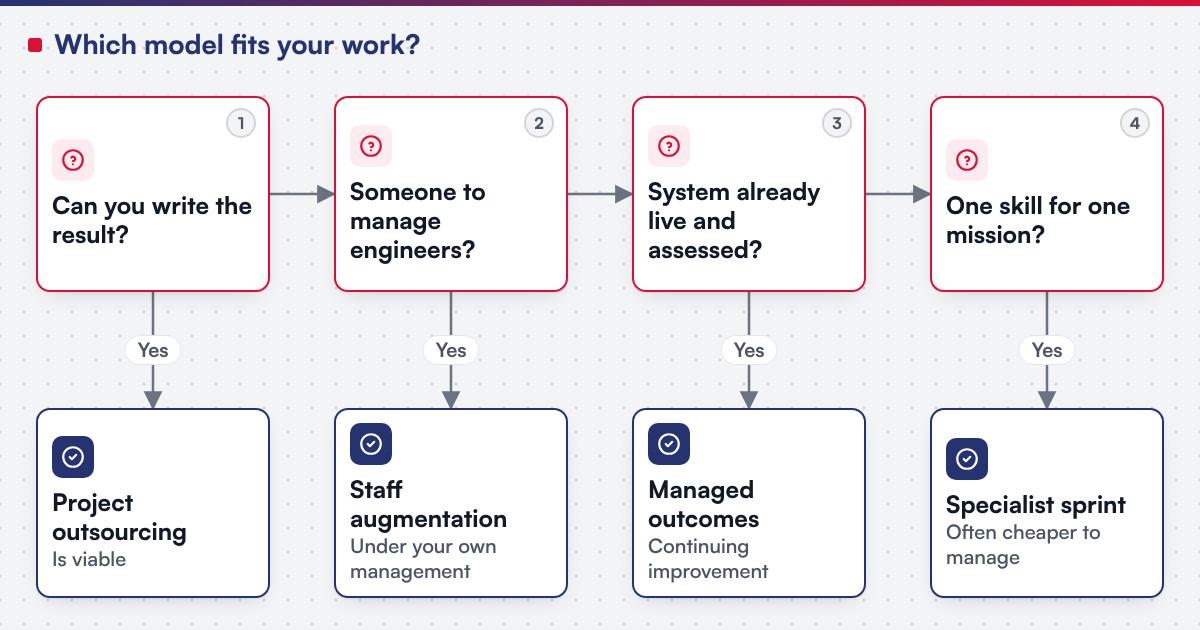 (opens the full-size diagram in a new tab)
Worked scenario: a marketplace founder deciding how to build
A founder wants a two-sided classifieds marketplace with accounts, paid listings, search, messaging and payments, live within about four months. There is no in-house engineering team, only the founder and an operations lead.
- Question 1. The founder can list the features and write acceptance tests for each. Project outsourcing is viable.
- Question 2. Nobody on the founder's side can manage developers daily. Staff augmentation would leave the founder running a team without the skills to review its work.
- Question 3. Nothing is live yet, so managed outcomes do not apply.
- Decision. A milestone project with a named delivery lead, then a support period after launch. Once the marketplace is live and the founder hires a product lead, the continuing roadmap can move to managed outcomes or to an in-house team with augmented developers.
The closest Netbase record matches this shape. For a founder (not named), Netbase delivered a bilingual English and Nepali classifieds platform: requirements, design, a Laravel backend with REST APIs, OTP accounts, paid ads, search, ratings, messaging, event ticket ads, a blog and forum, payments, multi-language SEO and AWS deployment. It was delivered in six milestones over four months with training and six months of support. The classifieds platform record documents delivered scope; it publishes no business result.
How does Netbase apply these models?
Most Netbase projects are agreed as fixed-scope contracts after discovery; milestone-based arrangements are also available. Netbase also offers dedicated development teams, on-demand support and fully managed delivery as secondary options. Delivery is remote-first: Netbase stays accountable while teams may combine Netbase staff, approved specialists or disclosed partners. The engagement models page sets out how each is contracted, and project delivery explains how a milestone project runs.
When the gap is leadership rather than capacity, fractional CTO and AI transformation advisory provides fractional or interim CTO, CIO and Chief Digital or Transformation Officer leadership, structured as agreed days each month over a 3 to 12 month term with written objectives and a handover to a permanent hire. This sits above the outsourcing-versus-augmentation choice: an advisory retainer can set the direction before either model is chosen, and engagement models shows where it fits alongside a project or a managed outcomes engagement. Where such an advisor recommends Netbase delivery teams, that interest is disclosed and the client decides. Both outsourcing routes compared here assume the work leaves your organisation; the in-house versus outsourced development guide steps back to that earlier choice, including a hybrid that keeps a core team in-house. Where the buyer is itself an agency reselling the work under its own brand rather than using it directly, the dynamics shift again; the white-label software development guide covers that confidentiality and ownership chain separately. Where the need is a standing team rather than one build, the offshore development centre guide covers what changes once dedicated capacity needs to run for years rather than a single project.
What legal and tax questions change with the model?
Staff augmentation puts individual contractors under your direction, which can change their status for tax and employment purposes in some countries. In the UK, for example, the off-payroll working rules make a medium or large client responsible for determining a contractor's employment status and issuing a status determination statement with its reasons (GOV.UK guidance, accessed 2026-09-28). A project contract with a company that directs its own people usually raises fewer of these questions, but the answer depends on your jurisdiction and the actual working arrangement, so take local advice before signing.
What should you ask each type of provider?
-
Who is accountable if a milestone fails acceptance?
A named delivery lead and the written next step
-
How are changes classified and approved?
Categories, an impact record and your written approval
-
What is handed over at the end?
Code, documentation, access and a walkthrough
-
What do you need from us before each milestone?
A list of inputs with dates
-
How are people replaced if they leave?
A notice and overlap arrangement in the contract
-
Who manages performance day to day?
A clear statement that you do, with provider support
-
Who owns the work product and access?
Your ownership, your accounts, provider access revoked on exit
-
Which country's employment rules apply?
A named contracting entity and a status position
The total software delivery cost guide helps compare the full cost of each route, including the management time staff augmentation needs from you. After signing, the remote delivery governance guide covers cadence, reporting and escalation for any model.
What goes wrong with each choice?
- Outsourcing a moving target. Signal: change requests in every review. Owner: the buyer's product owner, who either stabilises scope or changes model.
- Augmenting without a manager. Signal: augmented engineers ask each other what to do. Owner: the buyer's engineering lead.
- Calling augmentation a project. Signal: the contract says "deliver the platform" but bills time and gives the provider no decision rights. Owner: procurement, who aligns the contract with who really directs the work.
- No exit in either model. Signal: nobody can say what happens in the last month. Owner: both sides, who write the handover plan before work starts.
- Choosing by location, not by model. Signal: the debate is about countries, not responsibilities. Owner: the sponsor; global delivery covers the location questions separately.
How this comparison is sourced and where it stops
The comparison draws on Netbase's approved company facts about its commercial models and engagement options, one delivered classifieds record, and GOV.UK guidance on off-payroll working. The methodology explains how those records are reviewed. It does not rank providers and publishes no rates. The classifieds record is the published Netbase project closest to this scenario's shape, and the staff augmentation column describes that model as Netbase's approved engagement options define it.
Plan the next step for your project
Common questions
Not necessarily. Staff augmentation often looks cheaper per person, but the buyer carries the management time, the delivery risk and the cost of rework. A project contract includes delivery management and ties spending to accepted results. Compare the full cost of each route over the same scope before deciding.
Yes. The usual switch happens when a clear piece of work emerges from the backlog, such as a new module or a migration. That piece is scoped, given acceptance criteria and handed to a provider as a project, while augmented engineers continue on the rest.
No. You keep product decisions, priorities and acceptance. What moves to the provider is how the work is organised, who does it and the technical quality. Written change control keeps every change to scope, time or cost a decision you approve.
Managed outcomes fit a live system that needs continuing improvement, when you want one operator to plan and report against agreed objectives rather than direct individual engineers. They normally follow an accepted project, once the system's state is known and the objectives can be written.
Ownership is set by the contract, not by the model. Check that intellectual property created for you is assigned to you, that repositories and cloud accounts are in your name, and that any licensed components are listed. For custom development at Netbase, the client owns the IP created for it.
Choose the model before the provider
Bring the work, the result you need and who on your side can manage it. OutsourcingVN is Netbase's own outsourcing-services platform; submit a project and a person will say which model fits, including when that is not a Netbase project. Custom Product Engineering is the route for a bounded build.
Work behind this guide

Netbase delivered a bilingual classifieds marketplace, in English and Nepali, with paid ads, search, messaging, payments and an AI filter that flags offensive content into an administrator review queue. The client is not named, and no traffic, accuracy or commercial result is claimed.
Keep ReadingRelated services and solutions
 Custom product engineering for a bounded release outcome
One defined release of your product, built to named outcomes and handed over with acceptance evidence.
Learn More