

White-label software development for agencies
A white-label arrangement lets your agency keep the client relationship, the brand and the contract, while a delivery partner builds behind an agreed confidentiality line. Before the first ticket moves, settle who holds the code and the client material, who the client ever sees, how QA is signed off, and how either side exits.
Submit a project Compare engagement modelsReviewed by Huy Nguyen (David), CEO · Updated 14 Oct 2026 · 10 min read

Netbase is open to this model, and offers it directly through white-label development.
OutsourcingVN is operated by Netbase JSC, and this guide is written from the delivery-partner side of that arrangement, so read it as a description of what we would ask you to agree, not a sales pitch for a specific deal.
Contents
- What does "white-label" mean for a software build?
- Why would an agency choose this over hiring?
- What has to stay confidential, and how is that enforced?
- Who owns the intellectual property, and when does it move?
- Who holds what in a white-label engagement?
- How do you set up and run a white-label build?
- Worked scenario: an agency reselling a content-moderation rebuild
- What should you ask a white-label delivery partner before signing?
- What goes wrong in white-label delivery?
- Common questions
- Plan the arrangement before the first brief
What does "white-label" mean for a software build?
The agency sells the work, owns the relationship, and is the only party the client deals with; the delivery partner builds the product, the feature or the module without its own name appearing anywhere the client can see it. This differs from project outsourcing versus staff augmentation, which compares models for a buyer handling its own work directly: here, the agency is the buyer's single point of contact, and the partner's output passes through the agency's brand before the client sees it at all.
Beyond client projects, Netbase is open to technology and co-development partnerships, white-label development for agencies, co-build product partnerships, referral and reseller arrangements for Business Division products, and AI-first offshore development centres.
Why would an agency choose this over hiring?
An agency usually reaches for white-label delivery when a client need exceeds its own bench, a skill gap would take months to hire for, or a one-off project does not justify a permanent role. The commercial shape that follows from a bounded brief is usually a fixed-scope contract agreed after discovery, with milestone-based arrangements available for larger builds; dedicated development teams, on-demand support and fully managed delivery are secondary options once the relationship is proven. None of that is a reason to skip the groundwork below: a white-label partner is still a subcontractor you are accountable for, even though the client never hears its name.
What has to stay confidential, and how is that enforced?
Confidentiality is the one thing a white-label deal cannot get wrong, because the agency's credibility with its client depends on it. Contributors on the delivery side work under NDA, and NDAs and data processing agreements are available on request before any client material changes hands. Secure code review and version control, role-based access control and multi-factor authentication for admin dashboards are standard practice rather than a premium add-on, and the same controls apply whether the eventual user is the agency's client or the agency itself.
Put the confidentiality terms in writing before sharing a single client document: what the delivery partner may say about the engagement, to whom, and for how long after it ends. IP ownership in software outsourcing goes through the ownership half of this question in detail, and the same contract should name who may ever identify the client by name.
Who owns the intellectual property, and when does it move?
For custom development, the client who commissions the work owns the intellectual property created for it; a delivery partner's own productized modules are licensed rather than transferred, and they need to be identified before the agency's client accepts the proposal that sits on top of them. In a white-label chain this rule has to be stated twice: once between the delivery partner and the agency, and once between the agency and its own client, with the same licensed components called out in both places so nobody discovers a licence they did not know about after launch.
Who holds what in a white-label engagement?
Four things move between the delivery partner and the agency at different points: confidential material, the code and its IP, the accounts the build runs on, and the QA approval the client never sees happen. The table below sets out who holds each asset today, how that control is confirmed, and who acts on it once a milestone is accepted at handover.
| Asset | During build | Confirmed by | At handover |
|---|---|---|---|
| Confidential client material | Held under NDA by the delivery partner | Signed NDA and access log | Returned or destroyed on exit |
| Source code and IP | Written to the agency repository | Milestone acceptance | Agency owned repository |
| Accounts and access | Named accounts under the delivery partner | Access register entry | Transferred to the agency |
| QA approval | Delivery partner test evidence | Agency review before release | Agency releases to the client |
Treat every row as a contract clause, not a convention: an account the delivery partner can still reach after a milestone is accepted is the single most common way a white-label arrangement quietly fails.
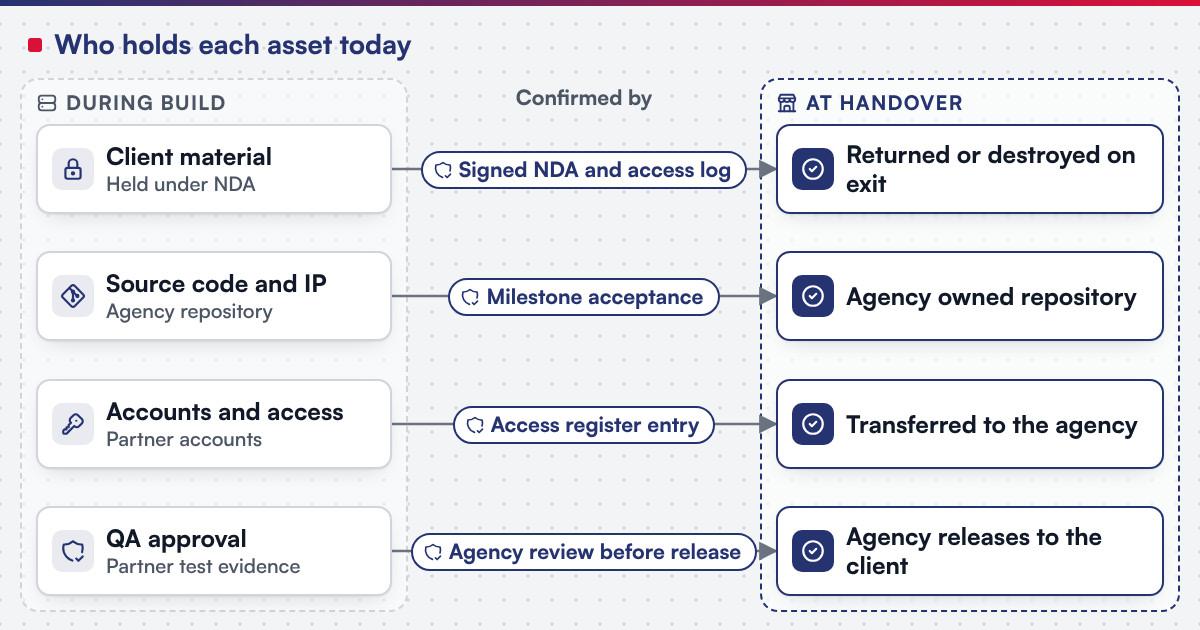 (opens the full-size diagram in a new tab)
How do you set up and run a white-label build?
-
Define the brand boundary
Agree in writing what the delivery partner may never put its name on, and what the agency may say about who built it, before any work starts.
-
Stand up accounts the agency controls
Repositories, cloud accounts and any third-party services are created in, or transferred early to, accounts the agency owns, with the delivery partner working inside them under named, logged access.
-
Route communication through one channel
Delivery communication runs in English with a named project manager and a weekly written review, so the agency always has one place to ask what changed and why; see remote delivery governance for the cadence and escalation detail, and global delivery for how the underlying team is composed across locations.
-
Build and test behind the line
The delivery partner's own QA runs first; only reviewed, agency-approved work reaches anything the client can see, so a defect never surfaces as the agency's own mistake.
-
Plan the exit before the first milestone
Decide what happens to accounts, repositories and support obligations if the agency moves the work elsewhere, or if the arrangement simply ends.
Worked scenario: an agency reselling a content-moderation rebuild
A digital agency has a retained client running an online marketplace whose moderation queue cannot keep up with new listings. The agency has no AI or trust-and-safety engineers on staff and does not want its client to know it is subcontracting the build. It scopes the rebuild itself, signs an NDA with a delivery partner, and keeps every client call on its own side.
The closest published example of this shape of work is the online classifieds platform record, which shows the kind of moderation and workflow build a delivery partner can carry behind someone else's front end. The agency uses that record, not a client name, to judge whether the partner's experience fits; the delivery partner never speaks to the agency's client directly, and every deliverable is reviewed by the agency before release, exactly as the table above sets out.
What should you ask a white-label delivery partner before signing?
Use the same discipline as any vendor shortlist, with white-label specific additions: vendor evaluation criteria covers the general list, and these questions cover the parts that are unique to reselling under your own brand.
- Who, by name, may ever see our client's identity, and what happens to that access when the engagement ends?
- Which accounts will be created in your name rather than ours, and when do they move to us?
- What does your QA sign off before we see a build, and what evidence do we get of it?
- If we move this work to another partner, what do we receive, and in what format?
- Which engagement model governs this: a fixed-scope project, a milestone plan, or a dedicated team? Engagement models explains what each implies for who directs daily work.
What goes wrong in white-label delivery?
- An account the partner never released. Signal: a login still works after the agency "owns" the system. Owner: the agency's technical lead, who should run the handover test from the handover and exit guide before calling the transfer complete.
- A licensed component nobody flagged. Signal: a dependency surfaces in a licence audit the agency never budgeted for. Owner: whoever signed the contract, who should have required every licensed module named up front.
- The client finds out by accident. Signal: a support email, a code comment or a status page leaks the delivery partner's name. Owner: both project managers, who should have agreed the brand boundary in writing, not by assumption.
- No named point of contact. Signal: questions bounce between people with no owner. Owner: the agency, which should insist on the same named project manager and weekly review it would expect from any remote team.
- Scaling into a dedicated team with no new contract. Signal: a one-off build quietly becomes ongoing capacity nobody re-scoped. Treat dedicated development teams and fully managed delivery as deliberate choices, not a drift from the original brief; an offshore development centre is the deliberate version of standing capacity, set up and governed as its own decision.
Plan the next step for your project
Common questions
Not under a white-label arrangement. The agency stays the only party the client deals with, and the contract should say so explicitly rather than leaving it as an assumption.
Yes. A bounded module, under the same confidentiality and IP terms as a full build, is scoped the same way; Custom Product Engineering covers a fixed-scope build of either size.
The delivery terms are similar; what changes is the confidentiality clause (who may ever name the client or the partner) and the brand clause (what may carry whose name). Add both to whatever contract you would otherwise use.
That is a deliberate decision, not a default. Dedicated development teams and fully managed delivery are offered as secondary options once the relationship is proven, and the shift should be re-scoped and re-contracted, not assumed.
Ask the questions above, plus the general vendor evaluation criteria, and ask for a sample handover pack as part of selection rather than after signature.
Plan the arrangement before the first brief
For how we source the claims on this page, see our methodology. OutsourcingVN is operated by Netbase JSC and is Netbase's own outsourcing-services platform; submit a project and say that it is a white-label brief so the proposal comes back with the confidentiality and brand terms already in it.
Work behind this guide

Netbase delivered a bilingual classifieds marketplace, in English and Nepali, with paid ads, search, messaging, payments and an AI filter that flags offensive content into an administrator review queue. The client is not named, and no traffic, accuracy or commercial result is claimed.
Keep ReadingRelated services and solutions
 Custom product engineering for a bounded release outcome
One defined release of your product, built to named outcomes and handed over with acceptance evidence.
Learn More
 White-label development for agencies and partners
Software built under your brand, with Netbase delivering behind an NDA and a defined exit.
Learn More