

Offshore development centre: when and how to set it up
An offshore development centre is a dedicated, long-running team under one delivery owner, set up for years rather than one project, with governance, ownership and an exit written in from the start. It fits once the work has outgrown a single project; it is a secondary option, not Netbase's default of milestone project delivery, and never a new office.
Submit a project Compare engagement modelsReviewed by Huy Nguyen (David), CEO · Updated 14 Oct 2026 · 10 min read

OutsourcingVN is operated by Netbase JSC, which sells milestone project delivery as its default engagement and offers a dedicated team as a secondary option, so read this guide as a description of what we would set up, not a sales pitch for one.
Contents
- What is an offshore development centre, and when does it fit?
- What does "AI-first" mean for a centre like this?
- Does a centre mean a new Netbase office near us?
- How does a centre start, run and transfer?
- Worked scenario: a standing partnership on one platform
- How is a centre governed day to day?
- Who owns the code, and what happens at transfer?
- What should you ask before committing to a centre?
- What goes wrong with offshore development centres?
- Common questions
- How this guide is sourced and where it stops
- Set up the centre properly before you scale it
What is an offshore development centre, and when does it fit?
A centre is a standing team, not a single deliverable: the same people work your roadmap continuously, under a named governance structure, for as long as the relationship runs. Some centres carry a build-operate-transfer path, where the buyer takes ownership of the team and its operation at an agreed point; others stay a managed, standing arrangement indefinitely. Netbase also offers dedicated development teams, on-demand support and fully managed delivery as secondary options; most Netbase projects are still agreed as fixed-scope contracts after discovery, and a centre is the model to reach for once a backlog is wide and continuous enough that a single project no longer fits it.
A centre differs from the two comparisons already on this site. Project outsourcing versus staff augmentation compares a bounded project against directing extra people yourself; a centre is neither, because it is a standing, Netbase-managed team rather than a one-off delivery or your own day-to-day management. In-house versus outsourced development compares building the capability yourself against buying it; a centre with a transfer path is one way to convert the second into the first on a planned date. It is also not a white-label arrangement: a centre works under your own governance and reports to you directly, where a white-label build keeps a reselling agency between the delivery team and the end client.
What does "AI-first" mean for a centre like this?
Beyond client projects, Netbase is open to AI-first offshore development centres: standing teams built from the outset around AI-assisted engineering under human review, rather than a traditional team that adopts AI tooling later. AI-assisted software delivery sets out the practice such a centre would run under, and AI engineering enablement is the service for a buyer whose own in-house team wants the same capability without standing up a separate centre.
Does a centre mean a new Netbase office near us?
No. Netbase JSC's head office is in Hanoi, Vietnam, and it is the company's only office. A dedicated centre is organised as a standing team working from Hanoi under its own governance structure; it does not imply a new Netbase office, a client-site facility, or a local legal entity in your market. Where a project genuinely needs people on your site, that is scoped as its own activity, separately from the centre's standing structure.
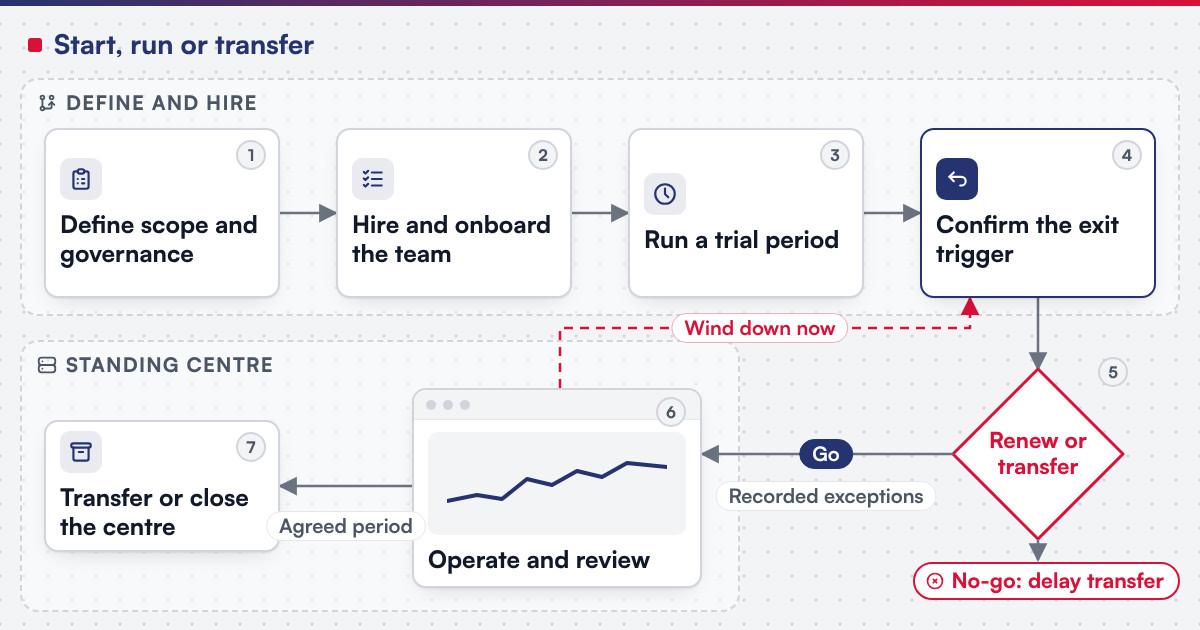
How does a centre start, run and transfer?
-
Define scope and governance
decide what the centre owns, who reports to whom, and which decisions stay with the buyer before anyone is hired.
-
Hire and onboard the team
recruit the core roles under NDA and role-based access, with a named lead on both the buyer's side and the centre's side.
-
Run a trial period
as a bounded first phase with written acceptance criteria, not an open-ended ramp into permanent headcount.
-
Confirm the exit trigger
agree in writing what signals an early wind-down now or a transfer later, before the centre is relied on for anything critical.
-
Renew or transfer
Go: continue the centre for an agreed further period with recorded exceptions. No-go: delay transfer to a new date instead.
-
Operate and review
run the standing centre through an agreed period of reporting, access review and milestone evidence.
-
Transfer or close the centre
hand over the team, code, accounts and documentation, or wind the engagement down in an orderly way.
Treat step four as the one that protects you: a centre with no written exit trigger tends to continue by default rather than by decision. The handover and exit guide lists what a transfer or close-out should contain in full.
 (opens the full-size diagram in a new tab)
Worked scenario: a standing partnership on one platform
Since 2020, Netbase has worked as offshore development and managing partner on a multi-tenant cloud ERP SaaS platform for a US client that is not named, rather than as a single delivered release. Phase one, running from 2020 to 2023 for agency SMEs, covered CRM, real-time messaging, HR, a knowledge base, custom fields and workflows, work and project management, and API integrations. The relationship continued past a single milestone because the scope kept growing, which is the shape a centre is for: not a bigger one-off project, but a standing team that keeps building on the same platform. The multi-tenant cloud ERP record has the delivered scope; it is the closest published example of this shape, not a guarantee that every centre runs for the same number of years.
How is a centre governed day to day?
Netbase delivers remote-first from Hanoi in Agile increments with weekly reviews, using AI-assisted engineering under human review, and the same cadence applies to a standing centre. Netbase project teams typically range from 3 to 30 people combining business analysis, project management, solution architecture, development, QA and UI/UX, so a centre's size should be agreed as a named range rather than left open. The Hanoi office works Monday to Saturday, 9:00 to 18:15 Vietnam time (UTC+7); time-zone collaboration in Vietnam sets out how an overlap window, written updates and escalation are agreed so a standing team does not drift out of sync with a buyer on the other side of the world. Once that window is set, remote software delivery governance covers the weekly cadence, reporting and escalation route that keep a centre's day-to-day work visible.
Security practices carry over unchanged from a project: secure code review and version control, role-based access control, multi-factor authentication for admin dashboards, contributors under NDA, and NDAs and data processing agreements on request. A centre simply runs these continuously rather than for one project's duration, which makes the access register and its review cadence more important, not less.
Who owns the code, and what happens at transfer?
For custom development, the client owns the intellectual property created for it; Netbase's own productized modules are licensed rather than transferred, and a centre should list any of those it relies on before the first sprint, not at transfer. If the centre carries a build-operate-transfer path, the transfer itself should follow the same rebuild-and-verify test as any handover: can a team that did not build the system run it from what is handed over, in an environment the outgoing team does not control. Handover and exit covers that test and the exit clauses worth agreeing before the centre starts, not at the point you need them.
What should you ask before committing to a centre?
- What is the minimum term before either side can trigger a wind-down or a transfer, and what does each cost in time and access?
- Who, named, owns which decisions: the centre's lead, or your own product owner?
- If the centre has a transfer path, what exactly transfers: people, accounts, code, or all three, and on what date?
- How does the centre's governance differ from a single project's, beyond simply running longer? Engagement models compares every model Netbase offers side by side.
- If your interest is Vietnam specifically rather than the centre model itself, does the Vietnam outsourcing guide answer the country question separately from this one?
What goes wrong with offshore development centres?
- No exit trigger was ever written. Signal: the centre has run for years with nobody able to say what would end it. Owner: the buyer's sponsor, who should set the trigger at the start, not when the relationship sours.
- The centre becomes a headcount line with no governance. Signal: nobody can name what the centre is accountable for this quarter. Owner: both leads, who should re-agree scope and governance at each renewal.
- Transfer is assumed rather than planned. Signal: "we'll transfer it eventually" with no rebuild test, no named date and no budget for the work. Owner: the buyer, who should scope transfer like any other handover.
- Treating the centre as a new office. Signal: a buyer assumes local legal presence or round-the-clock local coverage because the team feels permanent. Owner: whoever manages the relationship, who should restate that Hanoi remains the only Netbase office.
- Scaling before the trial period proves the fit. Signal: headcount grows before the first milestone is accepted. Owner: the sponsoring executive, who should hold the trial period's acceptance criteria before approving growth.
Plan the next step for your project
Common questions
No. Staff augmentation puts people under your own daily management; a centre is a standing team Netbase manages and governs, reporting against agreed objectives rather than your direct instruction.
No. Project delivery stays the default engagement model; a centre is a secondary option for continuous, wide-ranging work that no longer fits inside one project's scope.
Netbase is open to building one that way: standing teams designed around AI-assisted engineering under human review from the outset. That is an offer, not a record of a named client doing it today.
The exit trigger agreed at setup governs this. A centre with a written trigger and a tested handover process ends like any other engagement; the risk is only in centres that never wrote one down.
No. Netbase's head office is in Hanoi, Vietnam, and the centre is organised as a dedicated team working from there under its own governance, not a new office or local entity.
How this guide is sourced and where it stops
The multi-tenant cloud ERP record is the closest published example of a long-running delivery relationship; it does not establish a typical duration or team size for every centre.
Set up the centre properly before you scale it
Bring the scope you expect to keep growing, the governance you want in place, and the exit you are planning for even if you never use it. OutsourcingVN is Netbase's own outsourcing-services platform; submit a project and describe the standing work, and a person will reply with whether a centre, a project or a dedicated team fits it better.
Work behind this guide

Since 2020, Netbase has worked as offshore development and managing partner on a multi-tenant cloud ERP that a US software company offers as SaaS to small and mid-sized businesses.
Keep ReadingRelated services and solutions
 Custom product engineering for a bounded release outcome
One defined release of your product, built to named outcomes and handed over with acceptance evidence.
Learn More
 Dedicated development teams run by Netbase
A named Netbase team directed by your product owner, with Netbase accountable for staffing and governance.
Learn More