

In-house vs outsourced software development: who runs it, who owns it
Build in-house when the skill is permanent to your product and you can hire, manage and keep the people who will run it for years. Outsource when you need a bounded result faster than you can hire for it, or the skill is needed once rather than kept. A hybrid keeps what differentiates you inside and outsources the rest.
Submit a project See the related serviceReviewed by Huy Nguyen (David), CEO · Updated 18 Oct 2026 · 10 min read

OutsourcingVN is operated by Netbase JSC, which sells outsourced project delivery and a fractional leadership retainer, so this comparison is written by a supplier with an interest in the outsourced and hybrid answers. The criteria below work for any provider, including the choice to stay entirely in-house.
Contents
- What exactly are the three routes?
- Who owns and runs what under each option?
- How do you decide?
- Worked scenario: a seed-stage fintech choosing its first build
- What capacity does outsourcing actually add?
- Which questions should you ask before choosing?
- What goes wrong with each route?
- How this guide is sourced and where it stops
- Common questions
- Decide the route before you scope the build
What exactly are the three routes?
An in-house team is engineers you hire, manage and keep on payroll indefinitely; the skill stays inside your organisation for as long as the people do. An outsourced project hands a defined, turnkey piece of work to a provider that owns delivery until an agreed handover; you pay for an accepted result, not headcount. A hybrid keeps a small in-house core that owns the roadmap and the part that differentiates you, while an outsourced team builds the rest. None of the three is free of management: the question is which kind of management you want to carry, not whether to carry any.
Who owns and runs what under each option?
Every option trades starting speed against day-to-day control: the faster you can start, the less you directly control who does the work and how.
| Criterion | Outsourced project | Outsourced team | Hybrid: in-house core, outsourced build | Full in-house team |
|---|---|---|---|---|
| Who directs daily work | The provider's delivery lead | Your own managers, daily | Your lead for the core; the provider's lead for the built piece | Your own managers, daily |
| Where the code and data sit | With the provider until handover | With you, since your managers hold the keys | The core stays with you; the built piece transfers at handover | With you from the first day |
| Time to start building | Weeks, once scope is agreed | Weeks, once roles are agreed | Weeks for the built piece; the core waits on hiring | Months, for hiring and onboarding |
| Where the knowledge ends up | Mostly with the provider unless a handover is written in | Mostly with you, since your managers directed it | The core knowledge stays; the built piece needs a written handover | Entirely with you, for as long as the team stays |
| Exit | A planned handover at project end | A notice period, then the people leave | Two exits: the hired core stays, the built piece hands over | Staff leave or the team is restructured |
The question in every row is who runs the work day to day and who owns the result afterwards; the provider-run columns start fastest, the in-house column keeps the most control.
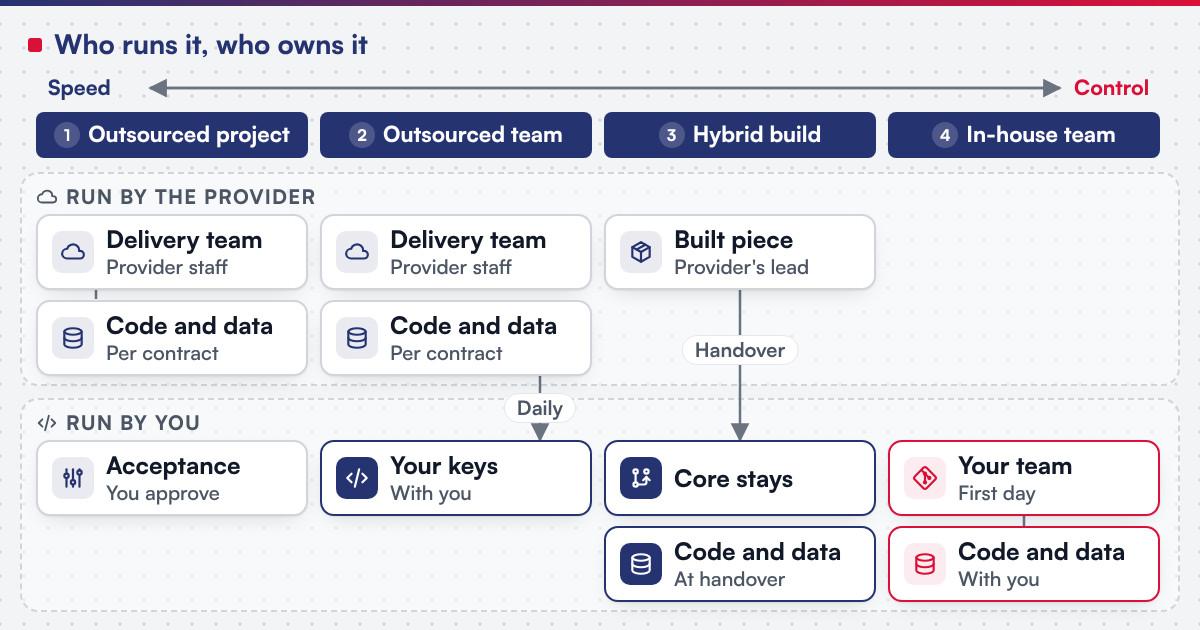 (opens the full-size diagram in a new tab)
How do you decide?
- Write down what must stay inside your organisation. Core product logic, proprietary rules or anything you cannot risk losing access to points toward in-house or a hybrid core.
- Check your hiring runway against your deadline. If you cannot hire, onboard and reach productive output before the deadline, an outsourced project or a hybrid build closes that gap faster.
- Count the roles you would need to hire and keep. A single skill for one build is usually cheaper outsourced; several permanent roles across a growing roadmap usually justify hiring.
- Decide who manages the work day to day. In-house needs your own technical management; an outsourced project shifts that to the provider's delivery lead; a hybrid splits it between the two.
- Write the exit before you start. An in-house team's exit is a resignation or a restructuring; an outsourced project's exit is a planned handover; name which one you are planning for, and whether a live system then moves to a managed outcomes arrangement for continuing improvement.
Worked scenario: a seed-stage fintech choosing its first build
A seed-stage fintech has two founders, no engineers yet, and six months of runway to ship a lending product before its next funding round. Hiring a founding engineering team would take two to three months before anyone writes a line of code, which the runway cannot absorb.
The founders choose a hybrid: an outsourced project builds the first lending product end to end, while they hire one in-house product engineer during the build to absorb the domain knowledge and own the roadmap afterwards. At handover, the in-house hire already knows the codebase from sitting in weekly reviews, and the next round of hiring builds a team around that person rather than starting cold. Had the funding round already closed with two years of runway instead of six months, hiring first and outsourcing nothing would have been the stronger choice, because the time to hire would no longer be the binding constraint.
What capacity does outsourcing actually add?
Netbase project teams typically range from 3 to 30 people combining BA, PM, solution architecture, development, QA and UI/UX, so an outsourced or hybrid build can add several disciplines at once that an early in-house hire would otherwise cover alone. Netbase delivery communication is in English, and Netbase delivery runs with weekly reviews and a named project manager, the same reporting rhythm an in-house lead should expect from any outsourced work.
Netbase delivers remote-first from Hanoi in Agile increments with weekly reviews, using AI-assisted engineering under human review, as the global delivery model sets out. Remote-first project delivery: Netbase stays accountable while teams may combine Netbase staff, approved specialists or disclosed partners. Netbase also offers dedicated development teams, on-demand support and fully managed delivery as secondary options when a single project is not the right shape, with the offshore development centre guide covering the standing version of that capacity. Netbase clients are in the United States, Europe and Asia-Pacific, and most projects come from clients outside Vietnam; for buyers weighing a Vietnam-based delivery partner specifically, the Vietnam outsourcing guide covers the governance questions and checks that matter, and time-zone collaboration in Vietnam sets out the overlap window a remote team needs regardless of which route you choose.
Which questions should you ask before choosing?
- For an outsourced project: who exactly hands over at the end, and in what format? The handover and exit guide lists what to secure before signing.
- For an outsourced project: is scope fixed before or after discovery? Most Netbase projects are agreed as fixed-scope contracts after discovery; milestone-based arrangements are also available.
- For a hybrid build: who owns the roadmap once the outsourced piece is delivered, and is that written into the contract?
- For an in-house hire: can you describe the role precisely enough to hire for it in your timeline, or would a specialist sprint close the gap faster while you hire?
- For any route: what does total delivery cost look like over five years, including management time, not just the first invoice?
What goes wrong with each route?
- Hiring too early. Signal: a new hire sits idle waiting on a product decision that was never made. Owner: the sponsoring executive, who should outsource the first build and hire once the roadmap is proven.
- Outsourcing the part that differentiates you. Signal: the one rule that wins deals is the one piece built by a provider with no handover plan. Owner: the product owner, who should keep that piece in-house or inside a hybrid core.
- No handover written down. Signal: nobody can say what format the code, credentials and documentation arrive in. Owner: both sides, who should write the exit before signing.
- Treating a hybrid as free. Signal: the in-house hire and the outsourced team both assume the other owns integration testing. Owner: whoever manages the hybrid, who should name the seam in writing.
- Comparing hiring cost to an invoice only. Signal: the in-house option "looks cheaper" because recruiting, benefits and management time were never counted against the same scope.
How this guide is sourced and where it stops
The multi-tenant cloud ERP record and the classifieds platform record are the closest published examples of Netbase holding delivery responsibility on a build; each page states its own scope and limits, and neither is evidence that every hybrid or in-house arrangement works the same way. The fintech scenario above is illustrative and describes no client.
Plan the next step for your project
Common questions
No. A hybrid adds a second relationship to manage: the seam between the in-house core and the outsourced piece. It earns that complexity only when something genuinely needs to stay in-house while the rest needs speed.
Ownership is set by the contract, not by the label. For custom development the client owns the IP created for it; Netbase productized modules and products are licensed, not transferred.
Yes. An outsourced project's handover is the natural switch point into in-house ownership; an in-house team that needs to move faster for one release can add an outsourced or hybrid build without giving up the core. Engagement models compares how each shape is governed.
No. Outsourcing moves who writes the code and runs the day-to-day work; product decisions, priorities and acceptance stay with you under a project model, and a written change-control process keeps any change to scope, time or cost a decision you approve, not something that happens to you.
When the skill is permanent to the business, the roadmap is long enough to justify hiring and onboarding, and you already have someone who can manage the person day to day; otherwise, an outsourced project or a fractional CTO covers the gap while you build toward that hire.
That is one of the clearest signals for a full project model over staff augmentation; the project outsourcing versus staff augmentation comparison works through that management-capacity question in depth.
Decide the route before you scope the build
Bring the roles you would need to hire, the piece that differentiates you, and your real deadline. Engagement models compares the ways to work with Netbase once you know which route fits, Custom Product Engineering is the service that delivers an outsourced or hybrid build, and a fractional CTO retainer can help set the roadmap first if nobody in-house owns it yet.
OutsourcingVN is Netbase's own outsourcing-services platform. Submit a project with the piece you have decided to outsource, keep or combine, and a person will reply with what discovery would need to confirm first.
Work behind this guide

Since 2020, Netbase has worked as offshore development and managing partner on a multi-tenant cloud ERP that a US software company offers as SaaS to small and mid-sized businesses.
Keep Reading
Netbase delivered a bilingual classifieds marketplace, in English and Nepali, with paid ads, search, messaging, payments and an AI filter that flags offensive content into an administrator review queue. The client is not named, and no traffic, accuracy or commercial result is claimed.
Keep ReadingRelated services and solutions
 Fractional CTO and AI transformation advisory: leadership without a full-time hire
Technology and AI transformation leadership on a monthly retainer, with a handover to a permanent hire.
Learn More