

Build vs buy AI agents for ecommerce operations: decide per job
Buy a packaged AI assistant when the job lives inside one platform, uses that platform's own data and needs no actions beyond what the vendor exposes. Build a custom agent when the job crosses systems, such as the store, an ERP, a warehouse and a helpdesk, needs your own permission rules or must follow business logic no product ships.
Submit a project See e-commerce and ERP integrationReviewed by Huy Nguyen (David), CEO · Updated 13 Nov 2026 · 9 min read

This guide is for CTOs, founders and ecommerce managers deciding how to put AI agents into order handling, catalogue maintenance and customer support. OutsourcingVN is operated by Netbase JSC, which builds custom agents and integrations, so it has an interest when the answer is "build"; the criteria below are written to give the "buy" answer whenever it fits. It is a spoke of the AI agent development services guide and the AI workflow automation buyer's guide.
Contents
- Why decide per job rather than per platform?
- Which ecommerce agent jobs favour buying, and which favour building?
- Which criteria tip the decision?
- What does a hybrid route look like?
- What data plumbing does a custom ecommerce agent need?
- Which Netbase work is closest to a custom commerce agent?
- Which questions should you ask before you buy or build?
- How this guide is sourced
- Common questions
- Choose per job
Why decide per job rather than per platform?
Most commerce teams meet AI first as a feature inside a tool they already pay for: a writing assistant in the store admin, a reply suggester in the helpdesk, a forecast in the inventory app. Those features are a reasonable default. The question is not "build or buy AI" across the business; it is whether each operational job can be done well by an assistant that only sees one system.
The general build-versus-subscribe logic is set out in the custom build versus SaaS guide: subscribe when the capability is common and your process can adapt, build when it differentiates you or the integration makes a subscription unworkable. Agents add one more variable. An agent acts, so the decision also turns on what it is allowed to change and who controls that permission. OWASP's LLM06 entry on excessive agency advises limiting the permissions an agent's extensions hold to the minimum necessary; with a packaged assistant, the vendor decides how fine-grained those permissions can be.
Which ecommerce agent jobs favour buying, and which favour building?
The table compares common operations jobs. "Buy" means an assistant packaged in the platform or an add-on; "build" means a custom agent connected to your systems.
| Job | Buy fits when | Build fits when |
|---|---|---|
| Order status replies | Orders and tracking live in one platform the helpdesk reads | Status depends on ERP, warehouse and carrier data together |
| Returns and refunds triage | The platform's own return flow covers your policy | Policy varies by product, channel or customer and needs your rules |
| Catalogue descriptions | Copy is drafted per product inside the store admin | Content draws on supplier feeds, PIM data and channel-specific rules |
| Catalogue data checks | Checks are the platform's built-in validations | You need cross-checks between store, ERP and supplier data |
| Inventory alerts | One store, one stock source | Several stores or warehouses must reconcile |
| Support first reply | Answers come from a help centre the tool indexes | Answers need order, account and policy data with permission filtering |
| B2B order entry | Not usually packaged | Orders arrive by email or file and must be checked against contract terms |
The pattern is consistent: a single-system job with standard logic favours buying, and a cross-system job with your own rules favours building. For order flows that already cross the store and an ERP, e-commerce and ERP integration is often the first step, because an agent can only act on data that is in sync.
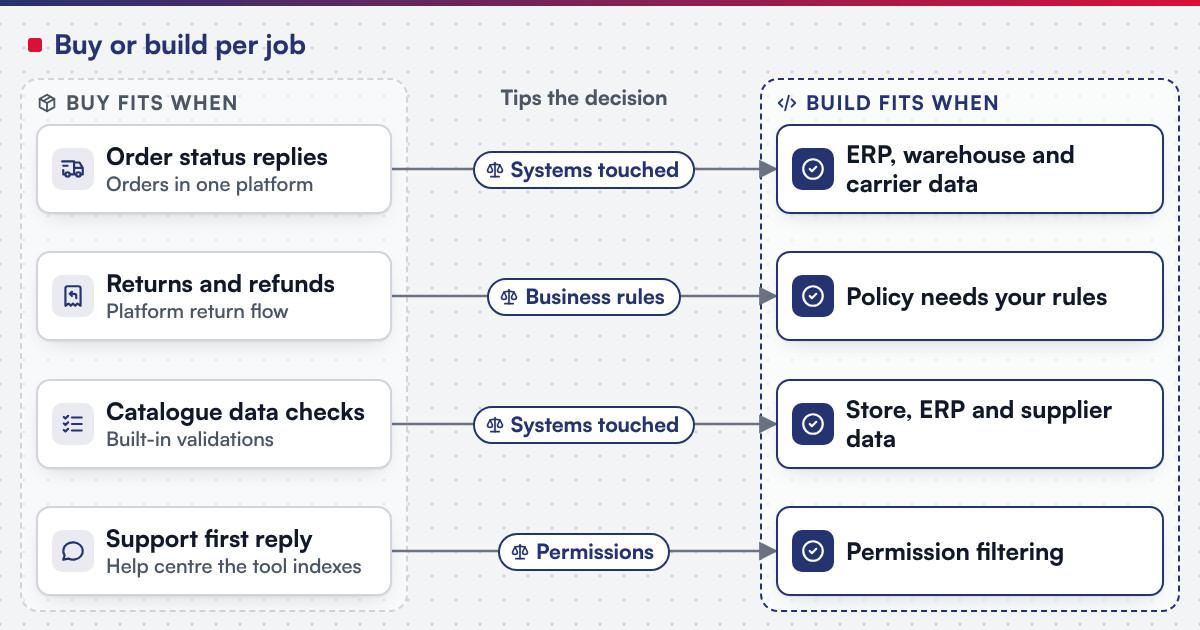 (opens the full-size diagram in a new tab)
Which criteria tip the decision?
-
Systems touched
- Points to buying
- One platform
- Points to building
- Two or more systems
-
Business rules
- Points to buying
- Platform defaults are acceptable
- Points to building
- Rules are specific to your business
-
Permissions
- Points to buying
- Vendor roles are fine-grained enough
- Points to building
- You need per-tool, per-field limits and your own approvals
-
Evaluation
- Points to buying
- The vendor's quality is acceptable on your cases
- Points to building
- You need your own evaluation set and thresholds
-
Data location
- Points to buying
- Vendor processing is acceptable
- Points to building
- Data must stay in systems you control
-
Ownership
- Points to buying
- Renting the capability is acceptable
- Points to building
- You want to own and change the agent
-
Exit
- Points to buying
- Switching tools later is easy
- Points to building
- The workflow would be hard to move
Score each row honestly. If most rows point to buying, buy, run the packaged assistant against a sample of your own cases and keep the rules in AI workflow evaluation and testing in mind for when it changes. If most point to building, the guide to scoping an AI agent project is the next step.
What does a hybrid route look like?
Many stores end up with both. The packaged assistant handles single-system tasks inside its own tool, and a custom agent handles the cross-system jobs, reading from the same store through its API. Anthropic's "Building effective agents" recommends finding the simplest solution possible and only increasing complexity when needed; for commerce, that usually means using the packaged feature until a specific job proves it cannot be done there.
The hybrid route needs two disciplines. Each agent's permission map must be written down so two tools do not both act on the same order, and the tool permissions guide gives a template. And a person must stay on the actions that cost money or reach customers, as human-in-the-loop AI workflows describes.
What data plumbing does a custom ecommerce agent need?
A custom agent reacts to events and reads current data. Shopify's developer documentation describes webhooks as a way for an app to subscribe to topics and receive near-real-time data about events on a shop, with examples such as informing shipping companies about changes in orders, returns or refunds. The same page warns that an app should not rely on receiving data from webhooks, because delivery is not always guaranteed, and recommends reconciliation jobs that periodically fetch data so the app stays consistent.
That advice applies to agents on any platform: trigger on events, but check the current record before acting, and run reconciliation so a missed event does not leave a customer waiting. Netbase's ERP consultancy and development experience covers Odoo consultancy and customization, cloud ERP platform development, e-commerce integration with ERP by API synchronisation of product catalogues, inventory, orders and customer data, a Vtiger CRM to ERP upgrade covering customer experience management, sales orders, workforce administration, support tickets, product management, resource allocation and budget planning, and Redmine to ERP development; modules built include finance and accounting, inventory, sales orders, HR and recruiting, CRM, project planning, e-commerce integration and reporting.
Store-side builds sit under e-commerce development, and support automation that combines a packaged helpdesk with custom steps is covered by customer support automation.
Which Netbase work is closest to a custom commerce agent?
For a client that is not named, Netbase built a WhatsApp Business AI chatbot with intent and conversation-flow handling, an LLM API (GPT-4 in the stack) and CRM synchronisation for lead capture, customer data and workflow automation. The WhatsApp chatbot record is the published example closest to a custom assistant that writes to a business system.
When the answer is to build, ownership matters. For custom development the client owns the IP created for it; Netbase productized modules and products are licensed, not transferred.
Which questions should you ask before you buy or build?
- Can the packaged assistant run on a sample of our real cases? If not before purchase, ask for a trial period long enough to score it.
- Which actions can it take, and can we restrict them per role? A tool that can refund but cannot be limited is a risk.
- Where is our data processed, and can we export the configuration? This decides the exit cost.
- For a build: which systems will the agent read and change? Each one needs an account, a permission and a test.
- For a build: what evaluation set and thresholds will accept it? Without them, acceptance becomes an opinion.
How this guide is sourced
The webhook behaviour and reconciliation advice come from Shopify's developer documentation; the permission advice from OWASP LLM06 (2025 edition); the simplicity advice from Anthropic's "Building effective agents". Netbase statements are approved claim-register entries, reviewed as the methodology describes. The job table reflects common commerce operations and names no product's feature list.
Plan the next step for your project
Common questions
Not necessarily over the life of the workflow. A packaged assistant costs less to start; a custom agent can cost less to change when your rules move often. Compare both against the same evaluation cases and the same time horizon.
Yes, if each has a written permission map and they never act on the same record without a rule deciding which one goes first.
Usually the one with high volume, clear rules and cheap mistakes, such as order-status replies drafted for a person to send.
If order, stock or customer data is split across systems and not in sync, yes; the agent will otherwise answer from stale data.
The code, prompts, tool configuration, evaluation set and runbook, listed in the contract and delivered to your own repository.
Talk to Huy Nguyen (David), Founder and CEO of Netbase JSC: message him on WhatsApp at +84 937 869 689 or email project@netbasejsc.com. You can also send your brief through the project request form. Say which workflow or system the project concerns and what has to stay unchanged; the first step is a discovery conversation, and scope and milestones are agreed after it.
Choose per job
Write down the job, the systems it touches and the actions it needs, then score it against the criteria table. AI Workflow Automation is the service that builds custom agents with human control when the score points to building.
OutsourcingVN is Netbase's own outsourcing-services platform. Submit a project with the job you want to automate and the tools you already use, and a person will reply with whether it is a build, a buy or both.
Work behind this guide

Netbase designed and built an AI chatbot on WhatsApp Business that handles intents and conversation flows and keeps lead and customer data in step with the client's CRM, delivered in milestones from prototype to knowledge transfer.
Keep ReadingRelated services and solutions
 AI workflow automation with evaluation and human control
One operating workflow automated, with an agreed way to judge it and a person on uncertain cases.
Learn More