

Custom build or SaaS: choosing the route for a new business capability
Subscribe to SaaS when the capability is common, your process can adapt to the product and the vendor's data and exit terms are acceptable. Build custom software when the capability differentiates you, the process cannot bend, or the integration and data rules make a subscription unworkable. Many organisations land in between: a platform customised, or SaaS extended.
Submit a project See the related serviceReviewed by Huy Nguyen (David), CEO · Updated 15 Oct 2026 · 9 min read

OutsourcingVN is operated by Netbase JSC, which earns its revenue from custom builds and platform customisation, so it has an interest in the "build" answer. The criteria below are written to be usable against that interest, and the most common right answer for a generic need is still "subscribe".
Contents
- What exactly is being compared?
- How do the routes compare?
- How do you make the decision?
- Worked scenario: field quoting for a signage installer
- What do Netbase records show about each route?
- Which questions should you ask a supplier or vendor?
- What goes wrong with each route?
- How this guide is sourced and where it stops
- Common questions
- Decide the route before you scope the build
What exactly is being compared?
SaaS, in NIST's definition, is the provider's application used over a network, where the consumer does not manage the underlying infrastructure or even individual application capabilities, apart from limited user-specific configuration settings. That last clause is the whole trade: you gain speed and lose control. A custom build is software made for your organisation, which you own and must run or pay someone to run.
Between them sit two middle routes. Configure and customise a platform means taking an extensible product, such as an open-source ERP, and adapting it. Subscribe and extend means using SaaS for the core and building a small custom layer through its API. This guide is about a new capability; if you are deciding what to do with a system you already run, the replace or refactor guide starts from that position instead. Where the "build" side itself splits further, into a low-code or AI app-builder platform against writing code, the low-code versus custom development guide takes that narrower decision.
How do the routes compare?
| Criterion | Subscribe to SaaS | Subscribe and extend | Customise a platform | Custom build |
|---|---|---|---|---|
| Time to first use | Days to weeks | Weeks | Weeks to months | Months |
| Fit to your process | You adapt to the product | Core adapts you; edges fit you | Close, within the platform's model | Exact, if specified well |
| Differentiation | None; competitors can buy the same | Limited to the extension | Moderate | Full |
| Data location and access | The vendor's terms | The vendor's terms plus your layer | Yours if self-hosted | Yours |
| Integration freedom | Whatever the API allows | API limits still apply | Broad | Unlimited, at your effort |
| Running responsibility | The vendor | Shared | Yours or a partner's | Yours or a partner's |
| Exit | Export on the vendor's terms | Export plus rewriting the layer | Migration of a known platform | You hold the code |
| Effort over five years | Subscription grows with users | Subscription plus maintenance | Licences or hosting plus changes | Build plus maintenance and hosting |
No route is cheaper in general. Compare the five-year effort for your case, using the full cost categories in the total software delivery cost guide rather than the first year's invoice.
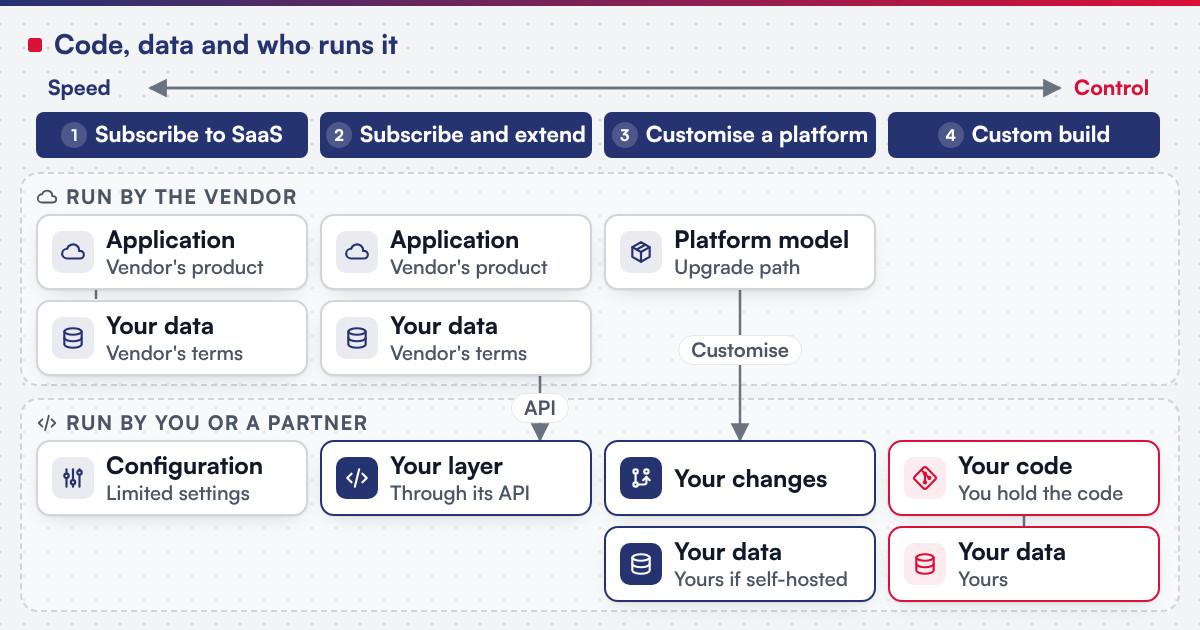 (opens the full-size diagram in a new tab)
How do you make the decision?
-
Write the capability as an outcome
"Quote a custom job in one visit", not "a CRM".
-
Test the market first
Trial two or three SaaS products against the outcome with real users for a week.
-
List what the products cannot do
Separate "we would prefer" from "we cannot operate without".
-
Check data and exit terms
Where data is stored, who can access it, and how it leaves.
-
Check integration limits
API coverage, rate limits and webhooks against the systems that must connect.
-
Score differentiation
If a competitor could buy the same capability tomorrow, it is probably not worth building.
-
Compare five-year effort
Include people time, migrations and the cost of changing your process.
-
Choose, and write down the trigger that would reverse the choice
For example, a user count or a missing integration.
Worked scenario: field quoting for a signage installer
A signage installer with twelve surveyors wants quotes produced on site. Three SaaS products in the shape of a field service and inspection app are trialled for a week. All three handle scheduling, photos and customer signatures well. None can calculate a quote from the installer's own rules for materials, access equipment and wall type, which is the part that wins work; each would need a spreadsheet beside it.
The decision splits the capability. Scheduling, photos and signatures stay on a subscription, because nothing about them differentiates the installer. The quoting rules become a small custom service that reads the SaaS product's job record through its API and writes the quote back. The reversal trigger is written down: if the vendor's API stops exposing job records, the whole workflow is rebuilt as a custom application. The installer pays for the part that is different about its business and subscribes to the rest.
What do Netbase records show about each route?
Netbase's published records sit on the build and customise side, which is itself a reason to weigh this page accordingly.
- Custom SaaS build. Since 2020, Netbase has worked as offshore development and managing partner on a multi-tenant cloud ERP SaaS for a US client that is not named; its phase one, from 2020 to 2023, covers CRM, real-time messaging, HR, a knowledge base, custom fields and workflows, work and project management and API integrations. The retail phase two was planned work when the profile was written and is not presented as delivered. See the cloud ERP record.
- Customise a platform. Working with a local Odoo implementation partner, Netbase has consulted on and customised Odoo in Vietnam for retail chains, a food and beverage franchise, manufacturers, distributors and other organisations that are not named. See the Odoo record. Where the choice is Odoo specifically against a custom ERP, rather than SaaS against custom in general, Odoo vs custom ERP covers that narrower decision.
- Reuse inside a build. Reusing Netbase productized modules can cut development time by up to 60%; that is an upper bound tied to module reuse, not a typical saving.
The subscribe-or-build decision is made in a short assessment against your own processes, and no measured comparison between routes is published. The methodology page explains how records are labelled.
Which questions should you ask a supplier or vendor?
- For a SaaS vendor: how is our data exported, in what format, and how long after we cancel is it deleted?
- For a SaaS vendor: which API endpoints and webhooks exist for the objects we must integrate?
- For a build supplier: who owns the code? For custom development the client owns the IP created for it; Netbase productized modules and products are licensed, not transferred. The IP ownership guide covers the contract terms.
- For a build supplier: how is scope fixed? Most Netbase projects are agreed as fixed-scope contracts after discovery; milestone-based arrangements are also available.
- For either: what does leaving look like? The handover and exit guide lists what to secure before you sign.
What goes wrong with each route?
- Building a commodity. A custom HR or ticketing system that a subscription would have covered, now maintained forever.
- Subscribing to a core process. The product cannot model what makes you different, so staff keep a spreadsheet beside it.
- Customising a platform past its model. Deep changes make every upgrade a project.
- Ignoring exit. The data export is incomplete, or the custom code has no one left who understands it.
- Comparing first-year spend only. Subscriptions grow with users; custom software needs maintenance every year.
- Treating configuration as free. A heavily configured SaaS product has its own specification, owner and test burden; when nobody documents the settings, a vendor upgrade or a staff change breaks the process just as surely as a code change would.
- Letting one department decide alone. Finance, operations and IT each see a different cost; the choice holds only when all three have signed the same criteria.
How this guide is sourced and where it stops
The route definitions use NIST SP 800-145; the criteria are editorial guidance. Netbase's evidence covers a custom multi-tenant SaaS build and partner-assisted Odoo customisation. No client, figure or partner is named beyond the linked records, the durations in the comparison table are typical ranges rather than measured results, and the signage scenario is illustrative.
Plan the next step for your project
Common questions
Usually, because nothing is built. Whether it stays cheaper depends on user growth, the cost of workarounds and what leaving would take.
Yes, and it is often sensible. Keep your data exportable and your process documented so the later build has a specification to work from.
When the capability is how you compete, when no product can meet a hard integration or data rule, or when you intend to sell the software yourself, in which case the SaaS product development workflow applies; the same criteria decide a booking and scheduling system as much as any other category.
Both. You buy a model and build the difference, so check the platform's upgrade path before customising deeply.
An outcome, the products you trialled and why they failed. The SaaS discovery questions cover the rest for a product you will sell.
Decide the route before you scope the build
Write the capability as an outcome, trial the market, and bring the list of what no product could do. A discovery milestone in Custom Product Engineering tests whether a build is justified, and the project delivery page describes how a build is governed.
OutsourcingVN is Netbase's own outsourcing-services platform. Submit a project with the products you trialled, and a person will reply with whether a build is worth scoping.
Work behind this guide

Since 2020, Netbase has worked as offshore development and managing partner on a multi-tenant cloud ERP that a US software company offers as SaaS to small and mid-sized businesses.
Keep Reading
Working with a local Odoo implementation partner, Netbase has consulted on and customised Odoo in Vietnam for a range of organisations, none of which is named.
Keep ReadingRelated services and solutions
 Custom product engineering for a bounded release outcome
One defined release of your product, built to named outcomes and handed over with acceptance evidence.
Learn More