

Low-code vs custom development: choosing the route in the AI era
Choose a low-code or AI app-builder platform when the application is mostly forms, approvals and standard data views that a visual editor already models well. Choose custom development when the logic, scale or integrations go beyond what any platform's editor can express, or when owning the source code matters more than building fast.
Submit a project See the related serviceReviewed by Huy Nguyen (David), CEO · Updated 14 Oct 2026 · 9 min read

Most products eventually need a bit of both.
OutsourcingVN is operated by Netbase JSC, which sells custom development, so this comparison is written by a supplier with an interest in the custom answer. The criteria below hold regardless of who builds, and the page names where a low-code or AI app-builder platform is the better fit.
Contents
- How do the two routes compare?
- Which route fits the application?
- Worked scenario: an operations team automating supplier approvals
- What does Netbase bring to a custom build?
- Which questions should you ask a low-code vendor or a custom development partner?
- What goes wrong with each route?
- How this guide is sourced and where it stops
- Common questions
- Scope the route before you commit
How do the two routes compare?
A low-code or AI app-builder platform (a visual, model-driven tool, or one that generates an application from a prompt and a schema) and custom development are not opposites so much as different places to put the same complexity.
-
Complexity it handles well
- Low-code / AI app-builder platform
- Standard forms, approvals, dashboards and CRUD workflows
- Custom development
- Any logic, including rules no platform models natively
-
Integration
- Low-code / AI app-builder platform
- Pre-built connectors; deep or unusual integrations strain the platform
- Custom development
- Any integration, built to the exact contract needed
-
Scale
- Low-code / AI app-builder platform
- Fine for most internal and departmental loads; some platforms cap records, users or automation runs
- Custom development
- Scales to whatever the architecture is built for
-
Governance
- Low-code / AI app-builder platform
- Version history and permissions the platform provides; audit depth varies by vendor
- Custom development
- Whatever the team builds and documents
-
Lock-in
- Low-code / AI app-builder platform
- Logic, data model and automations live inside the vendor's platform
- Custom development
- Code and data are yours; no platform to migrate off
-
Ownership at the end
- Low-code / AI app-builder platform
- A licence to keep running the application on the vendor's platform
- Custom development
- The source code itself, outright
No platform fits every workflow, so the questions below decide module by module rather than for the whole application at once.
Which route fits the application?
-
Is the workflow mostly forms, approvals and standard data views?
A low-code or AI app-builder platform usually covers that without custom code.
-
Does it need custom algorithms, heavy integration or scale beyond the platform's limits?
Custom development is the safer route once any of those appear.
-
Will non-developers need to keep changing the logic themselves?
A low-code platform's visual editor keeps that change cycle inside the business, without a developer for every change.
-
Does the organisation need to own the source code and avoid long-term lock-in?
Custom development, or a platform with a genuine code-export path, protects that.
-
Is this a first version meant to prove demand before a bigger investment?
If yes, prototype on low-code first, then move the proven parts to custom development if it succeeds.
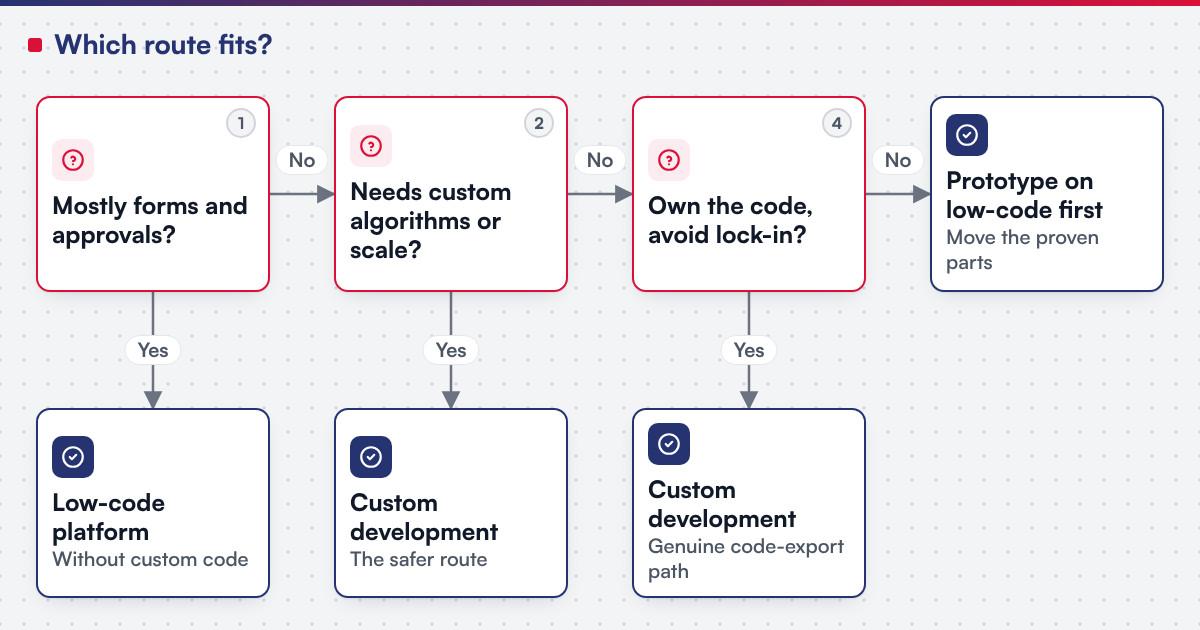 (opens the full-size diagram in a new tab)
Worked scenario: an operations team automating supplier approvals
An operations team at a mid-size distributor wants to replace a spreadsheet-and-email supplier approval process: a request form, a three-step sign-off, a record of who approved what and a monthly summary. Nobody on the team can write code, and the finance lead wants the first version running within a month.
A low-code platform fits every question above. The form, the approval steps and the audit trail are standard shapes the platform already models, the team can adjust the sign-off rule themselves as policy changes, and there is no integration beyond notifying people by email. Six months later, the same distributor wants the approval outcome to write directly into its ERP's purchase-order record through an API the platform's connector does not support. That one module moves to a small custom service that reads the platform's webhook and writes the order; the rest of the approval workflow stays exactly where it was, which is the mixed outcome most real products settle into once one integration outgrows the platform.
What does Netbase bring to a custom build?
Reusing Netbase productized modules can cut development time by up to 60%; that is an upper bound tied to module reuse, not a typical saving, and it narrows the speed gap a platform otherwise holds over a build from nothing. Netbase delivers remote-first from Hanoi in Agile increments with weekly reviews, using AI-assisted engineering under human review, which keeps a custom build's pace closer to a platform's iteration speed; AI-assisted software delivery sets out what that review discipline changes for the buyer specifically.
On the closest published example of a custom build at this scale, since 2020 Netbase has worked as offshore development and managing partner on a multi-tenant cloud ERP SaaS platform for a US client that is not named; phase one, from 2020 to 2023, covers CRM, real-time messaging, HR, a knowledge base, custom fields and workflows, work and project management and API integrations, on a stack that includes React and Next.js, Laravel and Strapi, PostgreSQL, MySQL, MariaDB and MongoDB on AWS. For custom development the client owns the IP created for it; Netbase productized modules and products are licensed, not transferred, so the ownership line in the comparison above is a contract term to check, not a given.
Which questions should you ask a low-code vendor or a custom development partner?
- For a low-code vendor: what happens to our data, automations and logic if we leave the platform? Ask for the export format, not a description of flexibility.
- For a low-code vendor: where exactly does the platform's limit sit for our busiest workflow, in records, users or automation runs per period?
- For a custom development partner: how much of the build reuses existing modules rather than being written from nothing, and on what licence?
- For either: who in the organisation can maintain this in a year, and what do they need to know?
- For either: what is the plan if one module outgrows the platform, or if the custom build needs a visual editor for business users later?
What goes wrong with each route?
- Outgrowing the platform mid-build. Signal: a workaround stacked on a workaround to make one screen do something the editor was never meant to do. Owner: the product owner, who should split that module to custom development rather than keep forcing it.
- Building a commodity workflow from nothing. Signal: months spent custom-coding a form, approval and dashboard that a platform already models. Owner: whoever scopes the build, who should trial a platform before committing to code.
- Ignoring the export path until it is needed. Signal: nobody knows what leaving the platform would produce. Owner: procurement, who should ask the export question before signing, not when leaving.
- Treating low-code as needing no governance. Signal: dozens of unaudited automations built by different people with no owner. Owner: IT or operations, who should apply the same change control a custom build would get.
- Choosing custom development to avoid a vendor relationship, not because the logic needs it. Signal: the requirements are standard forms and approvals, but nobody considered a platform. Owner: the sponsor, who should run the questions above before scoping code.
How this guide is sourced and where it stops
The multi-tenant cloud ERP record is the closest published example of a custom build at this scale, and the supplier-approval scenario above is illustrative and describes no client.
Plan the next step for your project
Common questions
Many can, for the workflow shapes they model; the limits that matter are usually automation runs, integration depth and governance controls, not raw user count. Check the specific platform's documented limits against your busiest workflow.
Not necessarily. Reusing Netbase productized modules can cut development time by up to 60% against a build from nothing, though that figure is an upper bound tied to module reuse and not a typical saving on every project.
You typically hold a licence to run what you built on the vendor's platform, not the platform itself; check the contract for what happens to your data and logic on export.
Yes, and it is common to move one module at a time, starting with whichever integration or scale limit the platform hits first, while the rest stays on the platform.
The criteria above still apply: complexity, integration, scale, governance, lock-in and ownership. An AI app-builder generates more of the first version from a prompt, which narrows the speed advantage custom development usually gives up, but the same export and governance questions still decide the route.
Sometimes, for an internal admin screen or a business-user configuration panel inside an otherwise custom product; that is a design choice within custom development, not a reason to call the whole product low-code.
Scope the route before you commit
Bring the workflow's forms, its busiest integration and who needs to keep changing it. Custom build vs SaaS covers the neighbouring decision when the alternative is a finished product rather than a platform you configure, SaaS product development is the workflow to scope once you are building a product to sell, and document and approval workflows and Laravel cover two of the shapes a custom build commonly takes. Custom Product Engineering is the service that delivers a custom build once you choose that route, with milestone project delivery setting out how that build is governed, and AI engineering enablement is the service to scope if your own team wants to adopt AI-assisted building rather than commission it.
OutsourcingVN is Netbase's own outsourcing-services platform. Submit a project with the workflow and the limit you are worried about, and a person will reply with whether a platform, a custom build, or a split between the two fits.
Work behind this guide

Since 2020, Netbase has worked as offshore development and managing partner on a multi-tenant cloud ERP that a US software company offers as SaaS to small and mid-sized businesses.
Keep ReadingRelated services and solutions
 Custom product engineering for a bounded release outcome
One defined release of your product, built to named outcomes and handed over with acceptance evidence.
Learn More