

AI agent development services in Vietnam: what the engagement covers
An AI agent development engagement turns one business task into a tested agent: a scoped job, a permission map for every tool it may call, an evaluation set agreed before build, human checkpoints for risky actions and a handover your team can run. Delivered remotely from Vietnam, it runs in short increments with weekly reviews against those acceptance criteria.
Submit a project Scope an AI Workflow BlueprintReviewed by Huy Nguyen (David), CEO · Updated 13 Nov 2026 · 10 min read

This guide is written for CTOs and founders in the US, Europe and elsewhere who want an agent built quickly and want to know what they are buying before they talk to any supplier. OutsourcingVN is operated by Netbase JSC, which builds AI workflows and agents, so the guide comes from a supplier with an interest in your project; the engagement structure below applies whoever you hire.
Contents
- When is an AI agent the right thing to build?
- What does an AI agent build engagement include?
- How do tool permissions and human checkpoints shape the build?
- How is an AI agent engagement delivered from Vietnam?
- What does acceptance look like for an agent?
- Which Netbase work is closest to an agent build?
- Which questions should you ask an AI agent supplier?
- How this guide is sourced
- Common questions
- Start with one task
When is an AI agent the right thing to build?
Anthropic's engineering guide "Building effective agents" draws the line most suppliers now use: workflows are systems where models and tools are orchestrated through predefined code paths, while agents are systems where the model dynamically directs its own process and tool use. The same guide recommends finding the simplest solution possible and only increasing complexity when needed.
That advice is the first test of a supplier. A good engagement starts by asking whether your task needs an agent at all. If the steps are known in advance, a deterministic pipeline with one model step is cheaper to run, easier to test and easier to explain to an auditor; the agent versus workflow automation guide sets out that choice in detail. An agent earns its place when the path through the task genuinely varies from case to case: an enquiry that may need a stock lookup, a policy search, a draft reply and a follow-up task, in an order nobody can fix ahead of time.
The wider buying decision, from choosing the first workflow to model selection and testing, is covered in the AI workflow automation buyer's guide. This page focuses on the build engagement itself.
What does an AI agent build engagement include?
An agent engagement is not a prompt and a demo. It is a small software project with a few parts that ordinary projects do not have. The table lists each workstream, what you should receive, and when it matters most.
| Workstream | What you receive | Fits when |
|---|---|---|
| Task scoping | A written job description for the agent, its inputs, its outputs and what it must never do | Always; it bounds the rest |
| Tool and permission map | Every tool, its scope, the account it runs under and its consent rule | The agent reads or writes business systems |
| Evaluation set | Real cases with expected outcomes, scored before and after each change | Always; it is the acceptance test |
| Human checkpoints | Review queues and confirmation steps for high-impact actions | Actions send, pay, delete or reach customers |
| Integration build | Connectors, error handling, retries and logging into your stack | The agent acts on live systems |
| Monitoring and runbook | Traces, alerts, a switch-off path and an owner | The agent goes to production |
| Handover | Code, prompts, evaluation set and documentation in your repository | You want to own and change it later |
Scoping is the workstream buyers most often rush. The guide to scoping an AI agent project walks through it step by step, including boundaries, tool permissions, evaluation and the points where a person must stay in the loop. For commerce teams weighing a packaged assistant against a custom one, the build versus buy guide for ecommerce operations agents covers order, catalogue and support agents specifically.
How do tool permissions and human checkpoints shape the build?
The OWASP GenAI Security Project lists excessive agency as risk LLM06 (2025 edition) and traces it to three causes: excessive functionality, excessive permissions and excessive autonomy. Its prevention advice reads like an engagement checklist: limit the extensions an agent may call to the minimum necessary, limit the permissions those extensions hold, and use human-in-the-loop control to require a person to approve high-impact actions before they are taken.
In a well-run engagement those three controls are deliverables, not intentions. The permission map is reviewed and signed before integration work begins, permissions are enforced by the systems the tools call rather than by instructions in a prompt, and every write, send or payment action has a named approver. The AI agent tool permissions guide shows how to build that map, and human-in-the-loop AI workflows covers the design of review queues so that confirmations stay meaningful instead of becoming a reflex click.
How is an AI agent engagement delivered from Vietnam?
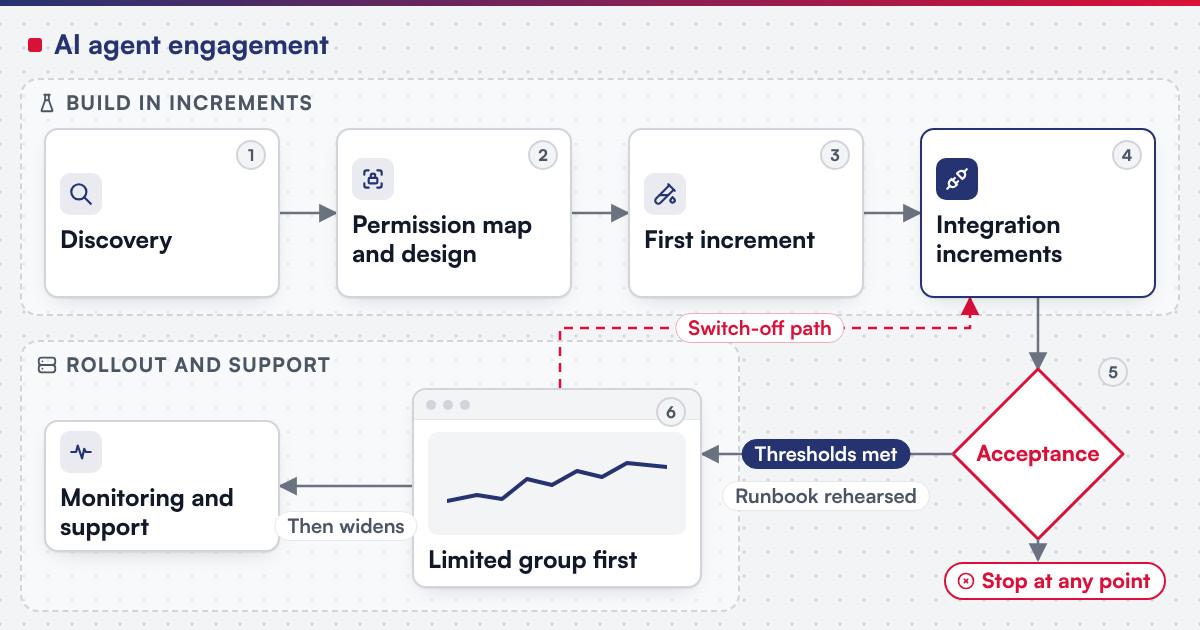
Netbase delivers remote-first from Hanoi in Agile increments with weekly reviews, using AI-assisted engineering under human review. For an agent project, that rhythm maps onto a sequence a buyer can follow and stop at any point:
-
Discovery
The task, the systems involved, the data the agent may see and the actions it may take are written down, with the evaluation cases collected from real history.
-
Permission map and design
Tools, accounts, consent rules and checkpoints are agreed, and the choice between an agent and a fixed workflow is confirmed in writing.
-
First increment
A working agent runs in a sandbox against the evaluation set, with every tool call logged.
-
Integration increments
Connectors to live systems are added one at a time, each behind its consent rule, each with its own tests.
-
Acceptance
The agreed thresholds are met on the evaluation set, the runbook is rehearsed and the owner signs off.
-
Rollout and support
The agent goes live for a limited group first, then widens, with monitoring and a switch-off path in place.
Netbase's delivery lifecycle runs discovery and strategic alignment; team assembly and architecture planning; agile execution with outcome-based milestones; modular components; training and rollout; ongoing support. The six agent steps above are that lifecycle applied to one agent.
Working hours matter for a weekly review cadence. The time-zone collaboration guide explains how the Vietnam working day overlaps with European and US teams, and how to plan review calls and asynchronous hand-offs around it. Anthropic's guide also notes that the autonomous nature of agents means higher costs and the potential for compounding errors, and recommends extensive testing in sandboxed environments with appropriate guardrails; a remote team that runs every increment in a sandbox first is applying that advice directly.
 (opens the full-size diagram in a new tab)
What does acceptance look like for an agent?
An agent is accepted on evidence, not on a demonstration. Before build, both sides agree the evaluation set and the thresholds: how many cases must be handled correctly, which failures are tolerated with a person catching them, and which are never acceptable. After each increment, the agent is scored against the same set so regressions are visible. AI workflow evaluation and testing covers how to build that set from real cases and keep it current.
Acceptance also covers the operating side. Anthropic's guide describes agents that pause for human feedback at checkpoints or when they meet blockers, and stopping conditions such as a maximum number of iterations to keep control. Those belong in the acceptance criteria too: the agent must stop, escalate and log in the agreed way, and the owner must be able to switch it off. Moving a validated pilot into a production service is the subject of the proof of concept to production guide, and the AI workflow governance questions list what an approver should settle before signing.
Which Netbase work is closest to an agent build?
For a client that is not named, Netbase built a WhatsApp Business AI chatbot with intent and conversation-flow handling, an LLM API (GPT-4 in the stack) and CRM synchronisation for lead capture, customer data and workflow automation. The WhatsApp chatbot record describes that project; it is the published example closest to an agent whose model output reaches a business system.
Netbase has delivered anonymised client AI projects including retrieval-based knowledge assistants, document AI and MLOps pipelines. On model choice, Netbase works with commercial and open-source AI models chosen per project (model-agnostic), so an agent can be built on whichever model passes the evaluation set for your task.
Netbase applies the ISO/IEC 42001 AI management system framework to its own AI delivery practice.
Which questions should you ask an AI agent supplier?
-
Should this be an agent or a fixed workflow?
A reasoned choice, with the simpler option considered first
-
Can we see the permission map before integration starts?
Every tool, scope, account and consent rule
-
How will you prove the agent works?
An evaluation set from our own cases and thresholds agreed in advance
-
Which actions need a person, and what does that person see?
The exact inputs of the action, not a summary
-
What happens when the agent gets stuck or loops?
Stopping conditions, escalation and logging
-
What do we own at the end?
Code, prompts, evaluation set and runbook in our repository
-
How often will we review progress?
A fixed weekly review against the acceptance criteria
A supplier who answers these in writing before a contract is one who has run an agent project before. A supplier who answers with a demo has shown you a prompt.
How this guide is sourced
The workflow and agent definitions, the simplicity advice, the cost and error warning and the checkpoint and stopping-condition guidance come from Anthropic's "Building effective agents". The excessive-agency causes and controls come from OWASP LLM06 (2025 edition). Netbase statements are approved claim-register entries, reviewed as the methodology describes. The delivery steps are an illustration of how the published lifecycle applies to an agent build.
Plan the next step for your project
Common questions
It depends on the number of tools, the systems behind them and the size of the evaluation set. A scoped discovery produces an estimate per increment, and the first increment runs in a sandbox before any live connection is added.
Usually not. Most agents run on a hosted commercial or open-source model chosen per task; the evaluation set decides which one, and the choice can change later without rebuilding the agent.
For reads and narrow, reversible writes, often yes, with logging. OWASP advises requiring a person to approve high-impact actions before they are taken, and the permission map records which actions those are.
The scope, the permission map, the evaluation thresholds, the acceptance steps, the handover list and the support period. The AI Workflow Blueprint is a scoped way to produce those before committing to a build.
Re-run the evaluation set whenever a prompt, tool or model changes, watch the traces and alerts, and keep a named owner who can switch the agent off.
Talk to Huy Nguyen (David), Founder and CEO of Netbase JSC: message him on WhatsApp at +84 937 869 689 or email project@netbasejsc.com. You can also send your brief through the project request form. Say which workflow or system the project concerns and what has to stay unchanged; the first step is a discovery conversation, and scope and milestones are agreed after it.
Start with one task
An agent engagement goes faster when the first task is narrow and its evaluation cases already exist in your systems. AI Workflow Automation is the service that builds and runs agents and workflows with human control.
OutsourcingVN is Netbase's own outsourcing-services platform. Submit a project with the task, the systems the agent would touch and the action you would least want it to take, and a person will reply with how to scope it.
Work behind this guide

The client, sector, region and CRM product are not named.
Keep ReadingRelated services and solutions
 AI workflow automation with evaluation and human control
One operating workflow automated, with an agreed way to judge it and a person on uncertain cases.
Learn More