

Vietnam vs Latin America for software outsourcing
A North American buyer weighing Vietnam against Latin America is weighing a compact offshore overlap window against a same-day nearshore rhythm spread across several countries. Vietnam gives one time zone and one supplier relationship to verify; Latin America gives daytime overlap with the US and Canada but spans multiple legal systems and languages depending on the team's country.
Submit a project Explore custom engineeringReviewed by Huy Nguyen (David), CEO · Updated 26 Oct 2026 · 12 min read

Neither fact settles the decision by itself.
OutsourcingVN is operated by Netbase JSC, which delivers from Vietnam and not from Latin America, so this comparison states that interest upfront. Every criterion below is checked in the same order for both: overlap hours first, then language, then legal footing, then talent and delivery governance, and the page ranks no named Latin American provider.
Contents
- Which criteria decide where a North American buyer sources from?
- How do the two locations compare?
- Worked scenario: a US SaaS company adding engineering capacity
- Which questions should you ask a supplier in either location?
- What usually goes wrong when buyers compare by region alone?
- Which location fits your work?
- What has Netbase built this way?
- Where Netbase fits in this comparison
- Common questions
- How this guide is sourced
- Ready to compare the same brief across locations?
Which criteria decide where a North American buyer sources from?
Latin America is not one legal or linguistic market: Brazil runs on its own data law and Portuguese, while each of the other countries runs on its own national rules and language. This guide is about where the engineering team is sourced from, not about delivering a product to buyers or users who happen to sit in the United States, Canada or Colombia; the United States software delivery, Canada software delivery and Colombia software delivery guides cover that separate question. The Vietnam outsourcing guide covers the Vietnam side of this sourcing comparison in its own depth, and a buyer weighing a non-nearshore alternative can read Vietnam vs India for software outsourcing for how the same four-question framework applies to a different pair of locations. The table below checks overlap, language, legal footing and talent for Vietnam against two illustrative Latin American economies, Brazil and Mexico, each named only where a dated source backs the fact.
How do the two locations compare?
| Criterion | Vietnam | Latin America |
|---|---|---|
| Time zone overlap | The Hanoi office keeps Vietnam-time hours, Monday to Saturday, 9:00-18:15 (UTC+7), roughly 11 to 15 hours ahead of the US mainland depending on the coast and the season. | Brazil's main zone, which includes Brasília, is UTC−03:00, one or two hours ahead of US Eastern depending on US daylight saving; Mexico's four zones run UTC−05:00 to UTC−08:00, with no seasonal clock change outside the northern border states and municipalities, so a nearshore team in either country shares most of a North American working day. |
| Language | Netbase delivery communication is in English. | Portuguese is Brazil's official language under Article 13 of its Federal Constitution; elsewhere the national language differs by country, so ask each supplier team to show its working English. |
| Legal and data rules | The contract's governing law and data-processing terms are agreed directly with Netbase. | Brazil's data protection law, the LGPD, is administered by the Autoridade Nacional de Proteção de Dados (ANPD); other Latin American countries run their own separate data-protection laws, so the applicable rule depends on which specific country a nearshore team sits in. |
| Talent and delivery model | Netbase delivers remote-first from Hanoi in Agile increments with weekly reviews, using AI-assisted engineering under human review. | Brazil's national software-industry association, ABES, publishes an annual study of the country's software market, one indicator among several of an established local engineering base feeding the wider nearshore industry. |
None of these rows names a winner. A buyer whose team wants same-day working hours with no planning may weight the Latin American rows higher; a buyer who values a single legal relationship and a compact, predictable overlap window may weight the Vietnam rows higher instead. Remote delivery governance sets out how either arrangement is run day to day once a location is chosen.
Worked scenario: a US SaaS company adding engineering capacity
A US-based SaaS company needs a new module built in parallel with its existing roadmap and is weighing an offshore Vietnam team against a nearshore team sourced somewhere in Latin America.
-
Name the overlap the module actually needs
Daily stand-ups and pairing sessions need live overlap; a written specification and nightly builds do not
- Why it matters
- Modules that need live pairing favour the nearshore option; modules built against a clear written spec can run well offshore
-
Confirm which country's law applies
If end users include Brazilian residents, the LGPD and the ANPD apply regardless of which country builds the module
- Why it matters
- The law follows the users' location, not the supplier's time zone
-
Get a written handover rhythm from each option
A Vietnam-based team proposes a daily async handover; a nearshore option proposes live stand-ups during US hours
- Why it matters
- Compare the actual rhythm each proposal commits to, not an assumption about the region
-
Check a reference on a similar module
A written approach with milestones, risks and a reference from a comparable build
- Why it matters
- The region did not build the last module; the team and the process did
The company does not need to settle "Vietnam or Latin America" before shortlisting. It needs the overlap requirement named, the applicable law confirmed and a written handover rhythm from each option.
Which questions should you ask a supplier in either location?
- What handover rhythm do you propose, async or live overlap, and at what cost to the rest of your day? Ask for a concrete rhythm, not a time-zone label.
- Which country's law applies to our end users' data, and who enforces it? A nearshore Latin American answer depends on which specific country the team sits in; a Vietnam-based answer is the clause Netbase proposes directly.
- How many of your working hours actually fall inside ours? Ask for the answer in your own local hours, including how it shifts with US daylight saving.
- Can you name the two or three people who would work on this module? A regional capability statement does not tell you who is free this quarter.
- Can we see a reference for a similar module, in this region or another? A relevant reference outweighs the supplier's time zone.
What usually goes wrong when buyers compare by region alone?
- Treating "Latin America" as one legal and linguistic market. Signal: a proposal cites one data law or one language for the whole region. Owner: the buyer's legal reviewer, who should ask which specific country the team sits in.
- Assuming nearshore always means less planning. Signal: a live-overlap rhythm is assumed without a written commitment on hours. Owner: the buyer's product lead, by asking for the proposed rhythm in writing.
- Picking a region before naming what the module needs. Signal: the brief says "a Latin America team" before it says whether the work needs live pairing or a written handover. Owner: the buyer, by separating the two decisions as in the worked scenario above.
- Assuming an established national software sector guarantees capacity. Signal: an industry-association report is quoted as if it were a staffing guarantee. Owner: the hiring manager, by asking for named people, not a market study.
Which location fits your work?
-
Does the module need live daily overlap with US or Canadian hours?
A nearshore Latin American team shares most of the North American working day directly; weight that option higher when live pairing matters.
-
Can the work run well on a written specification and async handovers?
Vietnam's compact, predictable overlap window suits work that does not depend on constant live collaboration; time-zone collaboration from Vietnam shows how that rhythm is designed and agreed in writing.
-
Does a specific country's data law reach your end users?
Check which country's law actually applies, such as Brazil's LGPD, rather than treating the whole region as one legal system.
-
Can the same due-diligence approach be applied to a shortlisted supplier in either location?
If yes, compare the strongest proposal on its own terms rather than ruling a location out first.
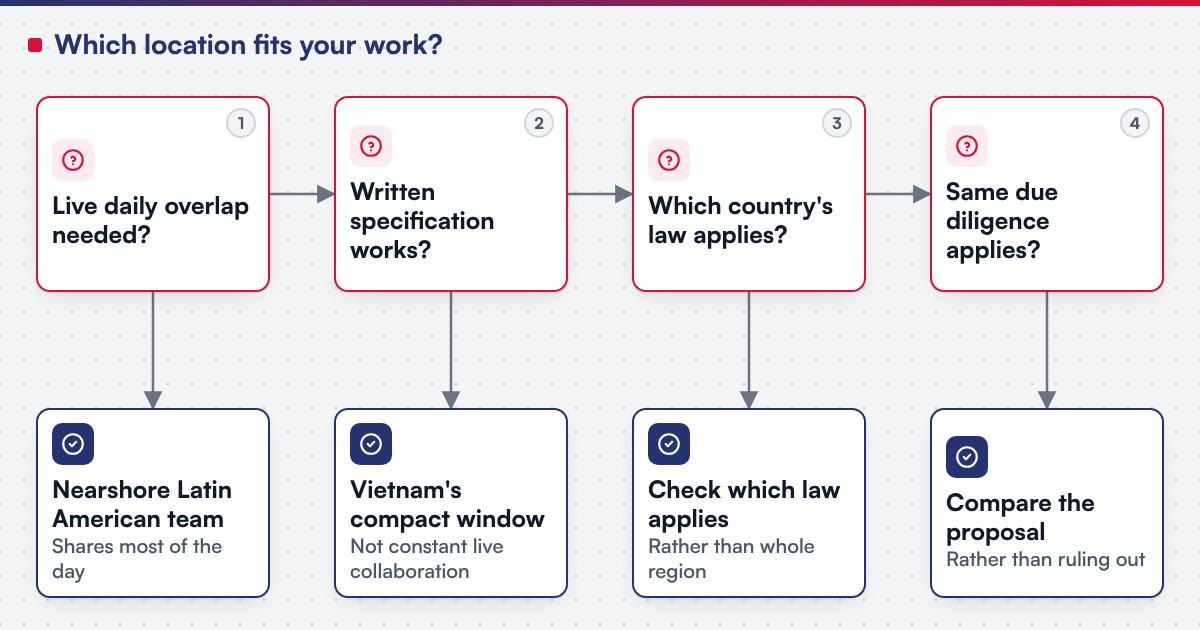 (opens the full-size diagram in a new tab)
What has Netbase built this way?
The closest published example of a bounded platform build for a North American client is the multi-tenant cloud ERP SaaS platform: since 2020 Netbase has worked as offshore development and managing partner on a multi-tenant cloud ERP SaaS for a US client, with phase one covering CRM, real-time messaging, HR, a knowledge base, custom fields and workflows, work and project management and API integrations for agency SMEs between 2020 and 2023. It shows a delivery structure Netbase runs for US clients; it does not show that Vietnam or a Latin American location suits your specific module.
Where Netbase fits in this comparison
Hanoi has been Netbase JSC's only office since the company's 2012 founding, and Netbase serves clients across the United States, Europe and Asia-Pacific; its 2023 company profiles put the outside-Vietnam share of projects at 85%. The Hanoi team works Monday to Saturday, 9:00-18:15 Vietnam time, delivering remote-first in Agile increments with weekly reviews and AI-assisted engineering under human review, communicating in English throughout every engagement.
Plan the next step for your project
Common questions
Neither, in general. The right choice depends on how much live overlap the work needs, which country's law reaches your users and the handover rhythm each supplier actually commits to.
Usually, since most of the region's working hours overlap the US day, but the specific rhythm, live calls or async handovers, is set by the supplier's proposal, not the geography alone.
It makes live overlap shorter, not impossible; Netbase's compact Hanoi hours still overlap part of a North American afternoon or evening, and work built around written specifications and async handovers is not limited by the gap.
Neither Vietnam's nor a generic "Latin America" answer; Canada software delivery covers the Canadian rules a product serving Canadian users must settle, separately from where the engineering team sits.
The criteria order is the same, but the specific facts differ: India offers a much larger single-country talent pool and its own 2023 data law, while Latin America spans several smaller national markets. See Vietnam vs India for software outsourcing.
That depends on the supplier. Ask directly whether delivery would be split across locations and how the handover rhythm and governing law are set for each part.
How this guide is sourced
OutsourcingVN records material claims with source, owner and review date, publishes the lower figure on conflict and does not rank competitors; this page applies a comparison framework, version 1.0, reviewed on 2026-09-22 with its next scheduled review in March 2027, and names no competing provider. Statements about Netbase map to approved rows in the OutsourcingVN claim register, sourced to Netbase's attested company facts. The regional facts come from Brazil's Federal Constitution, IBGE and the Observatório Nacional, Mexico's time-zone law, and the Brazilian bodies that publish directly on data protection and the software sector, checked between 2026-10-05 and 2026-10-26. See the methodology for how claims are reviewed.
Ready to compare the same brief across locations?
Submit a project with the outcome, the overlap your module needs and where your end users sit, and ask Netbase to answer the same questions this guide sets for a supplier in either location. Custom Product Engineering is Netbase's own service for a bounded, engineering-led release. OutsourcingVN is operated by Netbase JSC and is Netbase's own outsourcing-services platform. For the full set of sourcing guides, see all guides.
Work behind this guide

Since 2020, Netbase has worked as offshore development and managing partner on a multi-tenant cloud ERP that a US software company offers as SaaS to small and mid-sized businesses.
Keep ReadingRelated services and solutions
 Custom product engineering for a bounded release outcome
One defined release of your product, built to named outcomes and handed over with acceptance evidence.
Learn More
Sources
- Instituto Brasileiro de Geografia e Estatística (IBGE), Federação e território: fuso horário
- Observatório Nacional, Ministério da Ciência, Tecnologia e Inovação, Horário de Verão
- Secretaría de Gobernación, Orden Jurídico Nacional, Ley de los Husos Horarios en los Estados Unidos Mexicanos (Diario Oficial de la Federación, 28 October 2022, last reformed 29 November 2022)
- Presidência da República, Constituição da República Federativa do Brasil de 1988
- Autoridade Nacional de Proteção de Dados (ANPD)
- Associação Brasileira das Empresas de Software (ABES)