

Planning a legacy data migration
Plan a legacy data migration by profiling what the old system holds before designing anything, agreeing in writing what moves, what is archived and what is left behind, writing the mapping with the business rather than for it, rehearsing the move on a full-size copy more than once, and accepting the result on reconciliation evidence, not a clean log.
Submit a project Legacy application modernizationReviewed by David Nguyen (CEO) · Updated 14 Oct 2026 · 11 min read

OutsourcingVN is operated by Netbase JSC, which scopes and runs accountable project teams. This is the data chapter of the legacy system modernization guide, and the commercial route is legacy application modernization. One blunt thing first: data migration is where modernization projects usually overrun, and the overrun is almost always found in reconciliation rather than in the move itself.
The schema is not the data
The schema tells you what the old system was allowed to store, not what it stored. Between the two sits fifteen years of people getting work done with the fields they had: nullable columns where emptiness carries meaning, and several meanings at that — not applicable, not known yet, lost in an old import. The same customer under three spellings, two with a trailing space. A note field that became the home of a second process nobody would fund. Records nobody has touched since 2014 that are load-bearing for a year-end report.
None of that appears in a data dictionary. It appears in queries against real data, and it must appear before the target design is fixed, because each finding either changes the design or becomes a defect found in reconciliation at the worst moment. If nobody has examined the wider system yet, run the legacy system risk assessment first.
What to profile, and why each item changes the design
Profiling is queries, not interviews. Run them on a recent copy and record the numbers with their date.
| What to profile | What you are looking for | Why it changes the design |
|---|---|---|
| Volumes and growth | Records per entity, and the arrival rate | Sizes the rehearsal, the load and the freeze |
| Emptiness | Nullable columns where blank carries a meaning | Blank may mean not applicable, not yet known, or lost in an old import |
| Values and free text | Abandoned codes, and fields used as overflow | The target rejects values the source accepted happily |
| Duplicates | One entity under several records or spellings | Sets de-duplication scope, and who adjudicates |
| Referential integrity | Orphans, and links the application enforces but the database does not | Determines load order and what fails on insert |
| Dormancy | Records untouched for years, and the reports still reading them | Separates archive candidates from records that must move |
| Encodings, dates, units | Mixed character sets, ambiguous dates, unstated currencies | Silent corruption that still reconciles by count |
| Attachments | Files referenced from rows, and whether they still exist | Often the largest volume, and the most forgotten |
| Personal data | Which columns hold it, including free-text ones | Sets handling rules before the first copy is taken |
Profiling copies production data, so handling is agreed before the copy exists. Netbase security practices include secure code review and version control, role-based access control, MFA for admin dashboards, contributors under NDA, and NDAs and DPAs on request, and where data may not leave your environment the work runs inside it.
See data security and compliance
What moves, what is archived, what is left behind?
Three destinations, one decision per entity, one name against it.
Moves. Records the new system must operate on. They carry the full mapping, reconciliation and test burden, so keeping this set honest is the largest single lever on cost and duration.
Archived. Records you must read but not operate on. A read-only copy of the old database, an open-format export or a reporting store all qualify, and all cost far less because none needs mapping into a new model.
Left behind. Records that stop existing in any live sense. A real option, used far less than it should be, because nobody will sign for it.
Somebody must sign — not the supplier or the project manager, but the business owner of that data, who will be asked in eighteen months why a record cannot be found. If how much of the system to replace is still open, settle that in replace or refactor legacy software before drawing the cut list.
The mapping document is the real deliverable
For every field that moves, the mapping says where it comes from, what happens on the way, what the target field is, what happens when the source value is absent or invalid, and who decided. The migration is built from it, tested against it and argued over it, and it outlives the project.
It is written with the business, not by the supplier alone. A supplier can read a customer-type column and describe it accurately; only the people who use it can tell you that one of its values has meant "do not chase for collections" since a decision in 2017 that never reached the reference table. Every rule encoding a judgement gets a named business owner, and rows where the business disagrees with itself are findings, not something to settle quietly.
Keep exceptions beside the rules, and version the document: a mapping that changed unnoticed turns a rehearsal that passed into a cutover that fails. For back-office data the target model matters as much as the mapping, which ERP and back-office operations covers.
Reconciliation is the acceptance test
A migration is accepted on evidence produced by people who know the domain, not because the load script exited zero. A green log says rows were written, not that they are right.
Row counts, per entity, source against target, with every difference explained by a line in the cut list rather than by a shrug. An unexplained difference of one is the same class of problem as ten thousand.
Control totals, on values the business cares about: balances, quantities, open items, totals by period or category. Counts catch missing rows; totals catch rows carrying the wrong number, which is where encoding, rounding and unit errors surface.
Spot checks by domain people, on records they choose. They go straight to the account merged in 2019 and the contract with the odd renewal; a sample the supplier chose proves considerably less. Agree before the build which reconciliations must balance exactly, which may differ with a written explanation, and who signs each.
Plan the next step for your project
The migration procedure
-
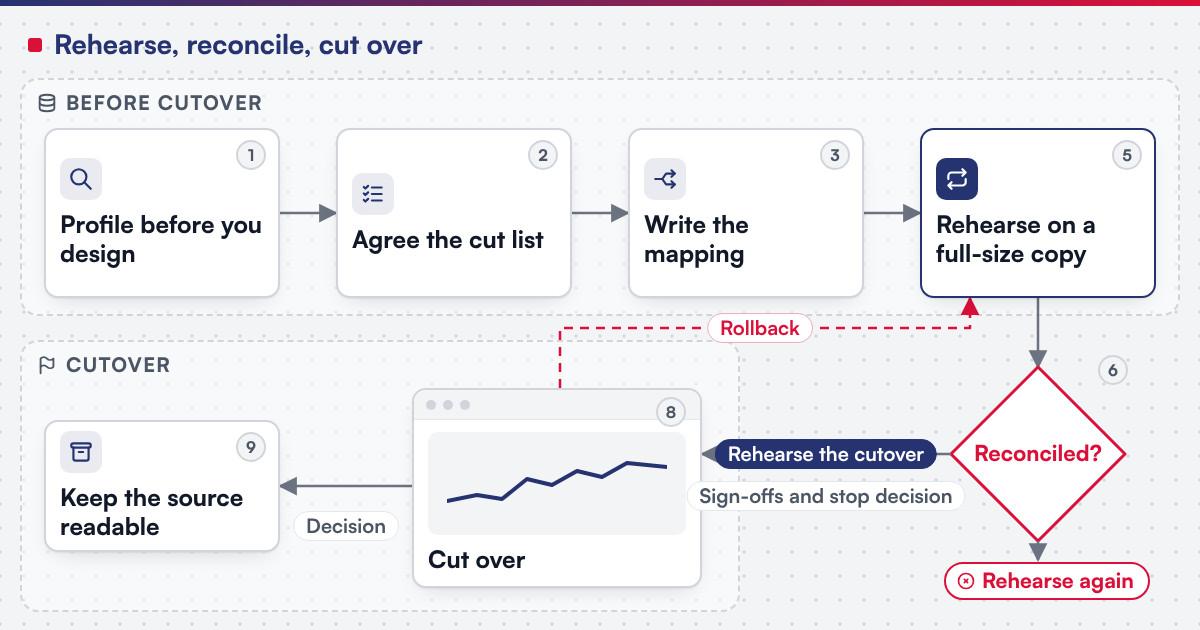
Profile before you design
Query real data, record the numbers and the date, and let the findings change the target model while that is cheap.
-
Agree the cut list
Moves, archived, left behind: one decision per entity, with a named signatory and a written reason.
-
Write the mapping with the business
Field by field, including absent and invalid cases, with an owner for every rule that encodes a judgement.
-
Build the load as a repeatable job
You will run it many times, and what cannot be rehearsed cannot be trusted.
-
Rehearse on a full-size copy
Volume exposes timing, memory and index behaviour; a sample lets you believe in a window that does not exist.
-
Reconcile, fix the mapping, rehearse again
The second rehearsal finds the defects the first one introduced.
-
Rehearse the cutover itself
Freeze, final delta, load, reconciliation, sign-offs and the stop decision, timed end to end.
-
Cut over
Freeze the source, run the job, reconcile, collect the sign-offs, open the new system.
-
Keep the source readable, then decommission on a written decision
Not on a date, and not when someone needs the disk.
Steps one to three usually form their own milestone, with the mapping as acceptance evidence; project delivery describes how that works. Most Netbase projects are fixed-scope contracts agreed after discovery, and a migration is the clearest case there is for scoping after profiling.
 (opens the full-size diagram in a new tab)
What do the freeze and rollback really mean?
A freeze is the period when the old system stops accepting changes and the new one has not opened. Its length follows from the rehearsals, not from what the business would prefer. Decide in advance what happens to work arriving during it — queued on paper, or replayed later from a holding area — because somebody needs that answer at hour two.
Then be precise about rollback. Before the new system accepts its first real transaction, rollback is genuine: the source is still authoritative, you unfreeze it and go home. Once real records exist on the far side there is no rollback, only a second migration in the other direction that nobody designed, mapped or rehearsed. Plan a defined point of no return, criteria evaluated before it, and forward fixes after it. Incremental modernization without a rewrite describes running old and new side by side, which moves that point but does not remove it.
History, retention and the records you may not drop
Financial and employment records, contracts, consent records and audit trails carry retention obligations from law and from your own agreements, and those apply to the archive exactly as to the live system. Retention therefore belongs in the plan: what is kept, in what form, for how long, who may read it, and what shows it is intact. Where history is kept by leaving the old database read-only, name who hosts and patches it for that period. Handover and exit covers the transfer.
AI in a migration, and what it may not decide
Netbase delivers remote-first from Hanoi in Agile increments with weekly reviews, using AI-assisted engineering under human review. On a migration that help is narrow: reading unfamiliar schemas, drafting profiling queries, summarising a stored procedure nobody has opened in a decade. It does not decide a mapping rule, adjudicate a duplicate or produce reconciliation evidence, because those are judgements about your business and carry a named human owner.
What record sits behind this page
This page publishes no durations, defect rates or volumes of ours; those depend entirely on the system in front of us. The related published record is long-running platform work.
Since 2020 Netbase has worked as offshore development and managing partner on a multi-tenant cloud ERP SaaS platform for a client that is not named. Its first phase, from 2020 to 2023, covered CRM, real-time messaging, HR, a knowledge base, custom fields and workflows, work and project management and API integrations, on a stack that includes React and Next.js, Laravel and Strapi, PostgreSQL, MySQL, MariaDB and MongoDB on AWS. A later retail phase was planned work when that profile was written and is not presented as delivered. The anonymised record is the cloud ERP platform page.
Netbase project teams draw on business analysis, project management, solution architecture, development, QA and UI/UX roles. Delivery is remote-first, with Netbase accountable whether the work is done by Netbase staff, approved specialists or disclosed partners, and for custom development the intellectual property created for you belongs to you, mapping and jobs included.
Common questions
Not honestly. The profile determines the mapping effort, the reconciliation effort and the freeze window, and all three routinely differ from what the schema suggests.
Usually not all of it. Separate operating need from retention obligation: the first argues for migration, the second is often satisfied by a read-only archive.
The business owner of each data domain, on evidence they can inspect. A supplier signing off its own migration is not a control.
Include migration in the takeover agreement
Use the takeover and maintenance guide when the team owning the migration will also operate the system. Agree the Managed Operations boundary separately from migration acceptance. The handover package, legacy risk assessment and security rules should reference the same data owners, reconciliation evidence and unresolved exceptions.
Bring the data, not just the system
The useful first conversation is about the data: how many entities, who owns each, and what must be retained. For how we source the claims on this page, see our methodology. When you are ready, submit a project. OutsourcingVN is operated by Netbase JSC and is Netbase's own outsourcing-services platform.
Work behind this guide

Since 2020, Netbase has worked as offshore development and managing partner on a multi-tenant cloud ERP that a US software company offers as SaaS to small and mid-sized businesses.
Keep ReadingRelated services and solutions
 Legacy application modernization, one bounded capability at a time
The code is assessed first, then one bounded capability moves at a time, with a way back.
Learn More