

Software takeover and maintenance: verify control, protect one path, agree the boundary
Take over a software system in three moves. First verify who controls the source, environments, data and accounts. Then protect the one journey the business cannot lose. Then agree a written maintenance boundary covering what is included, when support is available, how changes are approved and what is excluded. Routine maintenance starts only after all three.
Submit a project Assess managed operationsReviewed by Huy Nguyen (David), CEO · Updated 28 Sep 2026 · 10 min read

OutsourcingVN is operated by Netbase JSC, which offers managed delivery, so this checklist comes from a supplier that would like to take over your system. It applies whichever provider you choose, and it draws on a multi-year platform engagement Netbase has run since 2020, a recovery scope and a platform migration.
What this guide covers
- Why does a takeover need its own plan?
- What goes in the takeover inventory?
- How do you protect the critical path first?
- What should the maintenance boundary say?
- What coverage can you expect?
- What does a multi-year engagement look like?
- Worked scenario: the first month of a takeover
- What usually goes wrong?
- Which questions should you ask the incoming provider?
- How this guide is sourced and where it stops
- Common questions
- Start with the current control map
Why does a takeover need its own plan?
Source-code access is not operational control. A repository without its deployment history, secrets, data ownership and the knowledge of who restarts what at month-end is only part of a system. Most takeover problems come from what is missing rather than from the code itself: an account in a departed developer's name, a scheduled job nobody documented, a certificate that expires next month.
A takeover plan makes those gaps visible before the incoming team is responsible for them. It also protects the buyer: if the new arrangement does not work, the same inventory makes the next transition possible. The handover and exit guide covers the conversation with the outgoing team. If the system is still being evaluated before a purchase or investment, run software technical due diligence first.
What goes in the takeover inventory?
Record every asset, who holds it today, how control is verified and what transfer means. An item that cannot be verified is a risk, not an asset.
| Asset | Who holds it today | How control is verified | Transfer action |
|---|---|---|---|
| Source repositories | Outgoing supplier or a developer's personal account | New owner can push, and history is complete | Move to a buyer-owned organisation |
| Cloud and hosting accounts | Often the supplier's billing account | Buyer is account owner with MFA | Change ownership and billing; remove old admins |
| Domain and DNS | Sometimes a personal registrar account | Buyer can change DNS records | Move to a buyer-owned registrar account |
| Secrets and API keys | Environment files, CI settings, a password manager | Every key is listed with its service | Rotate after transfer |
| Data stores and backups | Hosting account | A backup has been restored in a test environment | Document schedule, location and restore steps |
| Scheduled jobs and integrations | Server crontab, CI, third-party dashboards | Each job is listed with purpose and owner | Add to the runbook and monitoring |
| Third-party services and licences | Supplier or buyer, often mixed | Renewal dates and billing owners are known | Move to buyer billing where possible |
| Monitoring and alerts | Outgoing team's inboxes | Alerts reach the new on-duty contact | Re-route and test |
The data security and compliance guide lists the access questions to settle before anyone is granted production rights.
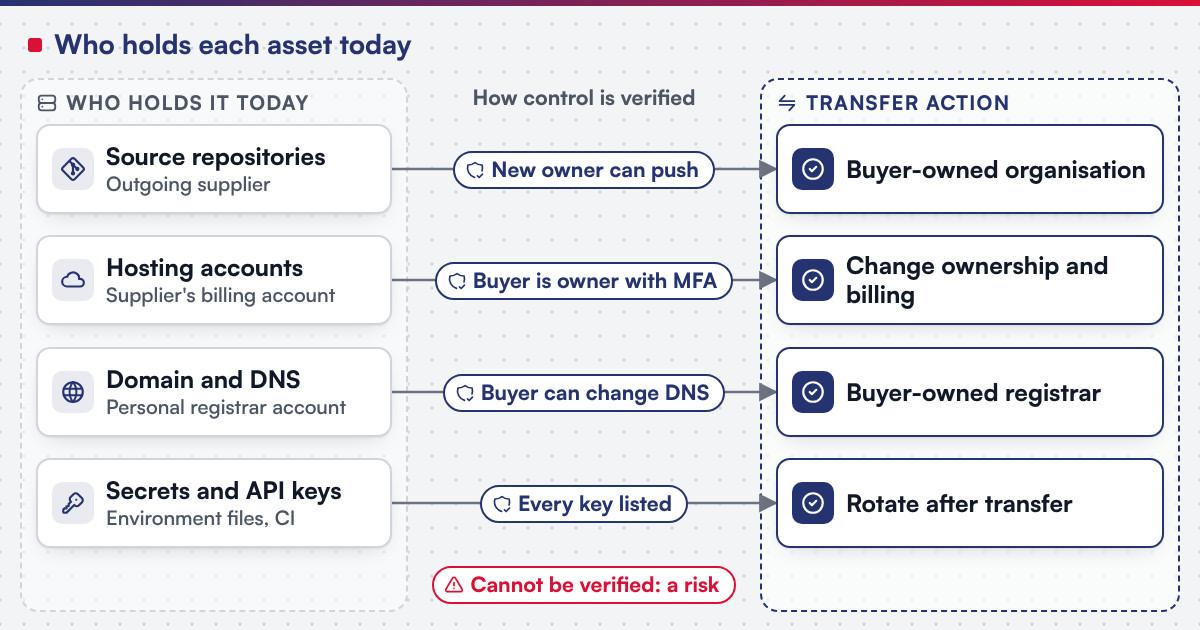 (opens the full-size diagram in a new tab)
How do you protect the critical path first?
-
Confirm authority
Name the buyer owner who grants access and accepts the takeover output.
-
Choose one critical journey
Checkout, order sync, payroll export: the path whose failure the business feels first.
-
Baseline it
Record how it runs today, what it depends on and how you would know it failed.
-
Add monitoring before changes
Make sure a failure on that path reaches a named person.
-
Rehearse recovery
Restore a backup and redeploy the current version in a test environment.
-
Record unknowns
List what has not been inspected and which access is still missing.
-
Agree the first bounded scope
Deliverables, acceptance evidence, rollback and exclusions.
The legacy system risk assessment helps rank risks beyond the first path, and legacy data migration planning applies when data has to move.
What should the maintenance boundary say?
A maintenance arrangement fails when either side assumes the other covers something. Write down:
- Systems in scope. Named applications, environments and integrations.
- Coverage days and hours. When requests are worked, and what happens outside that window.
- Request types. Incidents, defects, small changes and security patches, each with its own route.
- Change authority. Who approves a production change, and what acceptance check and rollback it needs; the release readiness checklist lists the evidence.
- Exclusions. Redesign, migration and new capability go to a separate project decision under project delivery, not into support.
- Reporting. What is reported, how often and to whom.
- Exit. Which artefacts and access stay with the buyer at all times.
Netbase also offers dedicated development teams, on-demand support and fully managed delivery as secondary options. Managed Operations is the service route for agreeing this boundary, and the managed software operations scope guide turns the list into a written scope.
What coverage can you expect?
Coverage should be stated, not implied. For Netbase, the Hanoi office works Monday to Saturday, 9:00-18:15 Vietnam time (UTC+7), and support coverage follows those days. Anything beyond that is agreed per engagement and written into the contract before the business relies on it. Design the critical path so that a failure outside coverage lands in a safe state with an alert, rather than waiting for someone to notice. Reliability and incident readiness covers alert routing, runbooks and restore rehearsals.
What does a multi-year engagement look like?
Since 2020 Netbase has worked as offshore development and managing partner on a multi-tenant cloud ERP SaaS for a US client (not named). Phase 1, from 2020 to 2023 and aimed at agency SMEs, covers CRM, real-time messaging, HR, knowledge base, custom fields and workflows, work and project management, and API integrations. The stack includes React and Next.js, Laravel and Strapi, PostgreSQL, MySQL, MariaDB and MongoDB on AWS. The retail phase 2 was planned work when the profile was written and is not presented as delivered.
See the multi-tenant cloud ERP SaaS platform record
A long engagement like this depends on the same discipline as a takeover: a stable review rhythm, written decisions and a system someone else could pick up. Netbase delivery runs with weekly reviews and a named project manager.
Worked scenario: the first month of a takeover
A distributor's order portal was built by a freelancer who has moved on. The portal syncs orders to the warehouse every night.
-
Inventory assets; find the domain in the freelancer's personal registrar account and the nightly sync in an undocumented server job
Incoming team with buyer
- Output
- Inventory with gaps marked
-
Move the domain and hosting to buyer-owned accounts; rotate all keys
Buyer owner
- Output
- Verified control
-
Baseline the order-to-warehouse sync; add an alert when the nightly run fails
Incoming team
- Output
- Monitored critical path
-
Restore last night's backup in a test environment
Incoming team
- Output
- Recovery rehearsed
-
Agree the maintenance boundary, coverage, exclusions and reporting
Buyer and incoming team
- Output
- Signed boundary
-
Handle the first routine changes under the agreed route
Incoming team
- Output
- Change records with acceptance checks
The domain and the hidden job are typical. Each would have become an outage if found during an incident instead of during week 1.
What usually goes wrong?
- Secrets in a departed developer's account. Signal: a service stops when an old account is closed. Owner: the buyer owner, via rotation in week 1.
- Undocumented scheduled jobs. Signal: a month-end report silently stops. Owner: the incoming team, via the inventory.
- A domain or registrar in a personal account. Signal: nobody can change DNS. Owner: the business sponsor.
- Backups never restored. Signal: a restore fails during an incident. Owner: the incoming team, via a rehearsal.
- Support quietly becoming a rebuild. Signal: "maintenance" tickets that take weeks. Owner: the buyer owner, who moves them into a project.
- A compromise found mid-takeover. Signal: unknown files or redirects. Owner: the security owner, who switches to an investigation-first recovery like the three-phase Magento recovery scope.
Which questions should you ask the incoming provider?
- What will the inventory cover, and how will you verify control? Expect a table like the one above.
- Which journey will you protect first, and how? Look for a baseline, monitoring and a restore rehearsal.
- What are your coverage days and hours? Expect a written window, not "always available".
- Who owns the code, accounts and data? For custom development the client owns the IP created for it; Netbase productized modules and products are licensed, not transferred.
- How will you protect our accounts and data during the takeover? At Netbase, security practices include secure code review and version control, role-based access control, MFA for admin dashboards, contributors under NDA, and NDAs and DPAs on request.
- What happens when the platform itself is at end of life? Look for a migration assessed as a separate project, like Netbase's Netztech Magento 1 to Magento 2 migration, delivered in 35 working days including 11 extensions.
How this guide is sourced and where it stops
This guide draws on Netbase delivery records and company practices approved in the OutsourcingVN claim register: the cloud ERP engagement, the recovery scope, the Netztech migration, support coverage, IP ownership, security practices and the review rhythm. The methodology explains how those records are sourced. It is written for technology and operations leads inheriting a system. Coverage beyond office days, and any response commitment, are agreed per engagement rather than published here.
Plan the next step for your project
Common questions
A bounded first step can, if access, authority and the risk being addressed are clear. Start with the inventory and the critical path. Documentation gaps then become listed unknowns with owners, rather than surprises during the first incident.
Only when a separate scope says so. Migration needs its own data mapping, acceptance tests and rollback plan. Folding it into maintenance hides the effort, blurs responsibility and makes it harder to compare the work with another provider.
As soon as the incoming team has verified control of each service, and before the outgoing team's access is removed. Rotating earlier can break integrations nobody documented; rotating later leaves former contributors with working credentials.
Requests are worked on the stated days and hours. Outside them, the system should fail into a safe state with an alert, and any extended cover must be agreed in writing. Ask each provider for its window before comparing proposals.
Yes, if exit is designed from the start. Keep repositories, accounts, domains and billing in your organisation's name, keep the inventory and runbook current, and require handover artefacts as part of the boundary rather than at the end.
Start with the current control map
Bring the system, the access you hold, the critical journey and the name of the person who can grant access. Managed Operations covers the maintenance boundary once control is verified, and the handover and exit guide covers the outgoing side.
OutsourcingVN is Netbase's own outsourcing-services platform. Submit a project with your control map, and a person will reply with whether a takeover assessment is feasible before suggesting maintenance.
Work behind this guide

This record covers phase-one scope for agency SMEs; the client and product are not named, and no usage or business result is claimed.
Keep Reading
This page describes the work, not the incident.
Keep Reading
What this record reports instead is a duration and a scope, both attested.
Keep ReadingRelated services and solutions
 Application maintenance and managed operations, agreed in an assessment
A production system kept maintained and improving under terms agreed after a paid assessment.
Learn More