

Software release readiness checklist: decide go or no-go on evidence
A release is ready when its owner can show evidence on six questions: does it do what was accepted, has it been tested where it could break, is it safe to expose, can it be deployed and rolled back, will anyone notice if it fails, and do support staff and users know what changes. Missing evidence means no-go.
Submit a project Scope a technical audit sprintReviewed by Huy Nguyen (David), CEO · Updated 29 Sep 2026 · 11 min read

OutsourcingVN is operated by Netbase JSC, which builds and releases software for clients, so this checklist reflects how a delivery supplier wants releases judged. It works for any team. It draws on Netbase's Netztech Magento 1 to Magento 2 migration, a release where every extension and data set had to be checked before cutover.
Why does a release need an explicit go/no-go decision?
Without an explicit decision, a release goes out because the date arrived. The people closest to the code are the most optimistic about it, and the people who will handle the consequences, support staff and the business owner, are often not asked. An explicit go/no-go puts the evidence in front of the person who carries the risk and records what was accepted.
The decision does not have to be heavy. For a small, reversible change it can be a checklist in the pull request and one approval. For a migration or a change to payments it should be a short meeting with named roles. What matters is that "not ready" is a normal, respected answer.
What goes on the release readiness checklist?
Each line needs evidence that someone other than the author can check. The last column says when a missing line stops the release.
| Area | Evidence | Who confirms | Blocks the release when |
|---|---|---|---|
| Acceptance | Each acceptance criterion demonstrated, with a record | Product owner | Any agreed criterion is unmet without a recorded exception |
| Regression | Automated tests pass; critical journeys checked by hand | QA | A critical journey fails or was not checked |
| Security | Code reviewed; dependency scan run; secrets not in the release | Technical lead | A high-severity finding is open without a named acceptance |
| Data changes | Migration scripts tested on a copy of production data | Technical lead | Scripts were only run on empty or sample data |
| Deployment | The release was deployed to a staging environment by the same method | Release owner | Production deployment would be the first run of the method |
| Rollback | A tested way back, including data | Release owner | No rollback exists for a change that alters data |
| Monitoring | Checks and alerts for the journeys the release touches | Operations | Nobody would know within an hour if the change broke a journey |
| Support and users | Support staff briefed; user-facing notes ready | Business owner | Support would learn about the change from customers |
| Timing | Release window agreed with the business | Business owner | The release overlaps a peak trading period without agreement |
A release with an open item can still go, but only as a recorded exception: who accepted the risk, why, and when it will be closed.
When a release touches an AI feature, the checklist grows by two lines: an evaluation set that passed its agreed threshold, covered in AI workflow evaluation and testing, and a red-team round with any residual risk accepted by a named owner, covered in AI assurance and red teaming. Where the feature can call tools, AI agent tool permissions sets the consent and scoping rules those two lines should check against. The quality, security and AI assurance service builds and runs all of these gates, AI and non-AI, as one standing release path rather than a checklist filled in once.
How do you run the go/no-go?
-
Freeze the scope
The release candidate is fixed; late additions wait for the next release.
-
Collect evidence per line
Each confirmer adds evidence to the checklist before the meeting, not during it.
-
Review open items
For each gap, decide: fix now, accept with an owner, or stop.
-
Confirm the rollback trigger
Agree in advance which signal after deployment means "roll back now", so nobody debates it at midnight.
-
Decide and record
Go, go with recorded exceptions, or no-go with the reason and the new date.
-
Deploy and watch
The release owner watches the monitoring for the agreed period with the rollback ready.
-
Close the release
Record what happened, including anything the checklist missed, and update the checklist.
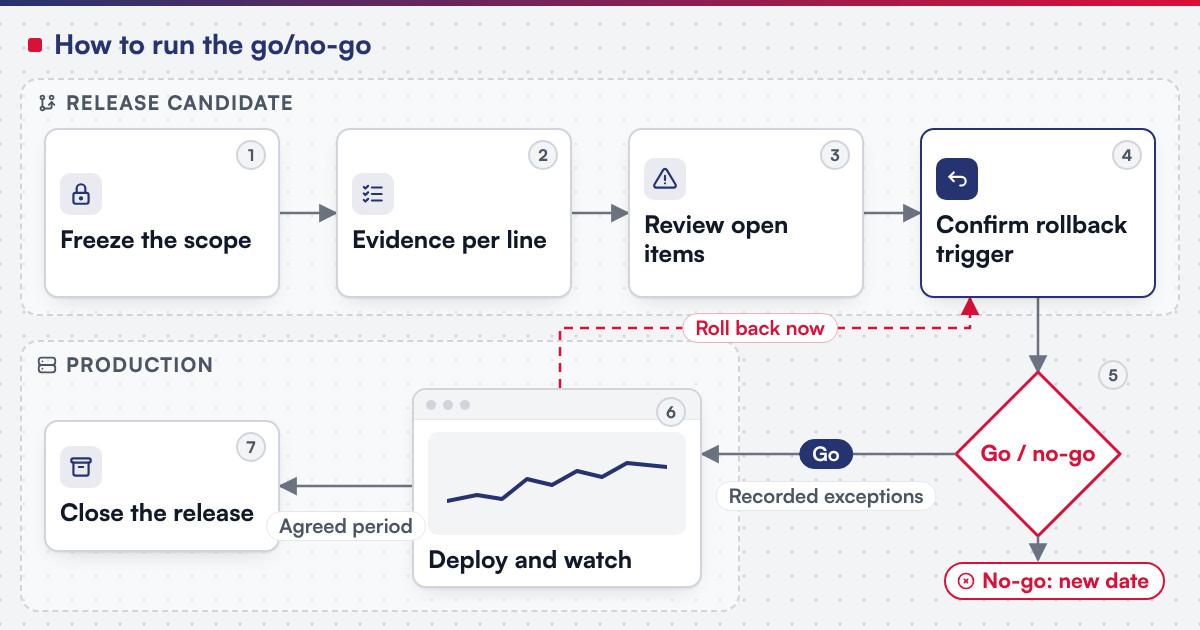 (opens the full-size diagram in a new tab)
How do release size and frequency change the checklist?
Smaller releases are easier to judge. Google's Site Reliability Engineering chapter on release engineering argues for frequent releases with fewer changes between versions, reproducible builds, and enforced policy on who may approve and deploy a change. A team releasing once a quarter needs a heavier go/no-go because each release carries more change and more unknowns.
NIST SP 800-218, the Secure Software Development Framework, is a useful reference for the security line: it describes practices such as reviewing code and checking third-party components that a release checklist can point to as evidence rather than restating.
What changes for a platform migration release?
For Netztech, Netbase delivered a Magento 1 to Magento 2 Commerce migration in 35 working days, including migrating 11 extensions with installation, configuration, customization and data transfer. A migration like that is one large release rather than a series of small ones, so the checklist grows: each extension becomes an acceptance line, and each data set becomes a reconciliation check between the old and new platforms. The Netztech migration record shows the scope that had to be covered.
A migration cutover adds lines the ordinary checklist does not have: a content and order freeze on the old platform, a final data sync, the switch of domain and payment settings, smoke tests on the live platform, and a rollback window during which the old platform stays ready. Legacy data migration planning covers the data side in more depth.
Worked scenario: a go/no-go for a checkout change
An online retailer changes its checkout to add a second delivery option. The release candidate is ready on Thursday for a Friday morning deployment.
-
Acceptance
Met- Evidence at the meeting
- Product owner has seen both delivery options work on staging
-
Regression
Gap- Evidence at the meeting
- Tests pass; card payment checked by hand, bank transfer not checked
-
Security
Met- Evidence at the meeting
- Review done; dependency scan clean
-
Data changes
Met- Evidence at the meeting
- New column added; migration tested on a copy of production data
-
Rollback
Met- Evidence at the meeting
- Previous version redeploys cleanly; the new column is harmless if left
-
Monitoring
Gap- Evidence at the meeting
- Alert on checkout completion exists; nothing specific to the new option
-
Support
Gap- Evidence at the meeting
- Support team not yet briefed
Decision: no-go for Friday morning. Bank transfer is checked that afternoon, an alert is added for orders using the new option, and support is briefed. The release goes out on Monday morning, outside the weekend trading peak, with every line met. The delay cost one working day; a broken bank-transfer checkout over a weekend would have cost far more.
Who should take part in the release decision?
Netbase project teams draw on business analysis, project management, solution architecture, development, QA and UI/UX roles. For a release decision, the useful subset is the product owner for acceptance, QA for regression, a technical lead for security and data, the release owner for deployment and rollback, operations for monitoring, and the business owner for timing and support. One person can hold several roles; nobody should confirm their own work alone.
Netbase's delivery lifecycle runs from discovery and strategic alignment; team assembly and architecture planning; agile execution with outcome-based milestones; modular components; training and rollout; to ongoing support. Release readiness sits at the point where agile execution hands over to training and rollout, which is why support briefing appears on the checklist.
Which questions should you ask your delivery team?
- Who decides go or no-go, and what evidence do they see? Expect a named person and a written checklist.
- Has the deployment method been run before production? Look for a staging deployment using the same steps.
- How do we roll back, including data? A good answer covers both code and data, and has been tested.
- What will tell us within the first hour that something broke? Expect specific checks on the changed journeys.
- What security checks ran on this release? At Netbase, security practices include secure code review and version control, role-based access control, MFA for admin dashboards, contributors under NDA, and NDAs and DPAs on request.
- What are you accepting as a known risk? Look for a written list with owners, not "nothing".
What usually goes wrong at release time?
- Release by date. Signal: the checklist is filled in after deployment. Owner: the business owner, who makes no-go an acceptable answer.
- Data changes tested on sample data. Signal: a migration script fails on production volume or odd records. Owner: the technical lead.
- No rollback for data. Signal: the code can go back but the data cannot. Owner: the release owner, who plans data rollback before release.
- Monitoring that misses the change. Signal: the first report of a problem comes from a customer. Owner: operations, who adds checks for changed journeys; the reliability and incident readiness guide covers alert routing.
- Support learns last. Signal: support tickets about a feature nobody told them about. Owner: the business owner.
- Late additions. Signal: "one small fix" merged after the freeze. Owner: the release owner, who holds the freeze.
How this guide is sourced and where it stops
This guide draws on the release engineering chapter of Google's Site Reliability Engineering book, NIST SP 800-218 and Netbase records approved in the OutsourcingVN claim register: the Netztech migration, team roles, the delivery lifecycle and security practices. The methodology explains how those records are sourced. The checkout scenario is illustrative rather than a client record, and the checklist needs adapting to regulated releases that carry their own sign-off rules.
Plan the next step for your project
Common questions
The business owner who carries the consequences should make the final call, advised by the people who confirm each line of the checklist. A technical lead can stop a release on technical grounds, but accepting a known risk should be a business decision that is written down.
No. A small, reversible change can pass with a checklist in the pull request and one approval. Hold a meeting for changes to payments, data structures, authentication, integrations or anything that cannot be rolled back quickly, and for any release with an open item that needs a named acceptance.
It names the signal that triggers rollback, the steps, who performs them and how long they take, and it covers data as well as code. It should have been tested in a staging environment. If data changes cannot be reversed, the plan must say so and the release needs a stronger go/no-go.
Yes. A bounded review can check a sample of recent releases against a checklist like this one, find where evidence was missing, and recommend changes. Keep the review separate from any work to fix the process, so the findings stay independent of the remedy.
Under managed operations, the change route in the scope should reference the release checklist, name who approves production changes and require a rollback step. The operations team then deploys and watches releases under rules both sides agreed in advance.
Check your next release against the list
Bring the release candidate, its acceptance criteria and your current deployment and rollback method. A technical audit sprint can review your release process against evidence, Managed Operations can run releases under an agreed change route, and the software takeover and maintenance guide covers the first releases on an inherited system. For systems still being evaluated, see software technical due diligence.
OutsourcingVN is Netbase's own outsourcing-services platform. Submit a project with the release you are preparing, and a person will reply with the checklist lines that most need evidence.
Work behind this guide

What this record reports instead is a duration and a scope, both attested.
Keep ReadingRelated services and solutions
 Application maintenance and managed operations, agreed in an assessment
A production system kept maintained and improving under terms agreed after a paid assessment.
Learn More
 Technical audit sprint: a bounded evidence pack, not an opinion
A timeboxed project that answers one question with an evidence pack and a decision.
Learn More