

Software technical due diligence: evidence for a decision, not a verdict on the code
Software technical due diligence answers one question before money or responsibility moves: can this system carry the plan you have for it, and at what risk? It checks asset control, architecture, security, delivery practice and the knowledge held by people, rates each finding by its effect on the decision, and ends in documented options.
Submit a project Scope a technical audit sprintReviewed by Huy Nguyen (David), CEO · Updated 15 Oct 2026 · 10 min read

OutsourcingVN is operated by Netbase JSC, which sells technical audit sprints and would gladly run this review for you, so read the method as a supplier's method. It works with any reviewer. It draws on two Netbase records: the scoped recovery of a compromised Magento store, whose first phase is an investigation, and a Magento 1 to Magento 2 migration.
When do you need technical due diligence?
You need it whenever a commitment would be expensive to reverse and the system is the thing being bought, funded or inherited. Typical triggers are acquiring a company whose value sits in its software, investing in a product business, choosing a vendor platform you will extend for years, and deciding whether a failing build is worth finishing. Due diligence happens before the commitment. Once the decision is made and the system is yours, the work changes into a transfer, which the software takeover and maintenance guide covers step by step.
What should the review examine?
Include an area only if a finding there could change the decision, and ask for evidence rather than descriptions.
| Area | Question for the decision | Evidence to request | Red flag |
|---|---|---|---|
| Asset control | Will the buyer own everything the system needs? | Account owners for repositories, cloud, domains and third-party services | Critical accounts held personally by an individual |
| Build and release | Can someone other than the author ship a change? | A build from a clean checkout; release history | The build works on one laptop only |
| Architecture | Will it carry the planned growth or integration? | Diagrams checked against the running system | Diagrams describe a system that no longer exists |
| Dependencies and licences | What does the dependency tree oblige or expose? | Dependency list with versions and licence terms | Unsupported framework versions or unclear licence terms |
| Security | How exposed is the application and its data? | Access model, secrets handling, patch history, previous findings | Shared admin logins; secrets in the repository |
| Data | Can the data be trusted, restored and moved? | Schema, backup schedule, a restore performed in a test environment | Backups that have never been restored |
| Operations | What breaks, how often, and who notices? | Incident notes, monitoring, on-call arrangement | No record of incidents at all |
| People and knowledge | Who would the business lose with the system? | Interviews with the people who build and run it | One person holds the only working knowledge of billing or deployment |
The legacy system risk assessment goes deeper on old platforms, and the data security and compliance guide lists the access questions to settle before a reviewer sees production data.
How do you run the review?
-
Write the decision question and its date
"Can this platform support three new markets within a year?" is reviewable. "Is the code good?" is not.
-
Agree access and handling
Read-only access, a named reviewer list, an NDA and a date when access ends.
-
Log evidence requested against evidence received
A gap in what the seller provides is itself a finding.
-
Inspect the running system, not the pitch
Build from a clean checkout, restore a backup in a test environment, and scan dependencies.
-
Interview the builders
Ask each person what they would fix first and what they are afraid to touch.
-
Rate every finding by its effect on the decision
using the scale below, with the evidence attached.
-
Report with limitations and options
State what was not inspected, then give the decision options and the conditions attached to each.
Two public references keep the security part systematic: the OWASP Application Security Verification Standard for testing web application controls, and NIST SP 800-218 for comparing the seller's development practice.
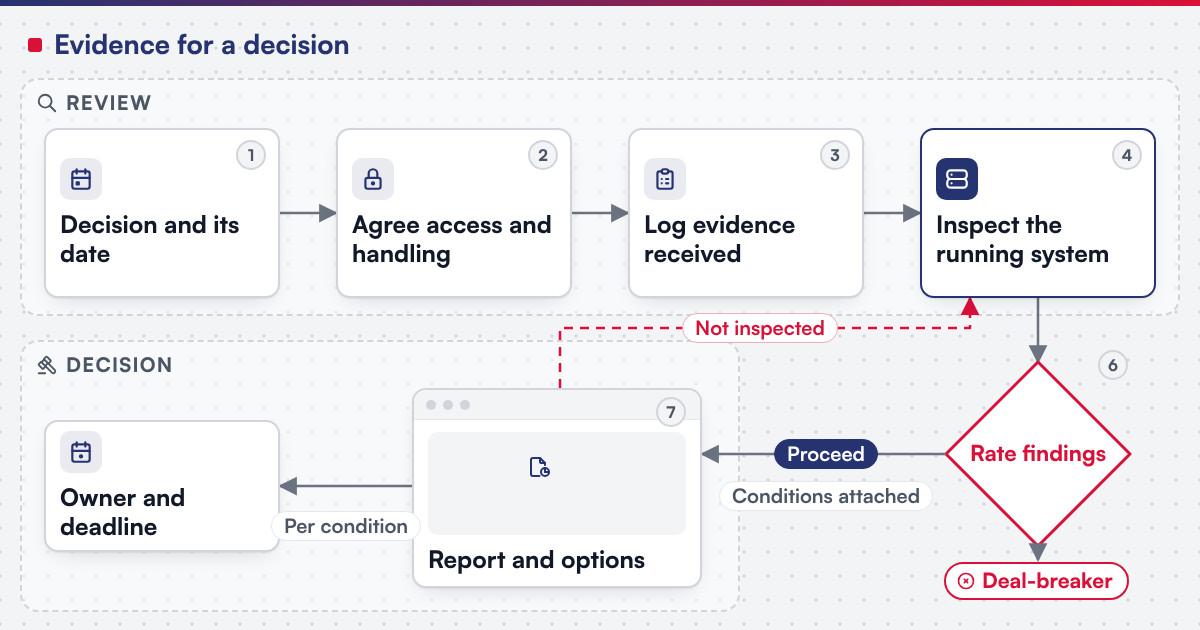 (opens the full-size diagram in a new tab)
How should findings be rated?
Rate each finding by what it means for the commitment, not by how untidy the code looks.
-
Deal-breaker
- Meaning for the decision
- The plan cannot proceed on current terms
- Example
- The seller cannot transfer ownership of the core repository
- What the buyer does
- Stop, or renegotiate the structure of the deal
-
Condition before signing
- Meaning for the decision
- Must be resolved before the commitment
- Example
- Production accounts sit in a former contractor's name
- What the buyer does
- Make the transfer a signing condition
-
Post-close remediation
- Meaning for the decision
- Fixable after the commitment, with known effort
- Example
- Framework two major versions behind
- What the buyer does
- Scope it as a separate project with an owner
-
Accepted risk
- Meaning for the decision
- Understood and tolerated
- Example
- Sparse tests on a rarely changed admin screen
- What the buyer does
- Record it with an owner and a review date
Worked scenario: an acquirer reviewing a quoting product
A regional logistics group plans to acquire a small company whose web product produces freight quotes for shippers. The deal team allows ten working days for technical review, and the decision question is whether the product can be integrated with the group's customer portal within a year.
- Days 1-2. The reviewer logs evidence. The main repository sits under the founder's personal account, and the cloud account is billed to the founder's card. Rated condition before signing.
- Days 3-4. A clean-checkout build fails because a private package lives only on one developer's machine. The developer supplies it; the build succeeds. Rated post-close remediation, with a note that the release process depends on one person.
- Day 5. A backup is restored in a test environment. It works but takes most of a day. Rated accepted risk with a review date.
- Days 6-7. Interviews show that the quote rules engine was written by a contractor who has left, and only the founder understands it. Rated condition before signing: two recorded knowledge-transfer sessions before close.
- Days 8-10. The report states that the integration question is answerable: the product exposes an API that the portal can call. It lists what was not inspected, including mobile builds and load behaviour.
The group signs with three conditions and a separate remediation scope.
What do Netbase records show about inspection before scope?
For an existing client store, Netbase scoped a three-phase recovery of a compromised Magento site. The first phase is investigation: a security scan with cause analysis, a full source-code and database malware scan, server log, permission and abnormal-file checks, and a damage assessment, delivering an infected-file report and a recovery plan. Cleaning and hardening come only after that report. The whole recovery typically takes 6 to 13 days depending on the damage, and it carries no guarantee of full recovery. The Magento recovery and hardening record shows how an evidence phase sets the scope of everything after it.
For Netztech, Netbase delivered a Magento 1 to Magento 2 Commerce migration in 35 working days, including migrating 11 extensions with installation, configuration, customization and data transfer. The Netztech migration record shows why a due-diligence inventory must list every extension and data store: each one becomes a line of migration scope.
Which questions should you ask the reviewer?
- Which decision will your report support? A good answer restates your question and says what the report will not decide.
- What access do you need, and can it stay read-only? Expect read-only by default and a named reason for any exception.
- Who will hold access, and under what agreements? At Netbase, security practices include secure code review and version control, role-based access control, MFA for admin dashboards, contributors under NDA, and NDAs and DPAs on request.
- Which roles will do the review? Netbase project teams draw on business analysis, project management, solution architecture, development, QA and UI/UX roles; a due-diligence review usually needs architecture and security depth first.
- Is the report a certification or an attestation? It should not be presented as one. Netbase JSC holds ISO 27001 certification for information security management; that is the company's own certification and never extends to a system Netbase reviews.
- How will you rate findings? Look for a scale tied to the decision, like the one above.
- Will you bid for the remediation? A reviewer who might win the follow-on work has a conflict; ask for it to be disclosed.
- What will you record as not inspected? A report without that section overstates its own coverage.
What goes wrong in due diligence?
- Reviewing the demo, not the system. Signal: the seller controls the environment you see. Owner: the deal lead, who insists on repository and production evidence.
- No clean build. Signal: "it builds fine here". Owner: the reviewer, who treats an unreproducible build as a finding.
- Findings without ratings. Signal: a long list and no recommendation. Owner: the reviewer, who must map each finding to the decision.
- Remediation slipping into the review. Signal: the reviewer starts fixing. Owner: the buyer, who keeps fixing as a separate project so the finder does not mark their own repair.
- Forgetting operations. Signal: nothing is said about who runs the system after close. Owner: the operating lead, who plans the post-close arrangement with the managed software operations scope guide.
How this guide is sourced and where it stops
This guide combines public secure-development references with Netbase records approved in the OutsourcingVN claim register: the scoped Magento recovery, the Netztech migration, security practices, team roles and the company's ISO 27001 certification. The methodology explains how those records are sourced. For an acquisition or investment, the same method is applied through a scoped assessment. It covers technical risk only; legal, financial and tax review belong to other advisers.
Plan the next step for your project
Common questions
The timebox follows the decision question and the access available. A focused review of one product with prompt access can fit into a couple of weeks; a group of systems with slow access takes longer. Agree the timebox before the review starts, and treat delayed evidence as a finding.
Rarely write access, sometimes read access. Most evidence comes from the repository, a non-production environment, logs, dashboards and a backup restored for testing. Where production must be seen, agree read-only access for named people and an end date.
The party relying on the answer should commission it. A seller-commissioned report can help preparation, but a buyer should still confirm its scope, method and limitations, and repeat the checks that bear directly on the decision, such as ownership of accounts and a clean build.
It can, as a separate project decided after the report. Keep the two contracts apart, so the report is complete before remediation is quoted and the same team is not grading its own later work.
Each condition before signing needs an owner and a deadline, and each post-close item becomes a scoped project or an accepted risk. The operating arrangement after close, including who handles incidents and releases, should be written down before the first incident rather than after it.
Bring your decision question
Start with the question, the date it must be answered and the access you can arrange. A technical audit sprint is the bounded review route; after close, Managed Operations covers running the system, and the release readiness checklist helps the first change after close go out safely.
OutsourcingVN is Netbase's own outsourcing-services platform. Submit a project with the decision question and the systems in scope, and a person will reply with whether a bounded review can answer it.
Work behind this guide

This page describes the work, not the incident.
Keep Reading
What this record reports instead is a duration and a scope, both attested.
Keep ReadingRelated services and solutions
 Application maintenance and managed operations, agreed in an assessment
A production system kept maintained and improving under terms agreed after a paid assessment.
Learn More
 Technical audit sprint: a bounded evidence pack, not an opinion
A timeboxed project that answers one question with an evidence pack and a decision.
Learn More