

Managed software operations scope: what the provider runs, when, and how you leave
A managed software operations scope names the systems the provider runs, the work types it handles, the hours it covers, the objectives it reports against, who approves production changes and what it excludes. Without that written scope, "managed" means whatever each side assumes, and the first serious incident becomes the negotiation.
Submit a project Assess managed operationsReviewed by Huy Nguyen (David), CEO · Updated 14 Oct 2026 · 10 min read

OutsourcingVN is operated by Netbase JSC, which sells managed operations, so this is a supplier describing the contract it would want to sign with you. The structure applies to any provider. It draws on a cloud ERP engagement where Netbase has worked as offshore development and managing partner since 2020.
What does managed operations actually cover?
Managed operations is the continuing work of keeping a live system useful: watching it, patching it, restoring it, answering users and making small changes safely. It sits between two other arrangements. A project delivers a defined change and ends. Staff augmentation supplies people whom the buyer directs. Under managed operations the provider takes responsibility for an agreed outcome within an agreed boundary, and the buyer keeps ownership and the final say on business priorities.
Netbase also offers dedicated development teams, on-demand support and fully managed delivery as secondary options. Knowing which of those you are buying matters more than the label on the contract, because each one puts the responsibility for a missed alert in a different place.
Which elements must the scope name?
A scope is strong when a new person on either side could read it and route a request correctly without asking anyone.
| Element | Weak version | Strong version |
|---|---|---|
| Systems | "The platform" | Named applications, environments, integrations and the data stores behind them |
| Work types | "Support and maintenance" | Incidents, defects, security patches, small changes and user requests, each with its own route |
| Coverage | "Business hours" | Named days, hours and time zone, plus what happens to an alert outside them |
| Service objectives | Copied from a template | Two to five measured objectives tied to journeys the business depends on |
| Change authority | "Changes as needed" | Who approves a production change, the checks it passes and how it is rolled back |
| Access and security | "Admin access for the team" | Named people, role-based access, MFA and a date when each access is reviewed |
| Reporting | A ticket count | Objectives against target, incidents with causes, open risks and planned changes |
| Exclusions | Not written | Redesign, migration and new capability routed to a separate project decision |
| Exit | Not written | Artefacts, accounts and knowledge that transfer, and the notice period |
How do you set objectives without inventing an SLA?
Google's Site Reliability Engineering book separates three terms. An indicator is a measured quantity, such as how long a checkout request takes. An objective is a target for that indicator. A service level agreement adds consequences when the objective is missed. The distinction matters in a contract: an objective written before anyone has measured the system is a guess, and attaching consequences to a guess produces disputes rather than reliability.
Start with indicators on the journeys the business feels, for example "orders placed in the storefront reach the warehouse system before the next picking run". Measure them for a period under the new provider, agree objectives from what the measurement shows, and only then decide whether any objective needs contractual consequences. The reliability and incident readiness guide covers how alerts and runbooks support those objectives.
What does coverage look like with a Hanoi-based team?
The Hanoi office works Monday to Saturday, 9:00-18:15 Vietnam time (UTC+7), and support coverage follows those days. For a European buyer that window covers the European morning; for a buyer in the Americas it falls mostly overnight, which suits scheduled maintenance and next-morning fixes but not live incident response during the buyer's own trading day. Any cover beyond those days and hours is agreed per engagement and written into the scope before the business relies on it. Design every critical journey so that a failure outside coverage stops in a safe state and raises an alert to a named person.
How do you agree the scope?
-
List systems and owners
Every application, environment and integration, with the buyer's owner for each.
-
Classify request types
Decide how incidents, defects, patches, small changes and user requests each arrive and who triages them.
-
Baseline a month
Collect the last month of incidents, tickets and releases, so the scope reflects real work rather than a wish list.
-
Draft service objectives
Two to five, on business journeys, marked provisional until measured.
-
Set the change route
Approval, acceptance checks and rollback for every production change; the release readiness checklist gives the checks.
-
Fix the reporting rhythm
Netbase delivery runs with weekly reviews and a named project manager, and the same rhythm suits operations reporting.
-
Write the exit
Name the artefacts that stay with the buyer; the handover and exit guide lists them.
-
Review after the first quarter
Adjust objectives and routes against what actually happened.
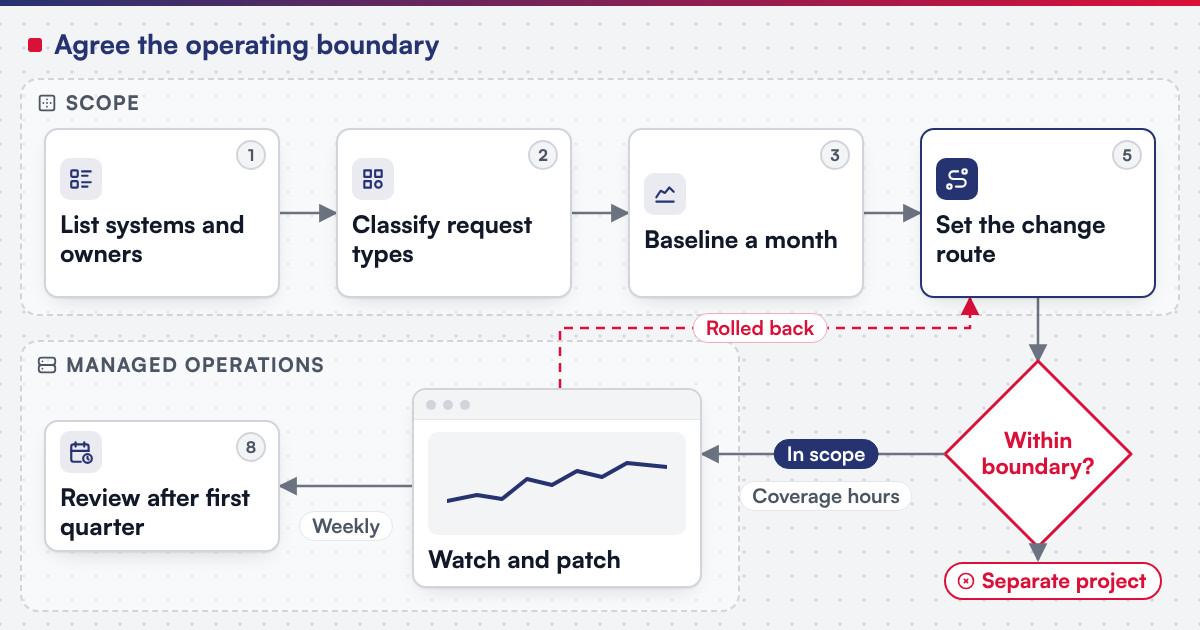 (opens the full-size diagram in a new tab)
Worked scenario: routing requests for a dealer ordering portal
A manufacturer runs a dealer ordering portal connected to its ERP. After a takeover, it agrees a managed operations scope. In the first weeks, four requests arrive.
-
A dealer cannot log in after a password reset
- Type
- User request
- Route under the scope
- Handled within coverage hours
- Owner
- Provider
-
Orders stop reaching the ERP overnight
- Type
- Incident
- Route under the scope
- Alert to the named contact; queued orders replayed after the fix
- Owner
- Provider, with the buyer's ERP owner
-
Sales asks for a new field on the order form
- Type
- Small change
- Route under the scope
- Estimated, approved by the product owner, released through the change route
- Owner
- Provider after buyer approval
-
The ERP vendor announces a new API version
- Type
- Project
- Route under the scope
- Assessed and scoped separately under project delivery
- Owner
- Buyer decides
The last row is the one that usually goes wrong. An API migration disguised as maintenance consumes the support capacity for weeks and hides its cost.
What does a long-running engagement teach about scope?
Since 2020 Netbase has worked as offshore development and managing partner on a multi-tenant cloud ERP SaaS for a US client (not named). Phase 1, from 2020 to 2023 and aimed at agency SMEs, covers CRM, real-time messaging, HR, knowledge base, custom fields and workflows, work and project management, and API integrations, on a stack of React and Next.js, Laravel and Strapi, PostgreSQL, MySQL, MariaDB and MongoDB on AWS. The retail phase 2 was planned work when the profile was written and is not presented as delivered.
A system of that breadth cannot be run under a one-line scope: every module has its own users, data and failure behaviour. Netbase's delivery lifecycle runs through discovery and strategic alignment; team assembly and architecture planning; agile execution with outcome-based milestones; modular components; training and rollout; and ongoing support, so operations is planned as a stage rather than bolted on.
See the multi-tenant cloud ERP SaaS platform record
Which questions should you ask a managed-operations provider?
- Which systems and request types are in scope? Expect a named list and a route for each type, not a general promise.
- What are your coverage days and hours? Expect a written window with its time zone, and a plan for alerts outside it.
- How will objectives be set? A good answer proposes measuring first and agreeing targets afterwards.
- Who approves a production change? Look for a named approver on the buyer's side, acceptance checks and a rollback step.
- Who owns what the operations team builds or changes? For custom development the client owns the IP created for it; Netbase productized modules and products are licensed, not transferred.
- How is operational access controlled? At Netbase, security practices include secure code review and version control, role-based access control, MFA for admin dashboards, contributors under NDA, and NDAs and DPAs on request.
- What will the monthly report show? Objectives against target, incidents with causes and open risks, not a ticket count alone.
- How do we leave? Expect a notice period, a named artefact list and a handover rehearsal.
What usually goes wrong with managed operations scope?
- A scope that says "everything". Signal: disputes about whether a request is covered. Owner: the buyer's service owner, who narrows the system list.
- Objectives copied from a template. Signal: targets met every month while users still complain. Owner: both sides, who re-anchor objectives on business journeys.
- Changes without approval. Signal: production changes nobody on the buyer side can explain. Owner: the buyer's product owner, who enforces the change route.
- Reports that count tickets. Signal: volume goes up and nobody knows whether the system is better. Owner: the provider, who reports causes and trends.
- Project work hidden in support. Signal: "small changes" that run for weeks. Owner: the buyer, who moves them into a scoped project.
- An untested exit. Signal: nobody knows which accounts the provider holds. Owner: the buyer, who keeps the inventory current.
How this guide is sourced and where it stops
This guide draws on the service-level terms in Google's Site Reliability Engineering book and on Netbase records approved in the OutsourcingVN claim register: the cloud ERP engagement, delivery options, office coverage, the review rhythm, the delivery lifecycle, IP ownership and security practices. The methodology explains how those records are sourced. Netbase publishes no standard response-time commitment or contractual service level; those terms are agreed per engagement, so this page gives the structure of a scope rather than its numbers.
Plan the next step for your project
Common questions
Maintenance usually means fixing and patching on request. Managed operations adds responsibility for an agreed outcome: monitoring, incident handling, objectives and reporting within a written boundary. Both need a scope; managed operations needs one that also names objectives, coverage and change authority.
Only for the systems whose control has been verified. Until the provider can see alerts, restore backups and deploy the current version, it cannot be responsible for the outcome. Start with the verified systems and add the rest to the scope as each passes the takeover checks.
Two to five is usually enough for one business system. Each objective should follow a journey the business notices when it fails, such as ordering or payroll export. More objectives dilute attention, and objectives on internal components rarely tell the buyer whether users are affected.
Yes, through a written change to the scope rather than by drift. A quarterly review is a natural point to add systems, retire objectives that no longer matter or move recurring work into a project. Record each change so the next provider inherits an accurate boundary.
Ownership of repositories, cloud accounts, domains, data and billing should stay in the buyer's organisation, together with the right to approve production changes. The provider operates with delegated access that can be revoked, which keeps the exit possible at any time.
Put your operating boundary in writing
Bring the list of systems, a month of incident and ticket history, and the name of the person who approves production changes. Managed Operations is the service route for agreeing this scope, and the software takeover and maintenance guide covers the control checks that come first.
OutsourcingVN is Netbase's own outsourcing-services platform. Submit a project with your system list and current support arrangement, and a person will reply with the questions a scope would need answered.
Work behind this guide

Since 2020, Netbase has worked as offshore development and managing partner on a multi-tenant cloud ERP that a US software company offers as SaaS to small and mid-sized businesses.
Keep ReadingRelated services and solutions
 Application maintenance and managed operations, agreed in an assessment
A production system kept maintained and improving under terms agreed after a paid assessment.
Learn More