

Vietnam developer rates by role in 2026: how to read a rate card
A Vietnam rate card lists roles, a seniority level for each and a unit of time, and comparing one figure with another tells you little. Compare what each role is accountable for, the level it works at, what the unit includes and how many hours of each role your scope needs; that is where two cards really differ.
Submit a project Compare engagement modelsReviewed by Huy Nguyen (David), CEO · Updated 13 Nov 2026 · 9 min read

This guide is for CTOs, founders and procurement leads in the US and Europe who have two or more rate cards from Vietnam teams on the desk. OutsourcingVN is operated by Netbase JSC, which staffs projects by role, so the page is written by a supplier; the comparison method works for any card. Figures belong in a written quote for a defined scope, so this page explains the structure behind them. It is a companion to the guide on AI-native development cost and delivery speed, and the total a rate card feeds into is explained in what drives Vietnam software outsourcing cost.
Contents
- Which roles appear on a software rate card?
- What moves a role's rate?
- How do seniority levels make two rate cards comparable?
- How do you compare two rate cards on the same basis?
- A worked comparison
- How does AI-assisted work change a role-based rate card?
- How does Netbase staff a project by role?
- How this guide is sourced
- Common questions
- Bring both cards and your scope
Which roles appear on a software rate card?
Most cards from Vietnam software teams use the same handful of roles, though titles vary. The table describes what each role is accountable for and what usually moves its rate, so you can match titles across cards before you look at a single figure.
| Role | Accountable for | Rate moves with | Fits when you need |
|---|---|---|---|
| Software engineer | Designing and building features | Level, stack, review duties | Features built to a spec |
| QA engineer | Finding and reporting defects | Automation share, domain rules | Evidence that features work |
| DevOps engineer | Environments, pipelines, operations | Cloud scope, on-call cover | Repeatable releases |
| UI/UX designer | Flows, screens, usability | Research share, design system | Users to succeed first time |
| Project manager | Plan, risks, reporting | Team size, client contact load | One accountable coordinator |
| Business analyst | Requirements and acceptance criteria | Domain depth, stakeholder count | Scope written before build |
| Solution architect | Structure, integrations, trade-offs | System count, risk level | Hard decisions made early |
The United States Bureau of Labor Statistics draws the same first line in its occupational handbook: software developers "design computer applications or programs", while quality assurance analysts and testers "identify problems with applications or programs and report defects". Two cards that merge those duties into one "developer" role are quoting for a different job than cards that separate them.
What moves a role's rate?
Within one role, several factors move the figure. None of them is the country label alone.
- Seniority, measured by responsibility. A senior engineer is one who makes decisions others rely on, not one with a certain number of years. The next chapter gives a shared scale for this.
- Stack scarcity. A mainstream web stack has a wide pool of engineers; a niche ERP platform, an older language or a regulated domain has a narrow one.
- Accountability for outcomes. A role inside a project with a fixed scope carries part of the supplier's estimate risk. The same role placed in your team under your direction carries none of it, and the figure reflects that difference.
- Allocation. A full-time person and a fractional one (a designer for a few days a sprint, an architect for reviews) are charged on different units, and a fractional role may carry a minimum allocation.
- Overlap hours. Shifting a team's day to overlap with US working hours is a real cost to the people working it. The time-zone collaboration guide covers which overlap is worth paying for.
- What sits inside the unit. Equipment, tools and AI licences, management, replacement cover, holidays and the supplier's quality assurance may be included or charged separately.
- The engagement model. Project delivery, a dedicated team and staff augmentation package the same people differently; project outsourcing versus staff augmentation explains who directs the work in each.
How do seniority levels make two rate cards comparable?
Titles such as junior, middle, senior and lead mean different things at different companies. A shared scale helps. SFIA, the Skills Framework for the Information Age, describes seven levels of responsibility from Follow (level 1) to Set strategy, inspire, mobilise (level 7), and characterises each level by generic attributes: autonomy, influence, complexity, knowledge, and business skills and behavioural factors. SFIA defines autonomy as "the level of independence, discretion and accountability for results in your role".
You do not need to adopt the framework to use it. Ask each supplier to describe, for every person on the card, how much direction they need, which decisions they make alone and who reviews their work. Two "senior engineers" at different levels of autonomy are different purchases, and the one who needs less direction may also reduce the hours your own team spends managing.
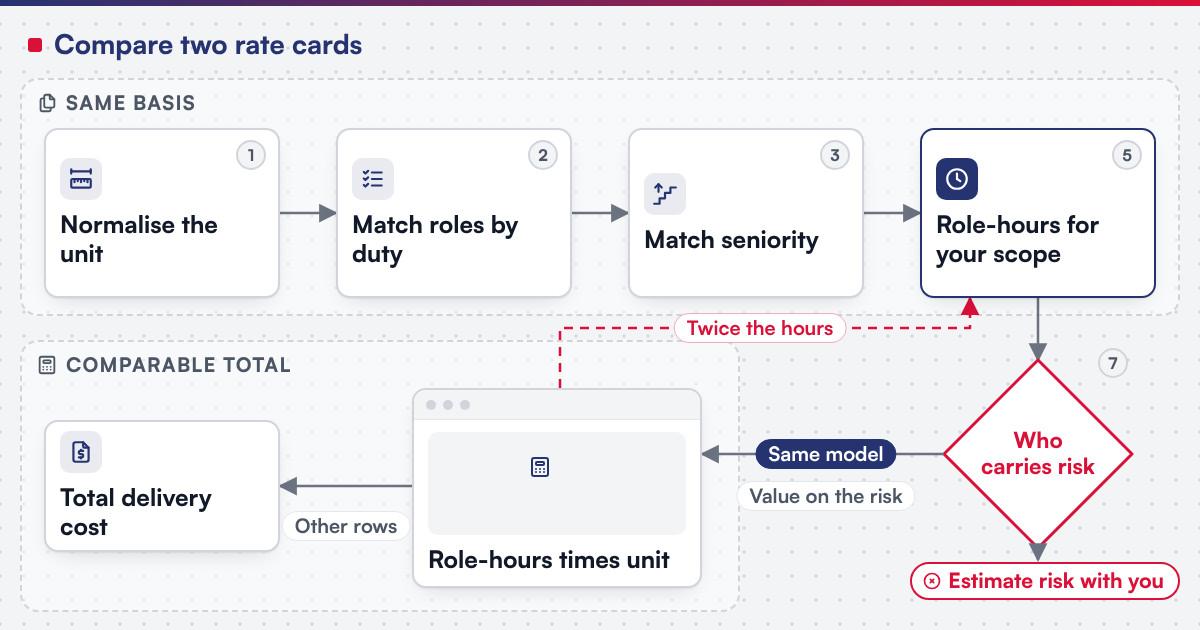
How do you compare two rate cards on the same basis?
-
Normalise the unit
Convert hourly, daily and monthly figures to one unit, and note the hours in a day, working days in a month and public holidays each supplier assumes.
-
Match roles by duty, not title
Use the role table above; split merged roles and mark any role one card omits.
-
Match seniority by responsibility
Map each person to a level of autonomy and influence, then compare like with like.
-
List what the unit includes
Tools, management, QA, replacement, onboarding and notice terms; anything excluded becomes a separate line.
-
Estimate role-hours for your scope
Ask each supplier how many hours of each role your scope needs. A low engineer figure with twice the hours is not a saving.
-
Multiply and add the missing roles
Role-hours times unit, plus the roles one card left on your side, gives a comparable total; the total software delivery cost worksheet lists the other rows.
-
Check who carries the risk
A card for a directed team leaves estimate risk with you; a project quote puts it with the supplier. Compare totals only within the same model, or put a value on the risk explicitly.
 (opens the full-size diagram in a new tab)
A worked comparison
A US founder receives two cards for a mobile app with a web admin. The example is illustrative and states no figures.
Card A lists three "developers" by the month and nothing else. Card B lists two engineers, a part-time QA engineer, a part-time designer and a project manager by the day, plus architect hours in the first month. On the face of it, Card A's developer figure is lower and its team looks simpler.
The comparison changes after step 2. Card A's developers are expected to test their own work, design screens from wireframes the founder supplies, and report directly to the founder, so QA, design and coordination have moved to the founder's side or out of the plan. After step 5, Card B's engineers need fewer hours because the analyst and designer remove rework. After step 7, Card B turns out to be a project quote with a fixed scope, while Card A is a directed team. The founder ends up comparing a staffing arrangement with a delivery commitment, which is the real decision.
How does AI-assisted work change a role-based rate card?
AI coding agents shift where hours go more than they change the list of roles. Drafting work for engineers and QA can shrink, while review, architecture and acceptance work grows in importance, so an AI-native team may show fewer drafting hours and more senior review time. Ask each supplier which roles it expects agents to shorten and by how much on your scope, and treat a card that cuts every role by the same share with caution. What AI-assisted delivery changes in estimates shows which estimate lines move and which do not.
How does Netbase staff a project by role?
Project teams draw on business analysis, project management, solution architecture, development, QA and UI/UX roles. Which of those roles a scope needs, and at what allocation, is a question for the scope rather than a fixed card.
For a buyer comparing cards, the role table above is the question to ask Netbase as well: who is on the team, at which level of responsibility, and on what basis. Custom product engineering is the project route, and dedicated development teams is the route when you want to direct a team yourself; the engagement models page compares them.
How this guide is sourced
Role duties for developers and testers come from the US Bureau of Labor Statistics Occupational Outlook Handbook. The seven levels of responsibility and their generic attributes come from the SFIA Foundation's "How SFIA works" page. Netbase statements are approved claim-register entries, reviewed as the methodology describes. The app comparison is illustrative and carries no market figures.
Plan the next step for your project
Common questions
It depends on the factors in this guide: stack, level of responsibility, allocation, what the unit includes and who carries the delivery risk. A figure is only comparable inside a quote for a defined scope.
Not by itself. Convert both to the same unit using each supplier's own assumptions about hours, working days and holidays before comparing.
If the supplier is accountable for delivery, yes, or the coordination work moves to you. A directed team may leave management with your own staff.
Usually because they work at different levels of autonomy, on different stacks, or under different engagement models with different risk.
Only after estimating role-hours for the same scope and valuing the estimate risk the rate card leaves with you.
Talk to Huy Nguyen (David), Founder and CEO of Netbase JSC: message him on WhatsApp at +84 937 869 689 or email project@netbasejsc.com. You can also send your brief through the project request form. Say which workflow or system the project concerns and what has to stay unchanged; the first step is a discovery conversation, and scope and milestones are agreed after it.
Bring both cards and your scope
Start with the scope and the cards you already have. The buyer guide to outsourcing a software project covers the wider decision.
OutsourcingVN is Netbase's own outsourcing-services platform. Submit a project with the outcome you need and the roles you expect, and a person will reply with the team shape the scope calls for.
Related services and solutions
 Custom product engineering for a bounded release outcome
One defined release of your product, built to named outcomes and handed over with acceptance evidence.
Learn More