

Vietnam-facing software delivery: the PDPL, e-invoices, VietQR and VNeID
A Vietnam-facing product turns on five decisions before a proposal is comparable: how the Personal Data Protection Law and its decree govern consent and cross-border transfer, where cybersecurity rules require data storage, how invoices enter the tax authority's e-invoice system, whether VietQR, NAPAS transfers or e-wallets belong at checkout, and when VNeID sign-in or a Vietnamese interface is required.
Submit a project Explore custom engineeringReviewed by Huy Nguyen (David), CEO · Updated 24 Oct 2026 · 13 min read

OutsourcingVN is operated by Netbase JSC, and this guide is written by a supplier that would welcome your project. It is written for a company whose own buyers or users are already in Vietnam, not for a company deciding whether to outsource engineering work to a Vietnam-based team; the Vietnam outsourcing guide covers that separate decision. The guides index covers other markets, and the market index shows which question each one answers first.
Contents
- What makes a Vietnam-facing build different?
- What can Netbase evidence for a Vietnam brief?
- Which requirement sits with which decision owner?
- Which steps come before a Vietnam-facing launch?
- Worked scenario: a Vietnamese shopper pays by VietQR transfer
- What has Netbase built that is relevant to a Vietnam brief?
- Which questions should you ask a supplier?
- What usually goes wrong?
- How this guide is sourced and where it stops
- Common questions
- Plan the first release
What makes a Vietnam-facing build different?
Six design choices come up in almost every Vietnam-facing brief, and each has a different owner.
- Personal data protection. The Law on Personal Data Protection (Law No. 91/2025/QH15), in force on 1 January 2026, and its implementing decree set out the conditions for collecting, processing and transferring personal data, including sending it outside Vietnam, and replace the government's previous decree on the subject.
- Cybersecurity data storage. Under the Law on Cybersecurity (Law No. 116/2025/QH15), in force on 1 July 2026 and replacing the 2018 Cybersecurity Law, domestic and foreign businesses providing telecommunications, internet or value-added online services in Vietnam that collect or process personal information, relationship data or data created by users in Vietnam must store that data in Vietnam for the period the Government sets; a foreign business among them must also open a branch or representative office in Vietnam.
- Electronic invoices. Decree No. 70/2025/NĐ-CP, in force on 1 June 2025, amends the government's rules on invoices and documents, including when an invoice must be issued for specific activities and, for taxi businesses using fare software, sending invoice data to the tax authority at the moment the e-invoice is issued.
- Payments. A Vietnamese checkout commonly offers a VietQR transfer, which settles over the NAPAS network by scanning a QR code instead of entering an account number, alongside cards and e-wallets.
- Identity and the website notice. A product may accept VNeID, the national electronic identification app the Ministry of Public Security operates, for identity verification; separately, under Decree No. 248/2026/NĐ-CP, in force on 1 July 2026, the owner of an e-commerce platform that sells directly with an online ordering function must have its notification confirmed before the platform operates.
- Vietnamese-language interfaces and contracts. Screens, notices and the contract itself are commonly expected in Vietnamese for Vietnamese users, which is a design decision to scope at discovery, not a late translation pass.
Settle each with your legal, finance and product owners before discovery, then let engineering translate the answers into a consent process, a storage location, an invoicing integration, a payment flow, an identity option and a language boundary.
What can Netbase evidence for a Vietnam brief?
Procurement, security and data protection reviewers tend to ask for the same statements. These are the ones Netbase can give.
- Head office and hours. Netbase JSC's head office is in Hanoi, Vietnam, and it is the company's only office. The Hanoi office works Monday to Saturday, 9:00-18:15 Vietnam time (UTC+7), and support coverage follows those days.
- Security practices. Security practices include secure code review and version control, role-based access control, MFA for admin dashboards, contributors under NDA, and NDAs and DPAs on request. A data processing agreement written for the Vietnam-facing system sits on top of this baseline.
- Reach. Netbase has worked with clients in 80 countries.
Which requirement sits with which decision owner?
A Vietnam brief spans several owners inside the buying organisation, and a proposal that conflates them is the fastest way to miss one once the contract is signed.
| Decision area | What Vietnamese rules and practice expect | What a supplier can evidence | Who decides |
|---|---|---|---|
| Data protection | A lawful basis under the Personal Data Protection Law, consistent with its decree | A data processing agreement, an access matrix, a tested breach-response plan | Data protection lead |
| Cybersecurity data storage | Personal, relationship and user-created data stored inside Vietnam, under the Law on Cybersecurity | A documented storage location and a retention schedule | Data protection lead |
| E-invoicing | A structured e-invoice issued, and for some sectors reported directly, under the tax authority's rules | A tested e-invoicing integration and a reconciled invoice export | Finance systems owner |
| Payments | VietQR transfers over the NAPAS network alongside cards and e-wallets | A tested payment flow with a fallback for a failed transfer | Product owner with payments provider |
| Identity and website notice | A VNeID option where chosen, and a confirmed platform notification before launch | A tested VNeID integration and a confirmed notice record | Product owner |
| Language | A Vietnamese-language journey for Vietnamese users | A named copy owner and a tested translation workflow | Localisation owner |
Ask for this table filled in, not just a general compliance statement, before shortlisting a supplier.
Which steps come before a Vietnam-facing launch?
-
Confirm PDPL and data-storage duties
Decide the lawful basis for each use of personal data and which user data the Law on Cybersecurity requires to be stored inside Vietnam.
-
Choose the e-invoice route
Decide how invoices reach the tax authority's system and who in your organisation owns the submission and the reconciliation that follows it.
-
Add VietQR and e-wallets
Support VietQR transfers over the NAPAS network alongside cards and e-wallets.
-
Scope VNeID and the website notice
Decide whether any journey should accept VNeID, and have the platform's notification confirmed before it operates.
-
Decide go-live readiness
Check the data protection, storage, invoicing, payment and identity decisions against the plan, and record the decision with its owner.
-
Launch and keep the record current
Keep the e-invoice, VietQR and VNeID integrations tested, and review all items again at the next major release.
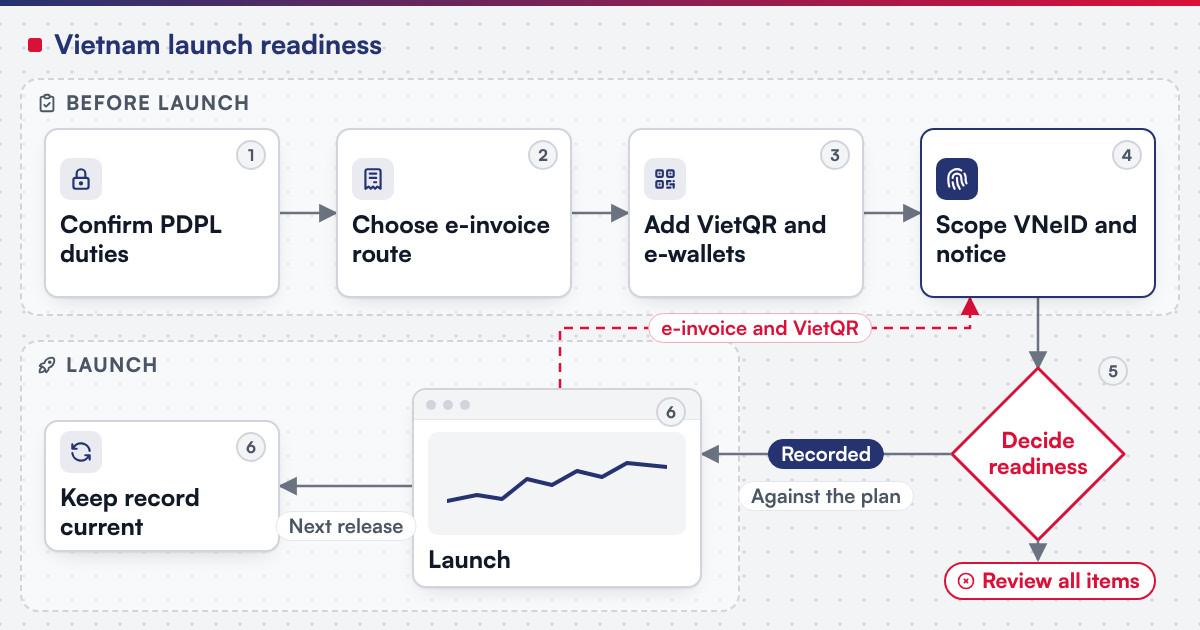 (opens the full-size diagram in a new tab)
Worked scenario: a Vietnamese shopper pays by VietQR transfer
A retailer launches a Vietnamese storefront where shoppers pay by scanning a VietQR code alongside cards and e-wallets.
-
VietQR selected
The shopper opens their bank's app and scans the checkout's VietQR code instead of entering an account number
- Owner
- Engineering
-
Transfer confirmed
The shopper confirms the transfer inside their own banking app
- Owner
- Shopper's bank app
-
Instant credit
The payment settles over the NAPAS network and the order updates immediately
- Owner
- Engineering
-
Fallback handled
If the transfer is not confirmed in time, the checkout offers a card or e-wallet retry rather than leaving the order stuck
- Owner
- Product owner
-
Invoice issued
A follow-up e-invoice, where one is needed, is issued under the tax authority's timing rules
- Owner
- Finance systems
-
Support view
An agent can see the payment status for a ticket, not the shopper's banking details
- Owner
- Support lead
A proposal that cannot describe step 4, specifically what the checkout does when a VietQR transfer does not confirm in time, has not yet scoped Vietnamese payments for this product.
What has Netbase built that is relevant to a Vietnam brief?
Working with a local Odoo implementation partner, Netbase has consulted on and customised Odoo in Vietnam for retail store chains, a food and beverage franchise chain, manufacturers, trading and distribution companies, a warranty service network, an industrial-park purchasing centre, an energy-sector project time and cost system, a university institute and a postal-service helpdesk; these clients are not named. The Odoo implementations record covers Odoo work of this kind, the Odoo platform page sets out where Odoo itself fits for a Vietnam-facing back office, and the Odoo for retail chains guide plans a rollout for one of the sectors above.
Which questions should you ask a supplier?
- Who owns the PDPL lawful-basis decision? It should be your organisation, with the supplier advising rather than deciding for you.
- Where is the data this product collects on Vietnamese users actually stored, and which categories does that cover? A supplier that cannot name the storage location should not be building the data layer yet.
- Which e-invoice route have you actually integrated, and who reconciles it? Ask for a real submission reference, not a slide.
- Does checkout support VietQR transfers and e-wallets alongside cards, and what happens when a transfer is not confirmed? A vague answer usually means the path has not been tested.
- Has the platform's notification been confirmed, and who maintains that record after launch? It should be your organisation's record, not the supplier's.
- Who owns Vietnamese copy, and how does a change reach production? Translation drift is easiest to catch before launch, not after.
What usually goes wrong?
- A lawful basis assumed rather than decided. Signal: nobody can name which basis each use of personal data relies on. Owner: the data protection lead.
- Data storage decided after the hosting provider is already chosen. Signal: user data for Vietnamese customers sits outside the country with no documented reason. Owner: the data protection lead, scoping this at discovery.
- The e-invoice route treated as a one-off form. Signal: the integration cannot issue a correction once a document has been reported to the tax authority. Owner: the finance systems owner.
- A checkout built around cards first, with VietQR bolted on at the end. Signal: the payment flow needs a disruptive rework rather than an addition. Owner: the product owner, who should put both rails in the same discovery estimate.
- The website notice forgotten until launch week. Signal: nobody can show the confirmation of the platform's notification. Owner: the product owner.
How this guide is sourced and where it stops
This guide uses the National Assembly's Law on Personal Data Protection and the government's decree detailing it, the National Assembly's Law on Cybersecurity, the decree amending the rules on invoices and documents, the Law on E-Commerce and its decree on platform notification, NAPAS's own description of VietQR transfers, and the Ministry of Public Security's own description of VNeID, all checked on 2026-10-24, together with company statements and delivery evidence approved in the OutsourcingVN claim register. It is written for product, finance and operations leads scoping a Vietnam-facing brief; it does not decide which lawful basis, storage location or notice route fits your organisation.
Plan the next step for your project
Common questions
The Law and its implementing decree took effect on 1 January 2026 and replaced the government's 2023 decree on personal data protection; check with your advisers which transitional provisions, if any, still apply to data your organisation collected earlier.
The Law on Cybersecurity requires covered online service providers to store the personal, relationship and user-created data of users in Vietnam inside the country for the period the Government sets; whether your product is covered is a question for your advisers.
Decree No. 70/2025/NĐ-CP lets high-volume services that reconcile data with the customer, such as telecommunications, e-commerce services, logistics and banking services other than lending, issue the invoice when reconciliation completes, no later than the 7th of the following month or 7 days after the agreed period ends; taxi businesses using fare software issue the e-invoice at the end of each trip and send its data to the tax authority at the same time.
Often both: a VietQR transfer moves over the NAPAS 247 fast-transfer service from a shopper's banking app, while cards and e-wallets cover other shoppers; scope the rails from where your customers pay.
Not necessarily. VNeID is an identification option a product may choose to accept, and many products launch without it and add acceptance once the integration is ready.
Under Decree No. 248/2026/NĐ-CP, the owner of an e-commerce platform that sells directly with an online ordering function files the notification online through the National Public Service Portal, the provincial People's Committee handles it, and a confirmed platform is listed on the e-commerce activity management system at online.gov.vn; confirm with your advisers whether your specific site or app falls inside that scope.
Plan the first release
Bring your PDPL lawful-basis and data-storage decisions, your e-invoice route, your VietQR and e-wallet scope, your VNeID and website-notice decisions, and your Vietnamese-language boundary. The data security and compliance guide lists the contract questions behind the data protection row, and the e-invoicing glossary entry defines the term this guide uses throughout. For other Southeast Asian markets, the Thailand guide covers the PDPA committee and PromptPay, the Malaysia guide covers the amended PDPA and MyInvois, and the Singapore guide covers phased redevelopment and identity data.
Custom Product Engineering is the service for a bounded build, and global delivery explains how remote delivery is organised. OutsourcingVN is Netbase's own outsourcing-services platform: submit a project with your Vietnam-facing scope, and a person will reply with whether discovery or a bounded implementation is the right next step.
Work behind this guide

No figure, no result and no partner name appears on this page.
Keep ReadingRelated services and solutions
 Custom product engineering for a bounded release outcome
One defined release of your product, built to named outcomes and handed over with acceptance evidence.
Learn More
Sources
- National Assembly of Vietnam, Law on Personal Data Protection, Law No. 91/2025/QH15
- Government of Vietnam, Decree No. 356/2025/NĐ-CP detailing the Law on Personal Data Protection
- National Assembly of Vietnam, Law on Cybersecurity, Law No. 116/2025/QH15
- Government Electronic Information Portal (policy news service), Decree No. 70/2025/NĐ-CP amending Decree No. 123/2020/NĐ-CP on invoices and documents
- NAPAS (National Payment Corporation of Vietnam), VietQR fast transfer service
- Ministry of Public Security, on VNeID level-2 electronic identification accounts
- Ministry of Industry and Trade, e-commerce activity management system
- National Assembly of Vietnam, Law on E-Commerce, Law No. 122/2025/QH15
- Government of Vietnam, Decree No. 248/2026/NĐ-CP detailing the Law on E-Commerce