

Nigeria software delivery: payments, phone sign-in and a state-by-state rollout
A Nigeria-facing product usually has to take payments through more than one provider, sign people in with their phone, keep messages flowing when one channel fails, and launch in one state before scaling. Decide who owns each payment state, each fallback and each rollout step before comparing build proposals, then test the failures as carefully as the successes.
Submit a project Explore custom engineeringReviewed by Huy Nguyen (David), CEO · Updated 13 Oct 2026 · 9 min read

OutsourcingVN is operated by Netbase JSC, so this guide is written by a supplier that would like your project. It rests on a Nigeria platform Netbase has built, two related West African records and official Nigerian references for the payment and data questions. The guides index lists the guides for other markets.
Contents
- What makes a Nigeria-facing build different?
- What did Netbase build for a Nigerian directory platform?
- Who owns each payment state?
- How should you test the provider boundary?
- Worked scenario: a pending payment that arrives twice
- Which questions should you ask a supplier?
- What usually goes wrong?
- How this guide is sourced and where it stops
- Common questions
- Plan the first release
What makes a Nigeria-facing build different?
Four design choices come up in almost every Nigeria-facing brief, and each changes what has to be tested.
- Payments through two providers. Buyers often integrate a second provider for resilience or coverage. That doubles the events to reconcile and raises the question of which provider's message is authoritative.
- Phone-first identity. Phone one-time-password sign-in is common, which makes SMS delivery part of the sign-in journey rather than a notification detail.
- Messaging with a fallback. Business messaging apps reach many users, but a message still needs a fallback route, often SMS, when the first channel fails.
- A staged geographic rollout. Launching in one state and scaling to others means configuration, administrators and reporting must work per state from the start.
The Central Bank of Nigeria publishes payment-service-provider categories and licensee lists, and the Nigeria Data Protection Commission publishes the Nigeria Data Protection Act 2023. Your commercial and legal advisers use those sources to choose providers and set data rules; engineering turns their decisions into states, fields and access rules.
What did Netbase build for a Nigerian directory platform?
For Dey Page, Netbase built a multi-state business directory in Nigeria, designed to launch in one state and scale to all 36. The registered scope maps directly onto the four choices above.
- Payments: featured-listing and badge subscriptions through two payment providers.
- Identity: phone one-time-password accounts.
- Messaging: business messaging with SMS fallback, plus click-to-chat from listings.
- Rollout: state, city and category pages, and five administrator roles with per-state dashboards.
- Field verification: a location-confirmed badge verified in the field with geotagged photos, identity capture, offline sync, a head-office review queue, 12-month expiry and an audit trail. Field capture runs in the mobile web app.
- Mobile: a cross-platform app with consumer and business-owner modes, push, deep links and in-app browser checkout, on a 12-week web and mobile plan.
The multi-state business directory record describes the built scope. It reports scope only: no public launch, app-store availability or user numbers are claimed.
Two related records add context. Netbase has built Magento stores with companion Android and iOS apps for an omnichannel fashion retailer in Nigeria, and an English-first multi-vendor marketplace for West Africa with vendor approval, commission deductions, payout requests and 90 days of post-launch support, described in the RB Marketplace and shopping app record.
Who owns each payment state?
Write the states down before choosing an integration, and give each one a single owner. The table assumes a subscription such as a featured listing.
| State | What triggers it | Authoritative record | Owner |
|---|---|---|---|
| Initiated | Customer chooses a plan and a provider | Your order record with its own identifier | Product owner |
| Pending | Provider accepted the request but has not confirmed | Provider reference stored against your order | Engineering |
| Confirmed | Verified server notification or status check from the provider | Provider event checked against your order and amount | Finance owner |
| Active | Business rule releases the benefit, such as the featured badge | Your subscription record with start and expiry dates | Business owner |
| Failed or abandoned | Provider failure or no confirmation within the agreed window | Order closed with a reason code | Support lead |
| Reversed | Refund or dispute accepted | Reversal record linked to the original order | Finance owner |
The rule that matters most: "the provider accepted a request" and "the business may release the benefit" are different states. Keep them apart even when a demonstration would look simpler with one.
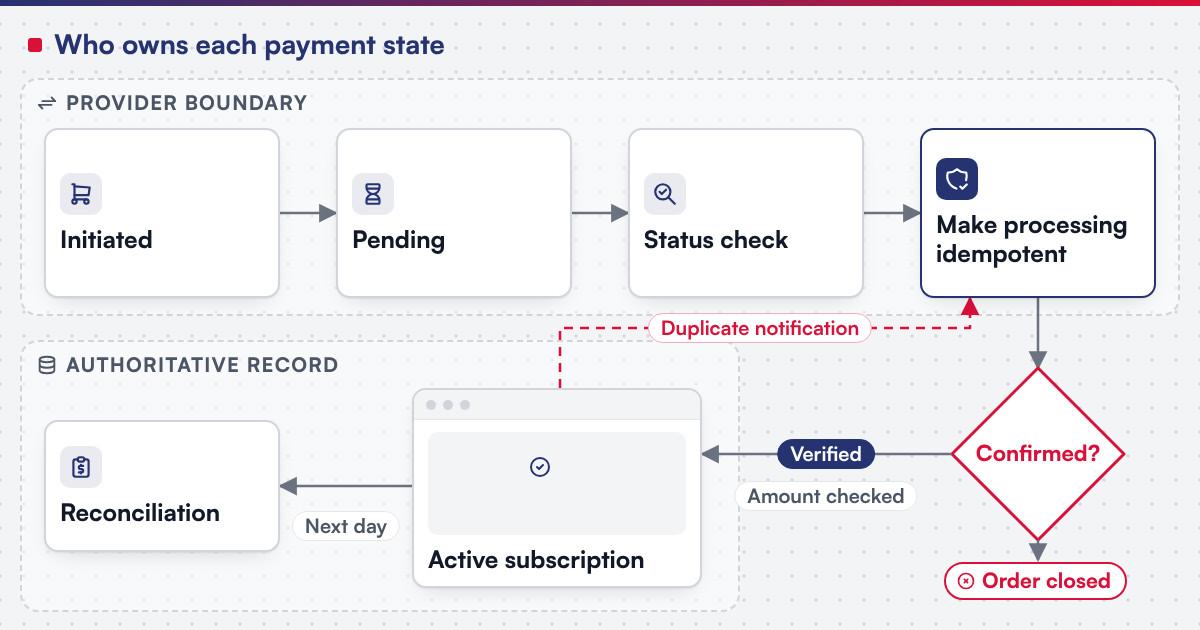 (opens the full-size diagram in a new tab)
How should you test the provider boundary?
-
Record account ownership
Name who holds each provider account, who stores credentials and who may change settings.
-
List every event
Browser returns, server notifications, status checks, settlement reports and manual back-office actions.
-
Make processing idempotent
A duplicate or delayed notification must update the same order, never create a second benefit.
-
Define the window for pending payments
Decide how long a payment may stay pending before a status check, and who is alerted.
-
Test OTP and SMS failure
Demonstrate a code that never arrives, a retry limit and a support route for a locked-out user.
-
Reconcile before launch
Compare your records with each provider's report for success, failure, duplicate and reversal cases.
Worked scenario: a pending payment that arrives twice
A business owner in the launch state buys a featured listing and pays through the second provider. The browser returns to the app before the provider confirms.
- Pending. The app shows "payment being confirmed" and stores the provider reference. The listing is not yet featured.
- Status check. No notification arrives within the agreed window, so a scheduled check queries the provider, which reports success.
- Activation. The subscription becomes active with a 12-month expiry, and a confirmation goes out by business messaging, with SMS as the fallback.
- Duplicate event. Ten minutes later, the provider's own notification arrives for the same payment. Because processing is keyed to the provider reference, the system records the event and changes nothing.
- Reconciliation. The next day, finance compares the provider report with orders. The payment appears once and matches one active subscription.
- Support. If the owner calls during step 1, the agent sees "pending, second provider, reference recorded" instead of guessing.
Every step names a record and an owner. A proposal that cannot describe steps 2, 4 and 5 has not yet scoped payments.
Which questions should you ask a supplier?
- Which provider's event is authoritative for each state? A good answer names the event and the check behind it.
- What happens to a duplicate notification? Look for idempotent processing keyed to a provider reference.
- How do you handle an OTP that never arrives? Expect retry limits, a fallback and a support route.
- How do you roll out state by state? Look for per-state configuration, administrators and reporting.
- How does field data sync when the connection drops? Expect offline capture, queued sync and a review queue.
- Who owns provider accounts and credentials at handover? It should be your organisation.
- What exactly is in the first release? Ask for a written boundary, including which provider launches first.
What usually goes wrong?
- One status for two meanings. Signal: benefits go live before payment is confirmed. Owner: the finance owner.
- SMS treated as guaranteed. Signal: users locked out when codes are delayed. Owner: the product owner, with a tested fallback.
- Rollout hard-coded for the first state. Signal: the second state needs code changes. Owner: engineering.
- Field records lost offline. Signal: agents repeat visits. Owner: the operations lead, with a sync and review queue.
- Provider accounts held by the supplier. Signal: you cannot rotate credentials after handover. Owner: the business sponsor.
How this guide is sourced and where it stops
This guide uses the Nigeria Data Protection Act 2023 published by the NDPC and the CBN's payment-service-provider pages, both accessed on 2026-09-27, and Netbase delivery records approved in the OutsourcingVN claim register. It is written for founders, product and operations leads preparing a brief. It does not select a provider or decide licensing; your advisers do. Netbase JSC's head office is in Hanoi, Vietnam, and it is the company's only office, so Nigerian projects are delivered remotely.
Plan the next step for your project
Common questions
Often yes, when resilience or payment-method coverage matters to your customers, but only if you can reconcile both. Each provider adds its own events, settlement report and support process. Launch with the provider that covers most customers, then add the second once the state model has been tested end to end.
Design for it. Set a retry limit, offer a second channel where your policy allows, and give support a way to verify and unlock an account. Test a code that never arrives before launch, because phone sign-in makes SMS delivery part of the login journey.
Yes, if the data model and administration are per state from the start. Dey Page was designed to launch in one state and scale to all 36, with per-state dashboards and five administrator roles, so adding a state is configuration and staffing rather than a rebuild.
It depends on scope. Dey Page was built on a 12-week web and mobile plan, which is the plan for one registered scope rather than an estimate for yours. Discovery should produce your own plan, with provider onboarding and field testing shown as separate tasks.
Your organisation. The supplier needs sandbox and test access to build and test, but production accounts, credentials and settlement reports should belong to the business that answers to customers and regulators, so handover does not depend on the supplier.
Plan the first release
Bring your payment journey, your provider shortlist, your OTP and messaging approach, your rollout order and the names of your finance, operations and support owners. The order and payment operations solution shows how payment states connect to fulfilment, and the total software delivery cost worksheet helps compare proposals line by line. The methodology explains how the records on this page are sourced. For other markets, the UAE guide covers bilingual Arabic products and identity, the Mauritius guide covers continuity and reconciliation, and the Ghana guide covers Data Protection Commission registration and mobile money interoperability for a neighbouring West African market.
Custom Product Engineering is the service for a bounded build, and global delivery explains how remote delivery is organised. OutsourcingVN is Netbase's own outsourcing-services platform: submit a project with your first payment journey, and a person will reply with whether discovery or a bounded implementation is the right next step.
Work behind this guide

This record reports built scope on a 12-week web and mobile plan.
Keep Reading
For RB Marketplace, Netbase built an English-first multi-vendor marketplace for West Africa on Laravel, then built the customer shopping app on that marketplace's own API.
Keep ReadingRelated services and solutions
 Custom product engineering for a bounded release outcome
One defined release of your product, built to named outcomes and handed over with acceptance evidence.
Learn More