

Ghana software delivery: data protection, mobile money and the Ghana Card
A Ghana-facing release usually turns on four decisions that sit outside the feature list: whether the product must register with the Data Protection Commission, how it joins mobile money interoperability for payments, whether it checks a customer's identity against the Ghana Card, and what connectivity and device limits the interface has to tolerate. Settle those before comparing proposals.
Submit a project Explore custom engineeringReviewed by David Nguyen (CEO) · Updated 13 Oct 2026 · 11 min read

OutsourcingVN is operated by Netbase JSC, so this guide is written by a supplier that would like your project. It sets out what Netbase can evidence for a Ghana brief, points to the official references your own advisers should read in full, and names the decisions that stay with you. The guides index lists guides for other markets, and the market index compares the first question each one raises.
Contents
- What makes a Ghana-facing build different?
- What can Netbase evidence for a Ghana brief?
- Which steps come before a Ghana-facing launch?
- Worked scenario: a Ghana Card check that returns no match
- What has Netbase built that is relevant to a Ghana brief?
- Which questions should you ask a supplier?
- What usually goes wrong?
- How this guide is sourced and where it stops
- Common questions
- Plan the first release
What makes a Ghana-facing build different?
Four design choices come up in almost every Ghana-facing brief, and each has a different owner.
- Data protection registration. Ghana's Data Protection Commission states that all data controllers and processors must register with it under the Data Protection Act, 2012 (Act 843), through a registration and renewal portal.
- Mobile money interoperability. GhIPSS, a wholly-owned subsidiary of the Bank of Ghana, runs Mobile Money Interoperability (MMI), moving funds between mobile money wallets, bank accounts and the e-zwich card scheme, alongside GhIPSS Instant Pay for real-time bank transfers.
- Ghana Card identity checks. The National Identification Authority (NIA) issues the Ghana Card and operates an Identity Verification Services programme that onboards outside institutions, including banks and telecoms, to confirm a cardholder's identity.
- Connectivity and device limits. The National Communications Authority (NCA) requires Type Approval before a device is sold or used in Ghana, and reports mobile voice and data penetration above 100% and 90%, which still leaves real gaps in device capability and connection quality.
A buyer's legal, finance and product owners should settle each of these with their own advisers before discovery starts; engineering then turns the decisions into registration records, payment integrations, verification calls and a tested low-bandwidth experience.
What can Netbase evidence for a Ghana brief?
Procurement and security reviewers tend to ask for the same statements. These are the ones Netbase can give, set against what a Ghana-facing brief actually needs decided.
| Decision area | What Ghana's rules and infrastructure expect | What a supplier can evidence | Who decides |
|---|---|---|---|
| Data protection | Registration with the Data Protection Commission for controllers and processors handling personal data | A data processing agreement, an access matrix, a tested breach-response plan | Data protection lead |
| Mobile money and payments | Interoperable transfer between wallets, banks and e-zwich through GhIPSS's MMI and GhIPSS Instant Pay | A tested integration against the chosen provider, with reconciliation against settlement reports | Finance systems owner |
| Identity verification | A Ghana Card check through the NIA's Identity Verification Services where the product needs verified identity | A tested verification call with a designed no-match and retry path | Product owner |
| Connectivity and devices | NCA Type Approval for any device sold into the market, and real gaps in bandwidth and device capability outside penetration headline figures | A tested low-bandwidth, low-end-device experience, not just a responsive layout | Engineering lead |
| Contracts and handover | A written scope, acceptance test and data-processing terms that respect Ghanaian consumer and data rules | A fixed-scope agreement with named milestones and acceptance evidence | Business sponsor |
Netbase's own security practices include secure code review and version control, role-based access control, MFA for admin dashboards, contributors under NDA, and NDAs and DPAs on request; a Ghana-facing data processing agreement sits on top of that baseline. Delivery communication is in English, and the Hanoi office works Monday to Saturday, 9:00-18:15 Vietnam time (UTC+7), with support coverage following those days.
Which steps come before a Ghana-facing launch?
-
Decide the registration posture
Confirm with your advisers whether your organisation, as controller or processor, must register with the Data Protection Commission before processing Ghanaian personal data at scale.
-
Choose the mobile money integration
Decide whether checkout needs direct wallet integration, GhIPSS's Mobile Money Interoperability, or a payment aggregator that already connects to it, and who holds the merchant account.
-
Scope the Ghana Card check
Name the journey that needs verified identity, and whether your organisation can onboard to the NIA's Identity Verification Services directly or through an intermediary your advisers approve.
-
Design for connectivity and device limits
Test the interface on a throttled connection and a low-end device, not only on the team's own hardware.
-
Decide go-live readiness
Check the registration status, the mobile money integration, the Ghana Card flow and the device testing against the plan, and record the decision with its owner.
-
Launch and keep the record current
Keep the data-processing agreement and breach-response plan current, and re-test the mobile money and identity integrations after any provider change.
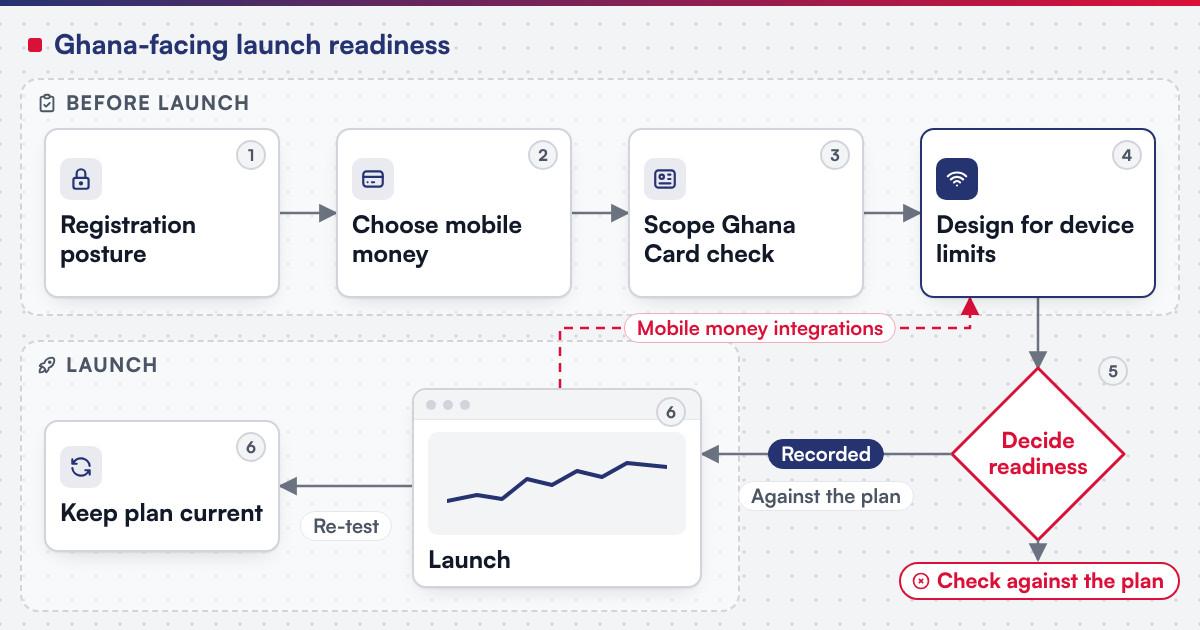 (opens the full-size diagram in a new tab)
Worked scenario: a Ghana Card check that returns no match
A fintech app asks new customers to verify their identity with their Ghana Card before raising their transaction limit.
-
Verification requested
The customer enters their Ghana Card number and the app calls the verification service
- Owner
- Engineering
-
No match returned
A typing error in the card number means the service reports no match, not a system fault
- Owner
- Engineering
-
Customer notified
The app tells the customer the check failed and asks them to re-enter the number, rather than silently rejecting the request
- Owner
- Product owner
-
Retry succeeds
The corrected number matches, and the verified status is recorded against the account
- Owner
- Engineering
-
Record stored
The account stores a verified flag and a timestamp, not the full verification response
- Owner
- Data steward
-
Support view
An agent handling a related ticket sees "verified" or "not yet verified", not the underlying card data
- Owner
- Support lead
A proposal that cannot describe steps 2 and 3, specifically what a customer sees when a check fails, has not yet scoped Ghana Card verification for this product.
What has Netbase built that is relevant to a Ghana brief?
The closest published examples for a Ghana-facing marketplace or directory brief are regional West African and Nigerian records, not Ghanaian ones. For RB Marketplace, Netbase built an English-first multi-vendor marketplace for West Africa: a buyer storefront with search and filters, cart and checkout; vendor registration with administrator approval, store profiles, inventory and order tracking; commission deductions and payout requests; and 90 days of post-launch support. Netbase also built that marketplace's customer shopping app, for Android with iOS in the extended scope, with social sign-in, smart search, a persistent cart, checkout through a secure web view, order tracking and returns with photos, across 45-plus screens delivered in six phases. See the RB Marketplace and shopping app record for the full scope; the client's legal entity and founder are not named.
For Dey Page, Netbase built a multi-state business directory in Nigeria, designed to launch in one state and scale to all 36: phone one-time-password accounts, a location-confirmed badge verified in the field with geotagged photos and offline sync, five administrator roles with per-state dashboards, featured-listing subscriptions through two payment providers, and business messaging with SMS fallback, on a 12-week web and mobile plan. See the multi-state business directory record; it is a Nigerian record, presented here as the closest published directory example, not as Ghanaian delivery. The marketplace and classifieds operations solution sets out how a buyer storefront, vendor management and payouts fit together for a West African or Ghanaian catalogue.
Which questions should you ask a supplier?
- Who registers with the Data Protection Commission? It should be your organisation as controller, with the supplier advising rather than registering on your behalf.
- Which mobile money integration have you actually tested, and can we see a reconciled settlement? Ask for a real report, not a slide.
- What happens when a Ghana Card check returns no match? Look for a retry path and a clear message, not a silent rejection.
- How do you test on a low-end device and a throttled connection? A good answer names a specific device and network profile, not just "responsive design".
- Who holds the merchant and verification-service accounts after handover? It should be your organisation.
- What is out of scope for the first release? A good proposal names it rather than leaving it implicit.
What usually goes wrong?
- Registration treated as optional. Signal: the product processes personal data at scale with no Commission registration on file. Owner: the compliance lead.
- Mobile money reconciliation skipped. Signal: finance cannot match payment records against a settlement report. Owner: the finance systems owner.
- Ghana Card mismatches left unhandled. Signal: customers who mistype their card number see a generic error with no retry path. Owner: the product owner.
- Testing only on flagship devices. Signal: the interface breaks on an older device over a weak connection, which office broadband never surfaces. Owner: the engineering lead.
How this guide is sourced and where it stops
This guide uses the Data Protection Commission's own site, GhIPSS's description of Mobile Money Interoperability and GhIPSS Instant Pay, the National Identification Authority's description of its Identity Verification Services, and the National Communications Authority's Type Approval requirement and penetration statistics, all accessed on 2026-10-13, together with Netbase delivery records approved in the OutsourcingVN claim register. It is written for founders, product and operations leads preparing a brief. It does not decide whether a specific product must register, or which mobile money integration fits a given business model; those decisions stay with your advisers. Netbase's only office is in Hanoi, Vietnam, and Ghana-facing work is delivered remotely from that base.
Plan the next step for your project
Common questions
Registration attaches to controllers and processors handling personal data, not to writing code, but the Commission's own site states registration is mandatory, so confirm your organisation's status and start the application early in the project rather than at launch.
No. GhIPSS runs the interoperability layer between wallets, banks and e-zwich, but many products integrate through a licensed payment service provider or aggregator that already connects to it; the choice changes who holds the merchant relationship and how reconciliation works.
No. Reserve it for journeys that need verified identity, such as raising a transaction limit or confirming an account holder, and design a clear retry path for the common case of a mistyped card number.
The National Communications Authority reports mobile voice penetration above 100% and mobile data penetration above 90%, but a headline figure is not a guarantee of fast, stable connections everywhere; test on a throttled connection and an older device rather than assuming uniform coverage.
Yes, when review and approval rhythms are agreed early. Netbase delivers remotely from Hanoi, with delivery communication in English and office hours of Monday to Saturday, 9:00-18:15 Vietnam time.
Plan the first release
Bring your registration status, your mobile money integration choice, your Ghana Card verification scope and the names of your compliance, finance and product owners. The marketplace and classifieds operations solution shows how storefronts, vendor management and payouts connect for a West African catalogue, and time zone collaboration in Vietnam sets out how an overlap window and escalation route are agreed. For other African markets, the Nigeria guide covers two-provider payments and a state-by-state rollout, the Kenya guide covers Data Protection Act registration and M-Pesa, and the South Africa guide covers a registered information officer and multi-method checkout.
Custom Product Engineering is the service for a bounded build, and global delivery explains how remote delivery is organised. OutsourcingVN is Netbase's own outsourcing-services platform: submit a project with your registration and payment questions, and a person will reply with whether discovery or a bounded implementation is the right next step.
Work behind this guide

This record reports built scope on a 12-week web and mobile plan.
Keep Reading
This record sets out what was delivered on each side, what deliberately stayed in the web panel, and what the project documents do not support.
Keep ReadingRelated services and solutions
 Custom product engineering for a bounded release outcome
One defined release of your product, built to named outcomes and handed over with acceptance evidence.
Learn More