

Singapore software delivery: phase the redevelopment, then add identity data
Many Singapore buyers are not starting from nothing: they run a working platform that needs redeveloping without stopping the business. Plan that work in phases with a written exit for each, decide separately whether Singpass Login or Myinfo prefill belongs in scope, and map where every personal-data field travels before a supplier starts building.
Submit a project Explore custom engineeringReviewed by Huy Nguyen (David), CEO · Updated 13 Oct 2026 · 9 min read

OutsourcingVN is operated by Netbase JSC, so this guide comes from a supplier that would like your project. It uses Netbase's longest Singapore engagement as the worked evidence and official Singapore references for the identity and data questions. The guides index lists the guides for other markets.
Contents
- What does a Singapore redevelopment usually involve?
- What did a multi-phase Singapore engagement look like?
- How should the phases be divided?
- How do you add Singpass or Myinfo safely?
- Worked scenario: a Myinfo prefill that does not match
- Which questions should you ask a supplier?
- What usually goes wrong?
- How this guide is sourced and where it stops
- Common questions
- Plan the first phase
What does a Singapore redevelopment usually involve?
A typical Singapore brief combines three kinds of work that should be scoped separately.
- Redeveloping what already runs. A live store, portal or service with real customers, orders and staff routines. The risk is breaking a working process, so the work moves in phases.
- Adding government identity services. Singpass Login for sign-in, and Myinfo for prefilling forms with verified personal data, each with onboarding prerequisites that the buyer's organisation must complete.
- Handling personal data. The PDPC's page on the Personal Data Protection Act is the official starting point for your advisers. Their conclusions about purpose, consent, notification and retention become fields, access rules and acceptance tests.
Mixing the three in one estimate hides the identity onboarding behind redevelopment work that is easier to see.
What did a multi-phase Singapore engagement look like?
Netbase's most substantial Singapore record is the redevelopment of an online print store for a large-format inkjet printing company in Singapore. Over several phases and more than a year, Netbase redeveloped the store's user experience, its interface and most of the system, using custom functions built from the client's own workflow, design and back-end and front-end specifications. The large-format print store redevelopment record describes the scope; the client is not named.
One custom function shows how redevelopment work becomes concrete. Shoppers upload PDF artwork into the online designer, and each page is converted to a high-resolution image that can be edited on the design canvas. The system warns about low-resolution uploads and maps the pages of a multi-page PDF to the sides of a product in order, so each can be picked in the editor. That function exists because the client specified its own production workflow, which is the pattern a long engagement should follow.
Netbase has also built web-to-print stores with online design tools for print businesses in Singapore, covering vinyl sticker cutting and large-format printing with specialist, production and designer roles. The identity sections below draw on the official Singpass and Myinfo documentation.
How should the phases be divided?
Give each phase a goal, an exit test and a decision that belongs to the buyer. A phase that cannot be accepted on its own is part of a larger phase.
| Phase | Goal | Exit evidence | Buyer decision |
|---|---|---|---|
| 1. Discovery and specifications | Written workflow, design and back-end specifications for the first release | Approved specifications and a data map | Which workflows move first |
| 2. Customer-facing redevelopment | New interface on the existing data and order flow | Side-by-side acceptance on real orders in staging | Cut-over date and rollback rule |
| 3. Custom functions | Functions that encode the buyer's own production rules | Test cases taken from real jobs, including awkward ones | Which rules are fixed and which are configurable |
| 4. Identity and prefill | Singpass Login or Myinfo prefill where the business decided it is needed | Onboarded test accounts, mismatch handling and fallback | Which attributes are requested and why |
| 5. Back-office and reporting | Staff screens, exports and reporting | Staff sign-off on daily tasks | What retires from the old system |
The incremental modernisation guide explains how to keep the old and new parts running side by side while phases move, which matters when the store takes orders every day.
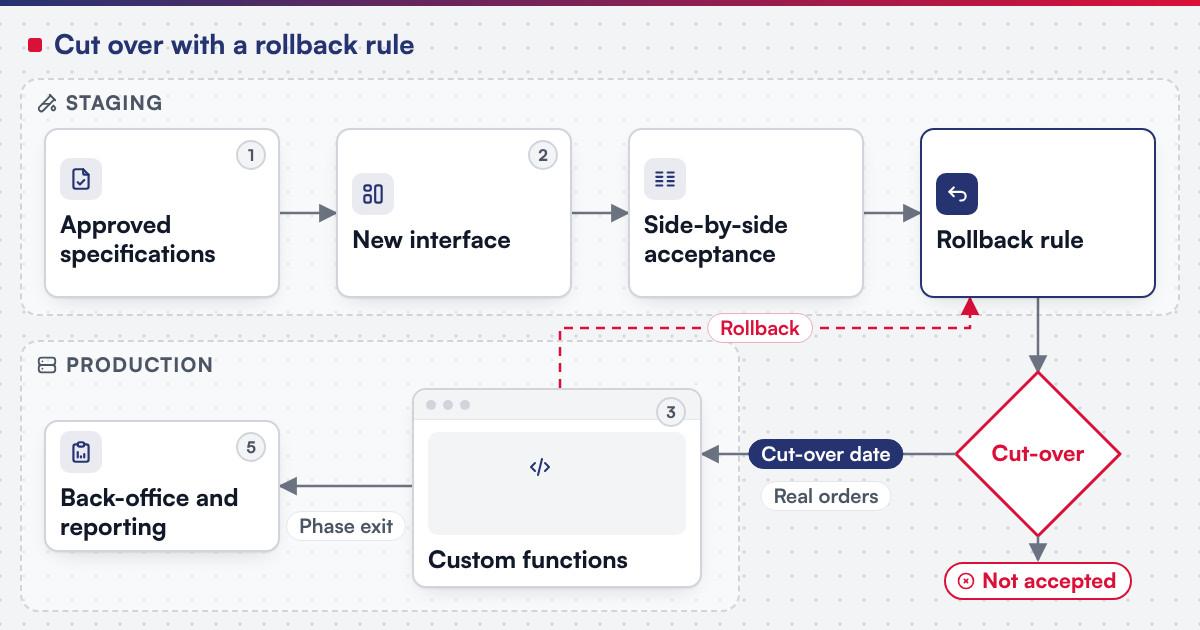 (opens the full-size diagram in a new tab)
How do you add Singpass or Myinfo safely?
-
Decide the purpose
Name the journey that needs verified identity or prefilled data, and why a customer benefits.
-
Complete onboarding as the buyer
The Singpass developer documentation describes onboarding prerequisites, test personas and integration materials; your organisation holds the relationship and credentials.
-
Request only the attributes the purpose needs
Your advisers confirm the purpose and notice wording; the data map records each field and its destination.
-
Decide which system owns each field
Myinfo can prefill a form, but your application still decides whether a customer may edit a prefilled value and which record wins later.
-
Design mismatch and fallback routes
Plan for declined consent, missing attributes, a session that expires and a service that is unavailable.
-
Test with official test personas
Demonstrate success, decline and mismatch in staging before the phase is accepted.
Worked scenario: a Myinfo prefill that does not match
A returning business customer of a print store starts a trade-account application and chooses to prefill with Myinfo. The registered address returned by Myinfo differs from the delivery address already on the customer's account, and the name format differs from the one on past invoices.
-
Prefill
The form shows Myinfo values marked as verified and keeps them read-only where the business requires it
- Owner
- Product owner
-
Mismatch found
The application compares prefilled values with the existing account and flags two differences
- Owner
- Engineering
-
Customer choice
The customer keeps the Myinfo registered address for the application and confirms the delivery address separately
- Owner
- Product owner
-
Record update
The account stores the verified registered address as a separate field; delivery addresses and invoice names are left untouched
- Owner
- Data steward
-
Review
Because the name differs from past invoices, the application goes to a staff queue instead of auto-approval
- Owner
- Operations lead
-
Audit
The system logs which fields were prefilled and which the customer changed, without copying the full Myinfo response into logs
- Owner
- Security owner
The scenario turns one vague requirement, "use Myinfo", into four decisions a proposal must answer: read-only rules, field ownership, the review queue and the logging boundary.
Which questions should you ask a supplier?
- How would you split our redevelopment into phases? A good answer proposes exits and rollback rules, not a single launch date.
- Where do the specifications come from? Look for a plan that starts from your own workflows and turns them into written specifications you approve.
- How do you keep the live platform running during redevelopment? Expect side-by-side operation, staged cut-over and a rollback route.
- Who completes Singpass or Myinfo onboarding? It should be your organisation, with the supplier working inside the access you grant.
- Which attributes will you request, and where will each one go? Expect a data map, not a list of every available field.
- What happens when prefilled data conflicts with our records? Look for a named rule and a review queue.
- Who runs weekly reviews, and who is our contact? Netbase delivery runs with weekly reviews and a named project manager; any supplier should name theirs.
What usually goes wrong?
- Every phase depends on the last. Signal: nothing can be accepted until the end. Owner: the product owner, who should require a usable exit per phase.
- Onboarding started late. Signal: identity work waits on credentials nobody requested. Owner: the business sponsor.
- Prefilled data overwrites the customer record. Signal: delivery addresses change without the customer asking. Owner: the data steward.
- Identity responses copied into logs. Signal: personal data appears in monitoring or support tools. Owner: the security owner.
- Specifications written by the supplier alone. Signal: custom functions fail on real jobs. Owner: the operations lead who knows the edge cases.
How this guide is sourced and where it stops
This guide uses the PDPC's Personal Data Protection Act page and the Singpass developer documentation, both accessed on 2026-09-27, and Netbase delivery records approved in the OutsourcingVN claim register. It is written for product, technology and operations leads preparing a brief. Your advisers decide how the PDPA applies to your organisation. Netbase JSC's head office is in Hanoi, Vietnam, and it is the company's only office, so Singapore projects are delivered remotely.
Plan the next step for your project
Common questions
Redevelop in phases when the current platform takes orders every day and its workflows are sound. Rebuild when the data model itself blocks change. Either way, write down what each phase delivers and what it retires, so the business can accept progress without waiting for a single launch.
It can prefill part of it. Your application still needs its own account model, consent wording approved by your advisers, and a route for customers who decline or whose data is incomplete. Treat Myinfo as a verified source for specific fields, not as your customer database.
It depends on scope. Netbase's large-format print store redevelopment in Singapore ran over several phases and more than a year. That is one record of one scope, and discovery should produce your own phase plan with an exit for each phase.
Only if the first phase includes a journey that needs verified identity. Many buyers redevelop the customer-facing flow first and add Singpass Login or Myinfo prefill once onboarding and the data map are ready, so identity does not hold up the rest of the release.
Yes, when the rhythm is set early. Netbase delivers remotely from Hanoi with weekly reviews and a named project manager. Agree the review day, the specification sign-off route and the escalation contacts at the start of the first phase.
Plan the first phase
Bring your current platform, the workflows that must not break, your Singpass or Myinfo decision and the names of your product, data and operations owners. The total software delivery cost worksheet helps you compare phased proposals, and the methodology explains how the records on this page are sourced. For other markets, the UAE guide covers bilingual Arabic products and UAE PASS, the UK guide covers supplier assurance and accessibility evidence, and the Malaysia guide covers the amended PDPA and DuitNow or FPX for a neighbouring Southeast Asian market.
Custom Product Engineering is the service for bounded phases, and global delivery explains how remote delivery is organised. OutsourcingVN is Netbase's own outsourcing-services platform: submit a project with your first phase, and a person will reply with whether discovery or a bounded implementation is the right next step.
Work behind this guide

No launch date, figure or business result is published here, because the source records none.
Keep ReadingRelated services and solutions
 Custom product engineering for a bounded release outcome
One defined release of your product, built to named outcomes and handed over with acceptance evidence.
Learn More