

Thailand software delivery: PDPA, PromptPay, e-Tax Invoice and Thai script
A Thailand-facing release usually turns on four decisions outside the feature list: how the Personal Data Protection Act and its committee govern consent, whether checkout needs PromptPay, whether invoices must enter the Revenue Department's e-Tax Invoice and e-Receipt system, and which Thai-language interface and font choices ship at launch. Identity checks, hosting and contract scope follow once those are settled.
Submit a project Explore custom engineeringReviewed by Huy Nguyen (David), CEO · Updated 17 Oct 2026 · 11 min read

OutsourcingVN is operated by Netbase JSC, so this guide is written by a supplier that would like your project. It sets out what Netbase can evidence for a Thailand-facing brief, points to the official references your own advisers should read in full, and names the decisions that stay with you. The guides index lists guides for other markets, and the market index compares the first question each one raises.
Contents
- What makes a Thailand-facing build different?
- What can Netbase evidence for a Thailand brief?
- Which steps come before a Thailand-facing launch?
- Worked scenario: a Thai QR payment that does not confirm
- What has Netbase built that is relevant to a Thailand brief?
- Which questions should you ask a supplier?
- What usually goes wrong?
- How this guide is sourced and where it stops
- Common questions
- Plan the first release
What makes a Thailand-facing build different?
Four design choices come up in almost every Thailand-facing brief, and each has a different owner.
- Data protection under the PDPA and its committee. The Personal Data Protection Act B.E. 2562 (2019) is Thailand's general data protection law, overseen by the Personal Data Protection Committee. It requires consent before personal data is collected unless one of the Act's other lawful bases applies, sets obligations on data controllers and processors and conditions for sending personal data out of Thailand, and requires a controller to notify the Office of the Personal Data Protection Committee of a breach without delay and, where feasible, within 72 hours.
- PromptPay and Thai QR at checkout. The Bank of Thailand supervises payment service providers and the country's payment systems under the Payment Systems Act B.E. 2560 (2017). PromptPay is the national scheme that lets a payer send funds using a registered mobile number or ID instead of an account number, and the Thai QR Payment standard carries QR-code checkout; most Thai consumer products expect at least one of them alongside cards.
- The Revenue Department's e-Tax Invoice & e-Receipt system. The Revenue Department runs e-Tax Invoice & e-Receipt as part of its move toward a fully electronic tax environment, and it keeps a public directory of the business operators already registered in the system.
- Thai-language interfaces and fonts. Thai script has no spaces between words, carries tone marks that change line-breaking and letter-shaping rules, and commonly appears alongside the Buddhist Era calendar in business documents; none of that is a late translation pass.
A buyer's legal, finance and product owners should settle each of these with their own advisers before discovery starts; engineering then turns the decisions into a consent and breach process, an invoicing integration, a payment flow and a language boundary.
What can Netbase evidence for a Thailand brief?
Procurement and security reviewers tend to ask for the same statements. These are the ones Netbase can give, set against what a Thailand-facing brief actually needs decided.
| Decision area | What Thai rules and infrastructure expect | What a supplier can evidence | Who decides |
|---|---|---|---|
| Data protection | Consent or another lawful basis under the Act, controller and processor duties, and breach notice to the committee's Office | A data processing agreement, an access matrix, a tested breach-response plan | Data protection lead |
| Tax invoicing | A structured submission into the Revenue Department's e-Tax Invoice & e-Receipt system | A tested submission route and a reconciled invoice export | Finance systems owner |
| Payments | PromptPay and Thai QR Payment, overseen by the Bank of Thailand, alongside cards | A tested PromptPay or QR flow with a designed fallback | Product owner with payments provider |
| Language | A Thai-language journey with correct script shaping in screens and generated documents | A named copy owner and a tested translation and rendering workflow | Localisation owner |
| Hosting and contracts | A written scope, acceptance test and hosting location that respects your data-protection decisions | A written scope with named milestones and acceptance evidence | Business sponsor |
Security practices include secure code review and version control, role-based access control, MFA for admin dashboards, contributors under NDA, and NDAs and DPAs on request. Netbase clients are in the United States, Europe and Asia-Pacific, and most projects come from clients outside Vietnam; delivery communication is in English, with the Hanoi office working Monday to Saturday, 9:00-18:15 Vietnam time (UTC+7).
Which steps come before a Thailand-facing launch?
-
Confirm the PDPA consent and breach decisions
Work with your advisers to decide your lawful basis for processing, whether a data protection officer or equivalent contact is needed, and how a serious breach is reported to the Personal Data Protection Committee.
-
Choose the e-Tax Invoice & e-Receipt route
Decide how invoices reach the Revenue Department's system and who in your organisation owns the submission and the reconciliation that follows it.
-
Add PromptPay and Thai QR
Decide which actions need PromptPay's proxy transfer, which need Thai QR Payment at the point of sale, and design a card fallback for when either is unavailable.
-
Scope the Thai-language interface
Name which journeys need Thai, decide how dates display, and who approves Thai copy and checks font rendering in generated documents before release.
-
Decide go-live readiness
Check the PDPA decisions, the e-Tax Invoice route, the payment flows and the language scope against the plan, and record the decision with its owner.
-
Launch and keep the record current
Keep the data-processing and breach-response plan current, and re-test the e-Tax Invoice and payment integrations after any provider or rule change.
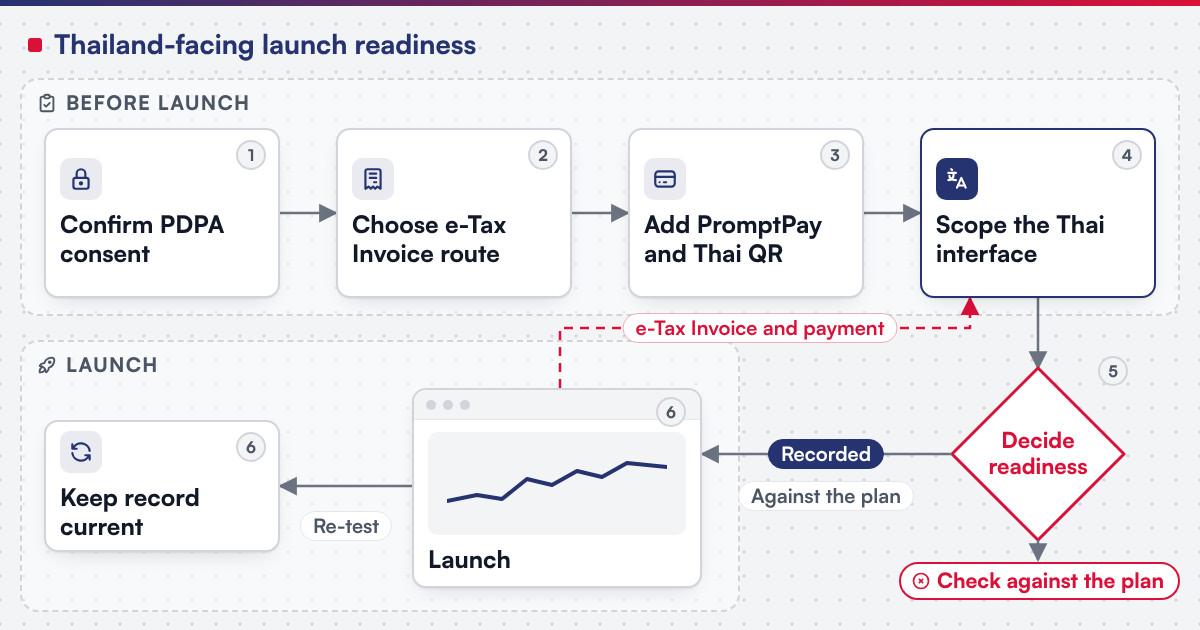 (opens the full-size diagram in a new tab)
Worked scenario: a Thai QR payment that does not confirm
An online retailer adds Thai QR Payment alongside PromptPay and cards so shoppers can pay straight from a banking app.
-
QR code shown
The checkout displays a Thai QR Payment code carrying the order amount and a merchant reference
- Owner
- Engineering
-
Scan and approve
The customer scans the code in their own banking app and approves the transfer there, outside the merchant's control
- Owner
- Engineering
-
No callback
The bank's confirmation callback does not arrive before the checkout's wait window closes
- Owner
- Product owner
-
Status checked
The checkout queries the transaction status rather than assuming failure, because the bank may still confirm later
- Owner
- Engineering
-
Fallback offered
If no confirmation arrives in the agreed window, the checkout offers PromptPay or a card as a fresh attempt, not a second QR charge
- Owner
- Product owner
-
Reconciliation
Finance matches the settlement report against orders the next day, by merchant reference
- Owner
- Finance owner
A proposal that cannot describe steps 3 and 5, specifically what happens when a QR confirmation does not arrive, has not yet scoped Thai payments for this product.
What has Netbase built that is relevant to a Thailand brief?
Netbase has a published record for a client in Thailand: a preview bar that lists every page of a multi-page design as a thumbnail, built for a design-tool provider in Thailand, is one of the online-designer features in the online designer feature builds record; the client is not named. The closest further evidence for a Thailand-facing commerce brief is regional. Netbase redeveloped an online print store for a large-format inkjet printing company in Singapore: over several phases and more than a year, Netbase redeveloped the store's user experience, interface and most of its system, including a function that converts uploaded PDF artwork into high-resolution, editable pages mapped to the sides of a product; the large-format print store redevelopment record has the detail. Netbase has also built web-to-print stores with online design tools for print businesses in Singapore, described by industry and country only. The product personalisation and online design solution sets out how designer and configurator work is scoped for a Thai storefront.
Which questions should you ask a supplier?
- Who owns the PDPA consent basis and breach reporting? It should be your organisation, with the supplier advising rather than making the decision for you.
- Which e-Tax Invoice & e-Receipt route have you actually integrated? Ask for a real submission reference against the Revenue Department's directory, not a slide.
- What happens when a QR confirmation does not return? Look for a status check and a fallback, not a second charge.
- Who holds the PromptPay and Thai QR merchant relationships after handover? It should be your organisation.
- How do you test Thai script in generated documents? Look for real Thai content, named devices and a defect log covering line breaks and tone marks, not a placeholder string.
- What is out of scope for the first release? A good proposal names it rather than leaving it implicit.
What usually goes wrong?
- PDPA consent and breach-reporting duties left undecided. Signal: nobody can say how a real incident would be reported to the Personal Data Protection Committee. Owner: the data protection lead.
- The e-Tax Invoice route treated as a one-off form. Signal: the integration cannot handle a correction or a cancellation. Owner: the finance systems owner.
- Only one payment method tested end to end. Signal: a QR confirmation failure leaves an order stuck with no fallback. Owner: the product owner.
- Thai rendering added as an afterthought. Signal: line breaks fall mid-word and generated PDFs mis-shape Thai text. Owner: the localisation owner.
How this guide is sourced and where it stops
This guide uses the Ministry of Digital Economy and Society's English translation of the Personal Data Protection Act, the Revenue Department's own e-Tax Invoice & e-Receipt page, the Electronic Transactions Development Agency's own site and the Bank of Thailand's payment-systems page, all accessed on 2026-10-17, together with Netbase delivery records approved in the OutsourcingVN claim register. It is written for product, technology and operations leads preparing a brief. It does not decide whether a specific product sits inside the Personal Data Protection Act's scope or which e-Tax Invoice route fits your transaction volume; those decisions stay with your advisers. Bangkok and Hanoi share the UTC+7 time zone.
Plan the next step for your project
Common questions
The Act sets duties around consent and its other lawful bases, controller and processor obligations and breach notice to the committee's Office rather than a universal registration step; confirm your organisation's specific duties with your advisers.
The Revenue Department runs the service as part of a broader move to electronic tax documents; a lower transaction volume may start with a simpler submission route, while a higher volume usually justifies a direct integration and reconciliation workflow.
Many Thai consumer products add PromptPay first for its proxy-transfer convenience, then Thai QR Payment for shoppers who prefer scanning a code in their banking app; test your own customer base before dropping either.
It depends on your audience. Many consumer products ship Thai for the journeys customers use most and keep internal back-office screens in English, provided the boundary is written down and a named owner reviews Thai copy and rendering before release.
Yes, when review and approval rhythms are agreed early. Netbase delivery communication is in English, and the Hanoi office works Monday to Saturday, 9:00-18:15 Vietnam time, in the same UTC+7 time zone as Bangkok.
Plan the first release
Bring your PDPA consent and breach-reporting decisions, your e-Tax Invoice route, your PromptPay and Thai QR scope and the names of your legal, finance and product owners. For neighbouring markets, the Malaysia guide covers the amended PDPA, phased MyInvois e-invoicing and DuitNow payments, the Singapore guide covers phased redevelopment and identity data, and the Indonesia guide covers electronic-system registration and QRIS. Time zone collaboration in Vietnam sets out how an overlap window and escalation route are agreed.
Custom Product Engineering is the service for a bounded build, and global delivery explains how remote delivery is organised. OutsourcingVN is Netbase's own outsourcing-services platform: submit a project with your registration and payment questions, and a person will reply with whether discovery or a bounded implementation is the right next step.
Work behind this guide

Netbase redeveloped the user experience, interface and most of the system behind the online store of a large-format inkjet printing company in Singapore, across several phases and more than a year.
Keep Reading
Netbase built custom features into the online designers and order flows of six unnamed print businesses: a photo background remover with more than 30 cartoon filter styles, a page-thumbnail preview bar, invitation-card order rules, finished-size rulers, wallpaper sample ordering and a label website with four design paths. No result is claimed.
Keep ReadingRelated services and solutions
 Custom product engineering for a bounded release outcome
One defined release of your product, built to named outcomes and handed over with acceptance evidence.
Learn More