

South Africa software delivery: settle POPIA, payments and hosting before the build
Software built for South African users typically needs a registered information officer, a checkout that accepts the payment methods local shoppers actually use, and a written decision on where personal information is processed and stored. Settle those three points, each with a named owner, before comparing build proposals.
Submit a project Explore custom engineeringReviewed by Huy Nguyen (David), CEO · Updated 15 Oct 2026 · 9 min read

OutsourcingVN is operated by Netbase JSC, so this guide is written by a supplier that would like to build your product. It draws on a West African marketplace platform Netbase has delivered and on South Africa's official information-regulator and payment-provider references for the questions your own advisers should answer. The guides index lists the guides for other markets.
Contents
- What makes a South Africa-facing build different?
- What did Netbase build for a West African marketplace?
- How do you decide which payment methods to support?
- Which registration and processing decisions come before launch?
- Worked scenario: a shopper pays by Instant EFT and closes the browser
- Which questions should you ask a supplier?
- What usually goes wrong?
- How this guide is sourced and where it stops
- Common questions
- Plan the first release
What makes a South Africa-facing build different?
Three decisions shape a South Africa-facing scope more than any single feature, and each needs a named owner on the buyer's side before development starts.
- Information governance. The Protection of Personal Information Act sets conditions for lawful processing and, under section 55, requires a responsible party to register its information officer with the Information Regulator before that person takes up the role.
- Payment acceptance. South African shoppers split across card payments, Instant EFT bank redirects and QR codes, so a checkout built around a single method turns away demand a wider integration would have captured.
- Data location. Where personal information is captured, processed, backed up and supported needs a written decision, because moving it outside South Africa carries its own conditions under the Act.
A buyer's legal advisers should open with the Information Regulator's own guidance on which POPIA conditions apply, who counts as the responsible party, and when an operator rather than the buyer's organisation carries the registration duty. Their conclusion becomes an engineering input: a data map, a retention rule and an access model.
What did Netbase build for a West African marketplace?
The most relevant registered scope for a South Africa-facing marketplace comes from a build for a different African market: an English-first, Laravel-based multi-vendor marketplace. On the buyer side it covers search and filters, a wishlist, cart and coupon-driven checkout. On the seller side, sign-up runs through an approval queue before a vendor gets a storefront profile, catalogue and stock controls, order handling with status tracking, and a ledger of earnings, commission deductions and withdrawal requests. Administrators moderate vendors and listings, set commission rules, run campaigns and read the analytics; a REST API feeds the customer app with device tokens for notifications, and outbound email is authenticated with SPF and DKIM. Post-launch support ran for 90 days. See the multi-vendor marketplace record for the full scope; the client is not named.
Two further registered records round out the picture. Netbase built a comparable multi-state business directory in Nigeria with phone sign-in, field verification and per-state administration, and has delivered Magento stores with companion mobile apps for fashion and equipment retailers in several countries. Together they show the marketplace, directory and commerce pattern a South Africa-facing brief typically draws on.
How do you decide which payment methods to support?
A South Africa-facing checkout is usually built around more than one method. PayFast's own product pages describe an integration that spans card payments, Instant EFT, QR codes and a buy-now-pay-later option in a single gateway, which matches the mix a local shopper expects to see.
| Method | What it needs | Typical buyer |
|---|---|---|
| Card payments | Tokenised card storage through the gateway, with a 3-D Secure step | Most consumer checkouts |
| Instant EFT | A bank-redirect flow with a webhook or polling confirmation | Buyers without a card, or who prefer a bank transfer |
| QR-code payment | A scannable code tied to the order and a mobile banking app | In-person and click-and-collect orders |
| Buy-now-pay-later | A separate approval step and its own settlement report | Higher-value consumer goods |
Write down which rows the first release needs and who reconciles each one; adding a row later is easier than untangling a checkout built for only one.
Which registration and processing decisions come before launch?
-
Name the information officer
Confirm who holds that role for the buyer's organisation and that registration with the Information Regulator happens before, not after, the platform starts processing personal information.
-
Map the data
List every field the product collects, why it is collected, and which condition of the Act justifies collecting it.
-
Choose the payment mix
Decide which of cards, Instant EFT, QR and buy-now-pay-later the first release needs, and who reconciles each one.
-
Decide the hosting location
Record where production data, backups, logs and support tools run, and who can access each environment.
-
Write the retention rule
Set how long each category of personal information is kept and how deletion is tested, not only promised.
-
Test the cross-border question
If any processor or sub-processor sits outside South Africa, confirm the safeguard your advisers require and record it against that specific transfer.
Worked scenario: a shopper pays by Instant EFT and closes the browser
- Redirect. The shopper chooses Instant EFT at checkout and is sent to their own bank's login page, away from the merchant site.
- Interruption. The shopper approves the payment inside the banking app but closes the browser tab before returning to the store.
- Pending order. The order stays in a "payment pending" state with the bank reference stored against it; no stock is released.
- Webhook arrives. The gateway's server notification confirms the payment a few minutes later, matched to the order by its reference.
- Fulfilment triggers. Because the match runs on the stored reference rather than the browser session, the order moves to "paid" and fulfilment starts without the shopper doing anything else.
- Support view. If the shopper calls in the meantime, support sees "EFT redirect confirmed, awaiting bank webhook" instead of a blank order status.
A proposal that cannot describe steps 3 and 4 has usually not scoped Instant EFT, because the browser return and the bank's own confirmation are two separate events a checkout must reconcile.
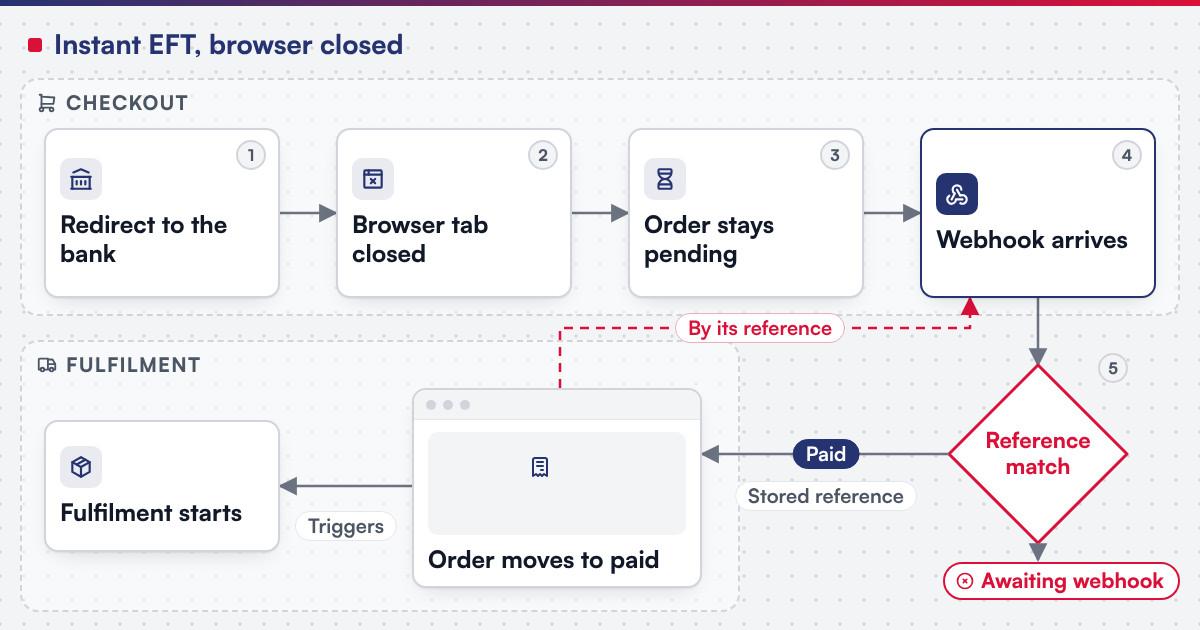 (opens the full-size diagram in a new tab)
Which questions should you ask a supplier?
- Which payment methods have you actually integrated, not just listed? Ask to see a completed order for each one.
- Who registers as the information officer, and when? It should be a named person at your organisation, registered before processing starts.
- What happens when a bank redirect is interrupted? Look for a pending state and webhook-based reconciliation, not a guess based on the browser return.
- Where do production data and backups live? Expect one written answer, covering support tools and logs as well.
- How is a cross-border transfer recorded? Expect a named safeguard per transfer, not a blanket assurance.
- What is excluded from the first release? A good proposal lists a second payment method or a later region as an exclusion, not a surprise.
What usually goes wrong?
- Information officer registered after launch. Signal: processing starts before the Regulator has the registration. Owner: the buyer's compliance lead.
- One payment method for a multi-method market. Signal: checkout abandonment on the payment step. Owner: the product owner, testing the full mix.
- EFT treated as instant. Signal: orders marked paid before the bank webhook arrives. Owner: engineering, with reconciliation built in from the start.
- No written hosting decision. Signal: staging or logs sit somewhere nobody chose on purpose. Owner: the security or operations lead.
How this guide is sourced and where it stops
This guide uses the Information Regulator's own site and PayFast's published payment-methods pages, both checked on 2026-09-29, and a Netbase delivery record approved in the OutsourcingVN claim register. It is written for product, operations and procurement leads preparing a brief. It does not decide which POPIA conditions apply to your organisation; that stays with your advisers. Hanoi, Vietnam, is Netbase JSC's only office, and South Africa-facing work is delivered remotely from there.
Plan the next step for your project
Common questions
Not necessarily. Many buyers launch with cards and Instant EFT, which cover most shoppers, and add QR or buy-now-pay-later once the checkout has been tested end to end.
A named person at your organisation, not the supplier. The supplier can help build the data map, but registration and ongoing accountability sit with the responsible party under the Act.
It depends on your organisation's own process and how quickly the data map and internal sign-off are ready; start the registration early rather than in the final sprint before launch.
Yes, when sandbox credentials are supplied early enough to test both the successful and the interrupted paths for each method before launch.
A registered scope only: search, cart and checkout for buyers; approval, catalogue, order and payout tools for vendors; and 90 days of post-launch support. See the multi-vendor marketplace record for the details.
Plan the first release
Bring your payment-method shortlist, your information officer's name, your hosting decision and the retention rule your advisers have set. The total software delivery cost worksheet helps you compare proposals that include registration, reconciliation and hosting work, and the methodology page explains how the claims on this page are recorded. Our guide to data security and compliance in outsourcing lists the contract questions that sit around the hosting decision. For other African markets, the Nigeria guide covers phone sign-in and two-provider payments, the Mauritius guide covers continuity and reconciliation, and the Ghana guide covers mobile-money interoperability and Ghana Card identity checks.
Custom Product Engineering is the service for a bounded build, and global delivery explains how remote delivery is organised. OutsourcingVN is Netbase's own outsourcing-services platform: submit a project with your payment shortlist, and a person will reply with whether discovery or a bounded implementation is the right next step.
Work behind this guide

This record sets out what was delivered on each side, what deliberately stayed in the web panel, and what the project documents do not support.
Keep ReadingRelated services and solutions
 Custom product engineering for a bounded release outcome
One defined release of your product, built to named outcomes and handed over with acceptance evidence.
Learn More