

Saudi Arabia software delivery: decide who issues the invoice before you scope the storefront
A Saudi-facing build needs three answers before suppliers can quote it well: which system issues the tax invoice, how customer personal data reaches a remote delivery team, and who accepts the Arabic and English versions. Phase the project around those answers, so the storefront can launch while e-invoicing and ERP links follow on a dated plan.
Submit a project Explore custom engineeringReviewed by Huy Nguyen (David), CEO · Updated 28 Sep 2026 · 10 min read

OutsourcingVN is operated by Netbase JSC, so this guide comes from a supplier with an interest in how you buy. It draws on a bilingual web-to-print platform Netbase built for a Riyadh client and on official Saudi references your finance and legal advisers should read. The guides index lists the other market guides.
Contents
- What makes a Saudi-facing scope different?
- What did a Riyadh web-to-print build deliver, and what was planned?
- Which system should issue the e-invoice?
- How do you plan personal data with a remote team?
- Should national sign-in be in the first release?
- Worked scenario: a corporate order before the ERP link exists
- Which questions should you ask a supplier?
- What usually goes wrong?
- How this guide is sourced and where it stops
- Common questions
- Plan the first phase
What makes a Saudi-facing scope different?
Four Saudi-specific questions change the plan more than the feature list does.
- The tax invoice. ZATCA, the Zakat, Tax and Customs Authority, requires taxpayers in the Kingdom to adopt e-invoicing solutions that meet its requirements. Its e-invoicing page records a first phase from 4 December 2021 and a second, integration phase from 1 January 2023. The practical question is which system produces the compliant invoice.
- Personal data. The Personal Data Protection Law is overseen by SDAIA, the Saudi Data and AI Authority, which publishes the law, its implementing regulations and a separate regulation on transferring personal data outside the Kingdom. A delivery team working abroad makes that transfer question concrete.
- National sign-in. The national portal lists a National Single Sign-On service, widely known as Nafath. Whether your platform can use it, and for which journeys, is an onboarding and eligibility question your organisation answers first.
- The working week. Saudi offices usually work Sunday to Thursday, and Riyadh is four hours behind Hanoi with no daylight-saving change on either side. A supplier working Monday to Friday shares four weekdays with you, so plan approvals for Monday to Thursday.
What did a Riyadh web-to-print build deliver, and what was planned?
The closest published example is a platform for Deyar Printing & Advertising, a printing, packaging, signage and fleet-branding company in Riyadh. Netbase scoped and built a bilingual Arabic right-to-left and English web-to-print platform on a Laravel headless commerce foundation. It includes an online designer studio with Arabic fonts, templates and uploads, print-ready PDF generation with pre-flight checks and proof approval, request-for-quote lead capture, multi-branch ordering and a production back office, across seven product families and more than 50 configurations. Delivery ran in phases from discovery and launch to production operations.
The AI design and pre-press suite, ERP integration and ZATCA e-invoicing were planned third-phase work and are not presented as delivered. That sequence is itself the lesson for a Saudi buyer: the customer-facing platform, the Arabic design canvas and the production back office went first, and the finance integrations were scheduled as a distinct phase with their own dependencies. The bilingual web-to-print platform record describes the scope, and the print order and fulfilment guide covers the order-to-production workflow behind it.
Which system should issue the e-invoice?
Decide this with your finance owner and tax adviser before the build. Each option moves work and risk to a different place.
| Option | What the new platform does | Best fit | What to settle first |
|---|---|---|---|
| Platform issues invoices | Generates the invoice, connects to the ZATCA integration and stores the result | The platform is the system of record for sales and no ERP is in scope | Who operates the connection, renews its credentials and monitors rejected submissions |
| ERP or accounting system issues invoices | Sends confirmed orders to the ERP; the ERP produces the tax invoice | An ERP already handles tax and reporting, or one is planned | The order-to-ERP mapping, timing and what happens while the link is down |
| Accredited solution provider | Passes order data to a provider chosen from ZATCA's indicative list | The team wants invoicing kept outside the custom code | The provider's interface, your contract with it and reconciliation reports |
| Phased: interim route, then integration | Launches with the current invoicing route and adds integration in a dated phase | The storefront must launch before finance integration is ready | A written boundary, a manual procedure and a target date for the integration phase |
Whichever row you choose, name one owner for invoice correctness: the supplier builds the integration, but the tax position stays yours. The ERP procurement and inventory guide helps when the ERP option pulls stock and purchasing into scope, and the Mauritius guide covers the reconciliation reports that finance teams usually ask for once two systems hold order data.
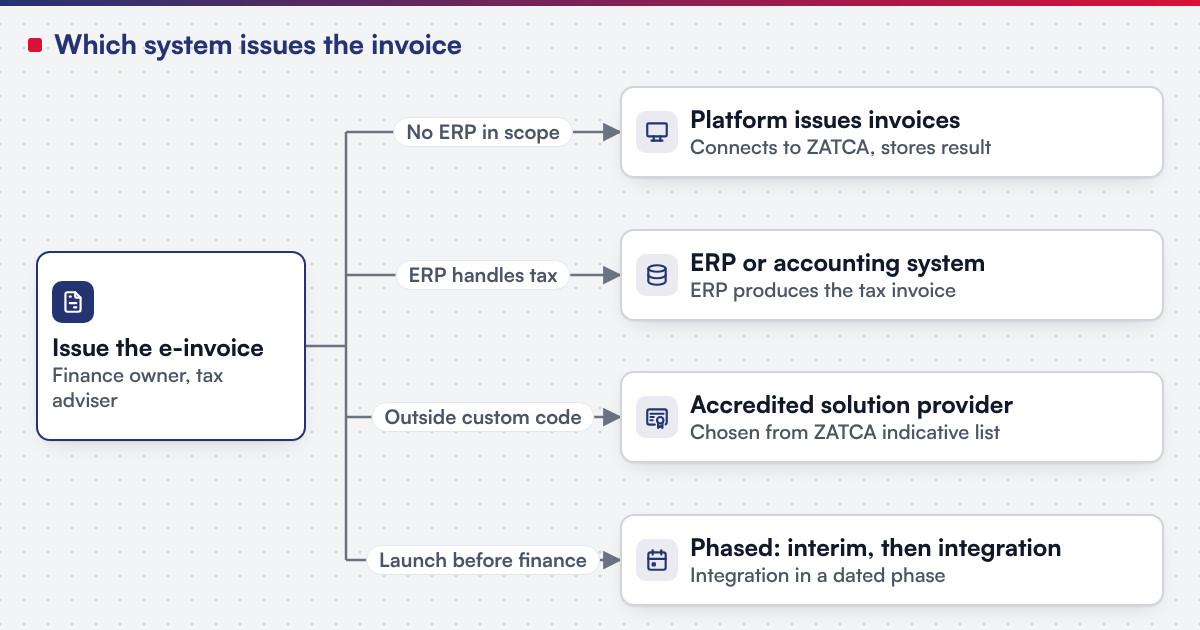 (opens the full-size diagram in a new tab)
How do you plan personal data with a remote team?
Your advisers decide how the Personal Data Protection Law and its transfer regulation apply to you. Their decisions become these engineering steps.
-
Map the personal data
List each field the platform collects, from delivery addresses to national identity attributes, and record why it is needed.
-
Decide where production data lives
Choose the hosting location with your advisers before architecture work, because it shapes environments, backups and monitoring.
-
Keep the remote team away from live data by default
Build and test with anonymised or synthetic records, and grant production access only for named support tasks.
-
Write the access rule down
Netbase security practices include secure code review and version control, role-based access control, MFA for admin dashboards, contributors under NDA, and NDAs and DPAs on request; ask any supplier for its equivalent in writing.
-
Plan requests and incidents
Decide how a customer's request to see or correct data is handled and who is called first when something goes wrong.
The data security and compliance guide covers the supplier controls to ask for in more depth.
Should national sign-in be in the first release?
Only if a journey needs verified identity and your organisation can obtain access through the approved onboarding route. A business-to-business print portal can often launch with email or phone verification and company approval by a branch administrator, then add national sign-in for account types that need it. Keep an identity-status field on each account from the start, so adding a verified route later does not create duplicate customers. The UAE guide walks through the same pattern for UAE PASS, including the declined sign-in case.
Worked scenario: a corporate order before the ERP link exists
A Riyadh print company launches its bilingual storefront in phase one. ERP integration and e-invoicing are scheduled for phase three, so the phased row of the table applies.
A procurement officer at a corporate customer switches to Arabic, designs fleet-branding panels in the design studio, requests a quote for three branches and approves the proof. The order reaches the production back office, which splits it into three branch deliveries.
Because the platform does not yet issue tax invoices, the written boundary says what happens next: the back office exports the confirmed order in an agreed format, the finance team raises the invoice through its current compliant route, and the invoice reference is entered against the order so customer service can answer questions in either language. Phase-one acceptance tests that export.
In phase three, that export becomes the specification for the ERP link, and the team replays past orders through it in staging before switching over.
Which questions should you ask a supplier?
- Invoicing. Which of the four invoicing options do you recommend for our setup, and what would you need from our finance team to test it?
- Arabic acceptance. Who on your side reviews right-to-left layouts, Arabic fonts in generated PDFs and bilingual notifications, and what evidence do we receive?
- Data access. Which of your staff would see production personal data, when, and how is that access granted and removed?
- Phasing. Which features do you place in later phases, and how are those phases written into the proposal so nobody reads them as delivered?
- Rhythm. How do you schedule reviews across a Sunday-to-Thursday and a Monday-to-Friday week?
What usually goes wrong?
- E-invoicing assumed to be part of checkout. Signal: finance discovers the gap during launch week. Owner: the finance lead, who should choose an invoicing option in discovery.
- Arabic tested only in the web interface. Signal: disconnected letters on proofs, labels or delivery notes. Owner: the operations lead, who must review real generated files.
- Production data copied to development. Signal: customer records appear in test environments or screenshots. Owner: the technical lead, with a written anonymisation rule.
- Planned phases described as scope. Signal: a sales deck promises ERP or AI features that sit in phase three. Owner: the product owner, who keeps the phase boundary in every document.
The software acceptance criteria guide shows how to turn each of these into a test before sign-off.
How this guide is sourced and where it stops
This guide uses the ZATCA e-invoicing page, SDAIA's laws and regulations page and the national portal's single sign-on service listing, all accessed on 2026-09-29, together with a Netbase delivery record and company statements approved in the OutsourcingVN claim register. It is written for product, finance, operations and procurement leads preparing a Saudi brief. It does not decide which tax or data rules apply to your organisation; your advisers do. Netbase JSC's head office is in Hanoi, Vietnam, and it is the company's only office, so Saudi projects are delivered remotely, and Netbase delivery communication is in English.
Plan the next step for your project
Common questions
Not necessarily. Your organisation must invoice through a compliant solution, but that solution can be an existing ERP, accounting system or provider rather than the new platform. Choose the route with your tax adviser and write it into the scope, including who owns rejected or corrected invoices.
Yes, when the design keeps personal data where your advisers decide it belongs and the remote team works mainly with anonymised records. Ask for named access, logged production support and a data processing agreement, and confirm the approach against the transfer regulation with your advisers.
Appoint a reviewer on your side who approves real Arabic strings, product names and generated documents in each increment. The delivery team implements approved content and reports layout breaks, while legal and marketing wording stays with its owners after launch.
Enough to take and fulfil real orders in both languages. The Riyadh platform above went first with its design studio and production back office, while ERP and e-invoicing formed a planned later phase.
Hanoi is four hours ahead of Riyadh, so a Hanoi afternoon overlaps a Riyadh morning. The time-zone collaboration guide explains how to set review windows, and the working-week difference means approvals are best planned for Monday to Thursday.
Plan the first phase
Bring your product families, the journeys you need in both languages, your invoicing route and the names of your finance, language and data owners. Custom Product Engineering is the service for a bounded bilingual build, global delivery explains how remote delivery is organised, and the methodology shows how the statements on this page are recorded. OutsourcingVN is Netbase's own outsourcing-services platform: submit a project with your invoicing decision, even if it is still open, and a person will reply with the discovery questions to settle first.
Work behind this guide

This record separates what was delivered from a third phase that the source describes as planned, and it claims no result for either.
Keep ReadingRelated services and solutions
 Custom product engineering for a bounded release outcome
One defined release of your product, built to named outcomes and handed over with acceptance evidence.
Learn More