

Plan print orders from configuration to accepted fulfilment
Print order and fulfilment software should carry one order record from the customer's configuration and artwork through proof approval, production release, dispatch and exception handling without anyone retyping it. Before choosing a platform, map that record, the release gate that moves an order into production, and the person who owns each hold, reprint and split shipment.
Submit a project Explore custom engineeringReviewed by Huy Nguyen (David), CEO · Updated 1 Oct 2026 · 10 min read

OutsourcingVN is operated by Netbase JSC, so this is buying guidance for work we sell. Print is also the domain where Netbase's record runs deepest: Netbase has built web-to-print platforms since 2012, the year the company was founded, and Netbase has delivered 50+ custom web-to-print platforms across apparel, packaging, signage, promotional merchandise and corporate B2B portals. The guide draws on that record wherever it answers a buyer question.
What this guide covers
- What must a print order record carry?
- Which checks can be automatic, and which need a person?
- What have Netbase's print projects put into the order record?
- What did the named print clients report afterwards?
- Worked example: a variable-data order with a rejected proof
- What goes wrong, and who acts?
- Which questions should you ask a print software supplier?
- Common questions
- How this guide is sourced
- Turn the map into a buyer brief
What must a print order record carry?
An online print order is not finished when payment succeeds. It still needs a valid specification, an artwork state, a production route, a delivery commitment and a record of every intervention. Follow one ordinary order from entry to delivery, then repeat the exercise for the orders that cause rework: variable data, artwork needing review, rush jobs, split shipments and a customer change after approval.
| Decision area | Question to settle | Evidence at handoff | Delivered example |
|---|---|---|---|
| Configuration | Which options are valid together, and who maintains the rules? | A saved configuration with a version | A 3D preview for boxes and other multi-sided products |
| Artwork | Which formats are accepted, what is checked automatically, when does a person step in? | Original file, rendered proof and approval state | PDF pages converted to editable images, with a low-resolution warning |
| Proof | Who approves, and what happens after a rejection? | Proof version, approver and timestamp | Print-ready PDF generation with pre-flight checks and proof approval |
| Production release | Which conditions create a job or hold the order? | Route, quantity, due date and queue | Structured order data with a production summary per order for staff |
| Fulfilment | Can an order split, substitute or ship partly? | Shipment records and tracking reference | Multi-branch ordering and a production back office |
| Service recovery | Who may reprint, refund, cancel or escalate? | Reason, approver and customer message | Defined by the buyer's own policy |
Write down which system is the source of truth for each field. If a storefront and a production system can both overwrite a status, decide precedence before implementation. The printing and packaging industry page describes the wider operating context, and the order and payment operations workflow covers payment capture and refunds alongside the production path.
 (opens the full-size diagram in a new tab)
Which checks can be automatic, and which need a person?
-
Name the release gate
State the minimum conditions for production: payment, approved artwork, and stock or supplier confirmation where relevant.
-
Automate the deterministic checks
File dimensions, resolution, required fields, option compatibility and address format can be checked consistently once the rule is written.
-
Keep judgement visible
Colour, artwork suitability and customer exceptions go to a person with a queue, a deadline and a recorded choice.
-
Design the hold path
Every failed check needs a status, an owner, a customer message and a route back to a valid order.
-
Prove the release
Agree which document or system state shows that production received the specification the customer approved.
Some manual steps are controls, not defects. The business workflow transformation guide gives a method for telling them apart.
What have Netbase's print projects put into the order record?
- Artwork that arrives usable. For 4over4, an automated conversion of uploaded Adobe Illustrator (.ai) design files to SVG so layers can be ungrouped and recoloured, with .ai files importable as editable templates. This is file-format automation, not AI. See the 4over4 record.
- Multi-page PDFs mapped to product sides. For a large-format inkjet printing company in Singapore, shoppers upload PDF artwork that is converted page by page into high-resolution editable images, with a warning on low-resolution uploads and each page mapped to a side of the product. See the large-format redevelopment record.
- Proof and pre-flight before release. For Deyar Printing & Advertising in Riyadh, a bilingual Arabic and English platform with print-ready PDF generation, pre-flight checks, proof approval, request-for-quote lead capture, multi-branch ordering and a production back office. See the bilingual web-to-print record.
- A production summary per order. For ACT Printing, print-location zones with location-bound artwork upload and structured order data with a production summary per order for staff. See the apparel ordering flow record.
- Configuration the customer can see. For Rebelo AG, a 3D preview for boxes and other multi-sided products, configured by uploading 3D model files and enabling the preview per product, live in about three and a half months. See the Rebelo AG record.
- Design inputs and store set-up. A background tab for USticker; the online design tool with artwork upload and upload-and-design for Geo-Tek IT Solutions in Cyprus; and the CMSmart WordPress Printshop package with its online design plugin for PrintLeo.
Across client print stores, Netbase has delivered product personalization including online designers and configurators for business cards, stickers, die-cut stickers and labels, banners, badges, photo books and mugs, 3D T-shirt, cover and box previews, print costing options and Adobe Illustrator file import, for print-commerce clients in Singapore, Switzerland, Hong Kong, Germany, China, the United Kingdom, the Netherlands, the United States, Poland, France and Portugal. The country list is a delivery footprint, not a list of offices. The product personalisation and online design workflow covers the configurator and designer side in more depth.
What did the named print clients report afterwards?
Six named clients published operational figures after the work. Each is that client's own result on its own store, published at the lower value where sources disagreed, and none is a forecast for another operation.
-
4over4
- Reported figure relevant to order handling
- Production time down 40%; fulfilment time down 50%; revenue up 82%
- Period recorded
- Revenue within six months; others none recorded
-
Geo-Tek IT Solutions
- Reported figure relevant to order handling
- Order processing down 30%; revenue up 36%
- Period recorded
- Revenue in the first quarter after launch
-
PrintLeo
- Reported figure relevant to order handling
- Order processing time down 15%
- Period recorded
- None recorded
-
Indieprint, Melbourne
- Reported figure relevant to order handling
- Design errors down 28%; production turnaround improved 15%
- Period recorded
- None recorded
-
Rebelo AG
- Reported figure relevant to order handling
- Productivity up 25%; revenue up 39%
- Period recorded
- Revenue in the first year
-
USticker
- Reported figure relevant to order handling
- Completed designs up 32%; conversion up 40% among users of the design tool
- Period recorded
- Completed designs in six months
Plan the next step for your project
Worked example: a variable-data order with a rejected proof
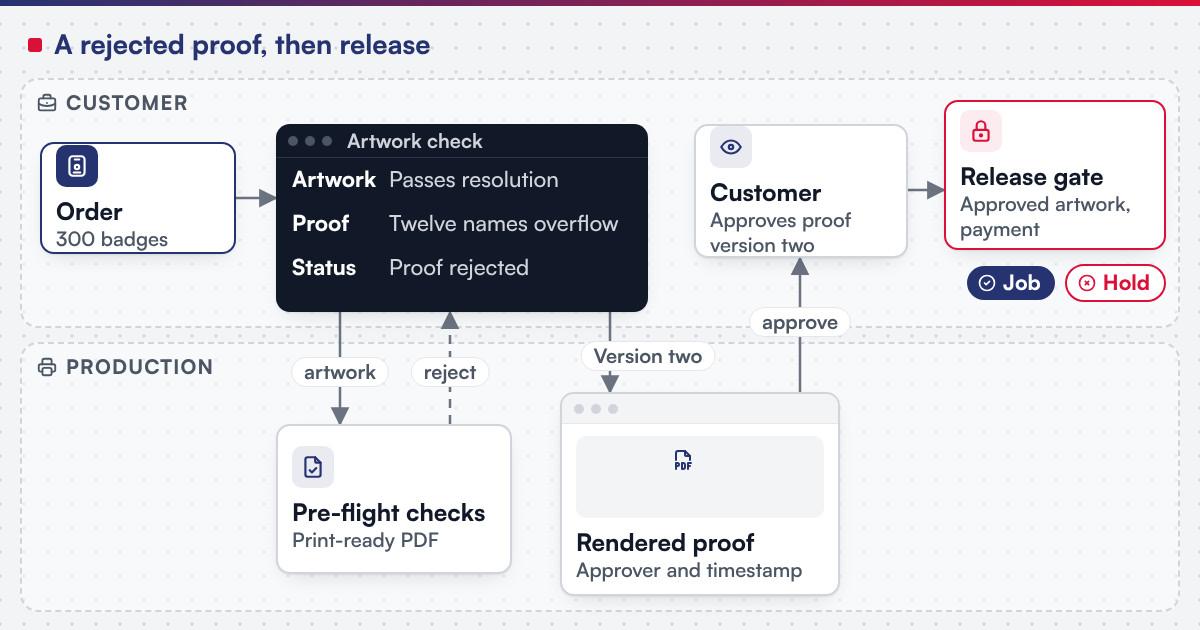
A school orders 300 name badges from a CSV file, split across two campuses. The configuration validates badge size and finish. The artwork check passes resolution but a pre-press operator rejects the proof because twelve names overflow the text box; the order moves to "proof rejected" with the reason, and the customer receives a message with the affected rows. The customer uploads a corrected file, approves proof version two, and the release gate creates one job with a production summary listing both destinations. Dispatch ships campus A first; the order shows "partly shipped" with one tracking reference until campus B ships and the order closes. Every state change carries an owner and a timestamp, so the acceptance test can replay the same order after each release.
What goes wrong, and who acts?
-
Production prints an unapproved proof version
- Early signal
- Reprints traced to superseded files
- Who acts
- Pre-press lead locks release to the approved version
-
Held orders sit unseen
- Early signal
- Orders past due date with no owner
- Who acts
- Customer service owns the hold queue
-
Two systems overwrite status
- Early signal
- Tracking says shipped, the job says printing
- Who acts
- Integration owner sets precedence
-
A split shipment closes the order early
- Early signal
- Customers report missing items
- Who acts
- Dispatch lead
-
Option rules drift from the catalogue
- Early signal
- Invalid combinations reach production
- Who acts
- Product owner maintains the rule set
Which questions should you ask a print software supplier?
-
How is a proof version tied to the job production receives?
A version identifier carried from approval to release
-
What happens to an order that fails an automatic check?
A named status, owner, customer message and route back
-
How do multi-page and layered files reach production?
Page-to-side mapping, format conversion and resolution handling
-
Can an order split across shipments?
A data model and customer messages for partial dispatch
-
Which integrations are in scope, and who owns failures?
Each interface listed with a test environment and reconciliation
-
What print work have you delivered that resembles ours?
Named or described records with their scope and limits
-
Which acceptance cases will you test?
Rejected proof, held order, partial dispatch, duplicate event, cancellation
Common questions
Automate only the checks with stable, testable rules, such as dimensions, resolution and file format. Colour judgement, artwork suitability and customer-specific exceptions belong in a visible queue with a named owner, a deadline and a recorded decision.
Yes, if the data model and customer messages describe partial dispatch. Include that path in the acceptance cases before launch, because an order that closes on the first shipment creates support tickets and lost items.
Not necessarily. A first project can improve order capture, artwork handling, proof approval or one handoff while existing production tools stay in place. The release gate and the source-of-truth rules decide how the two systems cooperate.
Sometimes. For 4over4, a product recommendation engine suggests products from browsing history and previous purchases. File conversion, pre-flight and resolution warnings are rule-based checks. The AI design and pre-press suite on the Deyar platform was planned third-phase work and is not presented as delivered.
Ask for a discovery scope when product rules, handoffs or integration ownership are still uncertain. A build estimate is credible after those assumptions are written down and agreed with production, customer service and the commercial owner.
How this guide is sourced
Every statement about Netbase on this page maps to a registered claim backed by attested company facts, listed under Sources, in the wording the register approves. Client figures appear exactly as each client published them, with the recorded period or a note that none exists. The badge order is a hypothetical example.
The limits, stated once: the large-format, Deyar and ACT Printing records publish scope and no result; the Deyar AI pre-press suite, ERP integration and ZATCA e-invoicing were planned third-phase work. The methodology explains how records are reviewed.
Turn the map into a buyer brief
Put the order record, release gate, sample orders, roles, integrations and acceptance cases into a short brief, and review it with customer service, pre-press, production and dispatch. The marketplace matching and quotation guide and the ERP procurement and inventory guide cover seller matching and stock decisions; where the order record is one piece of a larger build, the web-to-print platforms solution scopes the catalogue, quoting, artwork intake and back office as one project, and the solutions overview and the guides index list the rest. For a custom build, Custom Product Engineering describes the engagement. Submit a project with the first order path you want to stabilise: OutsourcingVN is Netbase's own outsourcing-services platform, and a person will assess whether discovery or a bounded build comes first.
Work behind this guide

They are that one company's outcomes on that one store, and this page presents them as nothing wider.
Keep Reading
This record is here because it shows the size of a sensible first project, which most suppliers never put on a website.
Keep Reading
This record separates what was delivered from a third phase that the source describes as planned, and it claims no result for either.
Keep ReadingRelated services and solutions
 Custom product engineering for a bounded release outcome
One defined release of your product, built to named outcomes and handed over with acceptance evidence.
Learn More