

Scope marketplace matching and quotation before building the platform
Marketplace matching and quotation software has to make four things traceable: the buyer's request, why each supplier was eligible to answer it, every version of every response, and the decision with its reason. Write the eligibility rules, the fields that make quotations comparable and the decision owner first; then scope the screens and integrations that record them.
Submit a project Explore custom engineeringReviewed by Huy Nguyen (David), CEO · Updated 1 Oct 2026 · 9 min read

OutsourcingVN is operated by Netbase JSC, so this guide supports buyers considering work that we sell. Netbase has built multi-vendor marketplaces, a business directory with field verification, a classifieds platform with moderation and a request-for-quote flow, and the guide uses those records where they answer a buyer's question.
What this guide covers
- Which marketplace transaction are you building?
- What must a request and its quotations record?
- How should matching rules stay reviewable?
- How did delivered marketplaces handle eligibility and moderation?
- Worked example: one request for quotation, intake to selection
- What goes wrong, and who acts?
- Which questions should you ask a marketplace supplier?
- Common questions
- How this guide is sourced
- Convert the workflow into a project brief
Which marketplace transaction are you building?
"Marketplace" names at least three different operating jobs, and an early release that mixes them hides the decision logic each one needs:
- Browse and buy. A standard product with a visible specification and checkout; the critical rules are vendor approval, catalogue moderation and fulfilment.
- Request and quote. A tailored need with documents, site details and questions; the critical rules are eligibility, comparable responses and a recorded selection.
- Directory and enquiry. A listing that generates contact; the critical rules are verification, reviews and complaint handling.
Describe one journey in plain language before naming features: who starts it, what they provide, who may respond, how a response becomes comparable, who decides and what happens next. The retail, commerce and marketplaces industry page covers the surrounding catalogue, seller and customer operations, the marketplace and classifieds operations workflow covers listing intake through to a closed deal, and mobile commerce apps plans the companion shopping app once the marketplace's own API exists.
What must a request and its quotations record?
The core product is the decision record, not the supplier list.
| Workflow stage | Buyer decision | Minimum record | Delivered example |
|---|---|---|---|
| Request intake | Is the request complete enough to distribute? | Requirement version, attachments, location, timing and owner | Request-for-quote lead capture on a web-to-print platform |
| Eligibility | Which suppliers may receive it, and why? | Rules applied, invitation list and any manual override | Vendor registration with administrator approval |
| Verification | Is the supplier who it claims to be? | Evidence, reviewer, date and expiry | A field-verified location badge with a head-office review queue |
| Clarification | Who may ask and answer, and who sees it? | Question, answer, audience and timestamp | Click-to-chat and in-platform messaging |
| Quotation | What makes offers comparable? | Scope, assumptions, validity, exclusions and version | Defined by the buyer's own policy |
| Selection | Who chooses, approves or rejects? | Decision maker, reason and selected version | Defined by the buyer's own policy |
| Handover | What must reach fulfilment? | Accepted scope, contacts and open items | Fulfilment routing with service-level breach alerts |
Free-text messages are useful for discussion but make a poor system of record. When a quotation changes, keep the earlier version and state which one the decision refers to. When a supplier is not invited, record whether the reason was eligibility, capacity, location, category or a manual exception.
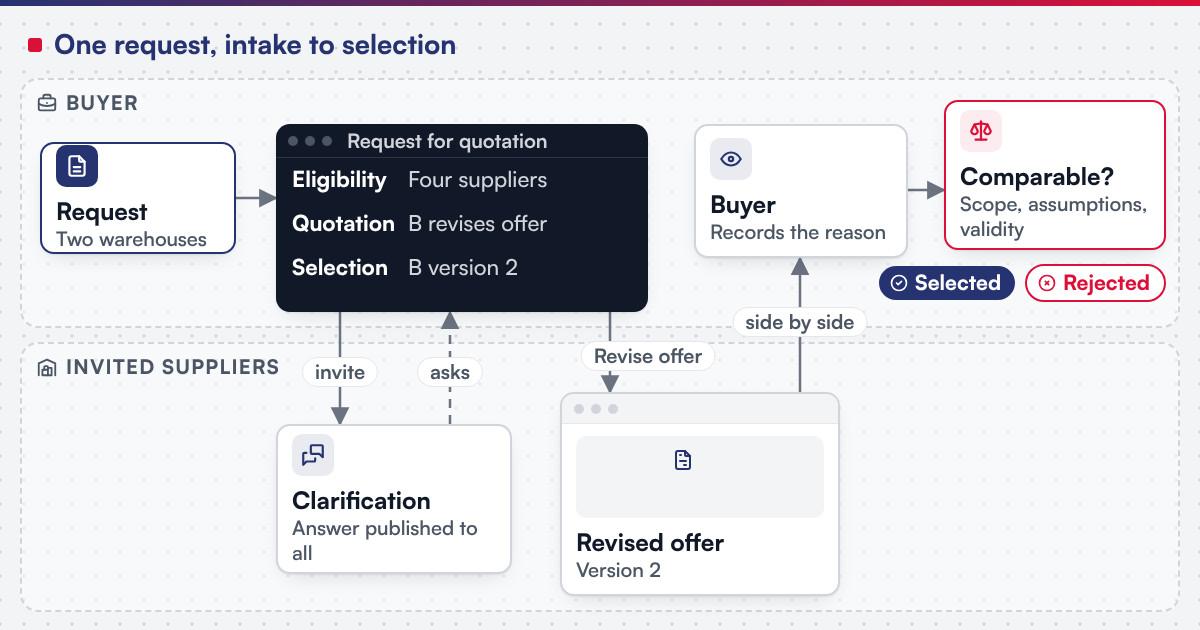 (opens the full-size diagram in a new tab)
How should matching rules stay reviewable?
-
Write the eligibility rules
Start with the few criteria that determine whether a supplier can respond: category, location, capability, capacity or account standing.
-
Name the data owner
Each criterion needs a source, an update route and a person accountable for corrections; a stale supplier profile is a workflow problem before it is a search problem.
-
Expose manual overrides
An operator may invite or exclude someone for a sound reason, but the reason is required and the history stays visible to authorised reviewers.
-
Keep ranking separate from eligibility
If the platform suggests an order, state the inputs, and never present a policy preference as an objective score.
-
Test the difficult paths
Include a withdrawn quotation, a late response, a duplicate supplier, a changed request and a dispute over what was selected.
The business workflow transformation guide helps decide which steps need a fixed rule, a person or a clearer evidence trail first.
How did delivered marketplaces handle eligibility and moderation?
- Vendor approval and payouts. For RB Marketplace, an English-first multi-vendor marketplace for West Africa on Laravel, Netbase built vendor registration with administrator approval, store profiles, product and inventory management, order fulfilment and tracking updates, earnings, commission deductions and payout requests, with administrator controls for vendor approval, product moderation, commission, payouts, campaigns and analytics. A customer shopping app on the same API runs on Android, with iOS in the extended scope. See the RB Marketplace record.
- Verification in the field. For Dey Page, a multi-state business directory in Nigeria, the design includes a location-confirmed badge verified in the field with geotagged photos, a head-office review queue, 12-month expiry, complaint automation and an audit trail, plus reviews, click-to-chat messaging and featured-listing subscriptions. See the Dey Page directory record.
- Moderation with a person deciding. A bilingual classifieds platform for a founder who is not named combines ratings, messaging and paid ads with AI-powered content filtering that flags offensive content into an admin moderation dashboard. See the classifieds record.
- Routing after the selection. For a Dubai-based loyalty and rewards technology company, a multi-vendor module with fulfilment routing and service-level breach alerts sits inside a headless multi-store reward shop platform. See the reward shop record.
- Quotes as structured leads. For Deyar Printing & Advertising in Riyadh, the web-to-print platform includes request-for-quote lead capture alongside online ordering. See the bilingual web-to-print record.
Onboarding speed is measurable when it is designed in. For an EU fashion-tech marketplace (not named), gross merchandise value rose 47% and vendor onboarding time fell 60% within six months of launch. That client's figures are published at the lower of two reported values and belong to that marketplace alone.
Worked example: one request for quotation, intake to selection
A facilities manager requests quotes for weekly cleaning at two warehouses. Intake blocks distribution until floor areas and an access schedule are attached. Eligibility invites four verified suppliers covering both locations; one capable supplier is excluded by an operator override, with the reason "expired insurance evidence". Supplier B asks whether weekend access is possible, and the answer is published to all invitees. Supplier C withdraws. Supplier B then revises its offer to version 2 with a narrower exclusion list. The buyer compares versions side by side on scope, assumptions and validity, selects B version 2 and records the reason. Handover sends the accepted scope and open items to account management. Every step carries an owner and a timestamp, so a later dispute is settled from the record rather than an inbox.
What goes wrong, and who acts?
-
Suppliers see each other's responses
- Early signal
- Complaints about copied offers
- Who acts
- Platform owner fixes visibility roles
-
Selection refers to a superseded quotation
- Early signal
- Scope disputes after award
- Who acts
- Product owner locks decisions to a version
-
Eligibility data goes stale
- Early signal
- Invited suppliers decline as out of scope
- Who acts
- Supplier data owner runs a review cycle
-
Overrides become the normal route
- Early signal
- Rising share of manual invitations
- Who acts
- Operations lead reviews the rules
-
Buyers choose off-platform
- Early signal
- Requests close without a recorded decision
- Who acts
- Commercial owner reviews the journey
Which questions should you ask a marketplace supplier?
-
How is a quotation versioned, and what does a decision point to?
Immutable versions and a decision linked to one of them
-
Where do eligibility rules live, and who can change them?
Rules as data, with an owner and change history
-
How is a supplier verified, and when does verification expire?
Evidence type, reviewer queue and expiry
-
Who sees clarification questions and answers?
A per-request audience rule
-
How do vendor approval and product moderation work?
Administrator queues with reasons recorded
-
Which marketplace have you delivered that resembles ours?
A specific record with its scope and its gaps
-
What will the first acceptance test demonstrate?
Request to eligible suppliers, versioned responses and a recorded decision
Plan the next step for your project
Common questions
Start with explicit eligibility rules and a visible review route. Automate matching only where the input data is reliable and the consequence of a wrong invitation is understood, and keep a reason on every manual override so the rules can improve.
They need enough shared fields to support comparison: scope, assumptions, validity and exclusions. Category-specific details can stay flexible, provided the selection record captures what the buyer actually compared and which version was chosen.
Yes, but treat them as separate journeys with separate release gates. Catalogue checkout depends on vendor approval and fulfilment; quotation depends on eligibility and versioned responses. Start with the journey that has the clearest operating owner.
The Dey Page directory design verifies a location in the field with geotagged photos and identity capture, routes the evidence to a head-office review queue and sets a 12-month expiry. RB Marketplace uses vendor registration with administrator approval. Pick the level of evidence your buyers need.
Show that a complete request reaches only eligible suppliers, that responses keep their versions, and that an authorised person can record a decision with its reason. If those three hold with difficult cases included, the core record works.
How this guide is sourced
Every statement about Netbase on this page maps to a registered claim backed by attested company facts, listed under Sources, in the wording the register approves. The warehouse request is a hypothetical example.
The limits, stated once: RB Marketplace delivered catalogue commerce, and its administrator and vendor work stays in the web panel; quotation matching was not part of it. The Dey Page record describes a directory built for launch, with no public launch or user numbers claimed. The methodology explains how records are reviewed.
Convert the workflow into a project brief
Gather sample requests, supplier records, past responses and the decision rules you use today, and ask the people who manage buyers and suppliers to review the first release boundary. The print order and fulfilment guide applies when a selected offer becomes a production order, and the ERP procurement and inventory guide covers the controls after selection. The solutions overview and the guides index list related workflows. Custom Product Engineering is the service route for a marketplace built around your rules. Submit a project with the journey, users and existing systems: OutsourcingVN is Netbase's own outsourcing-services platform, and a person will assess whether discovery or a bounded product scope comes first.
Work behind this guide

Netbase delivered a bilingual classifieds marketplace, in English and Nepali, with paid ads, search, messaging, payments and an AI filter that flags offensive content into an administrator review queue. The client is not named, and no traffic, accuracy or commercial result is claimed.
Keep Reading
Netbase scoped and built a bilingual web-to-print platform, Arabic right-to-left and English, for Deyar Printing & Advertising, a printing, packaging, signage and fleet-branding company in Riyadh, Saudi Arabia.
Keep Reading
Netbase delivered a headless multi-store reward shop platform for a Dubai-based loyalty and rewards technology company: each client programme gets its own branded shop, shoppers pay with points and cash, and orders route to the right supplier.
Keep ReadingRelated services and solutions
 Custom product engineering for a bounded release outcome
One defined release of your product, built to named outcomes and handed over with acceptance evidence.
Learn More