

Improve a business workflow by deciding the work before choosing the technology
Business workflow transformation means changing how a repeated piece of work gets done: a clearer process, an integration, a product change or AI-assisted automation. Pick one workflow and one accountable owner, collect real cases including the failures, compare the four routes against those cases, and commission the smallest change that passes the owner's acceptance test.
Submit a project Assess an AI workflowReviewed by Huy Nguyen (David), CEO · Updated 6 Oct 2026 · 10 min read

OutsourcingVN is operated by Netbase JSC, which scopes and builds these changes, so read this guide knowing that we sell the work it describes. Netbase delivers remote-first from Hanoi in Agile increments with weekly reviews, using AI-assisted engineering under human review. The method below applies whichever supplier you choose.
What this guide covers
- Which workflow should you change first?
- Process change, integration, product change or AI: which route fits?
- What have Netbase's delivered workflow changes looked like?
- Worked example: what does a mapped workflow look like?
- How should the change be scoped and delivered?
- What goes wrong, and who acts?
- Which questions should you ask a supplier?
- Common questions
- How this guide is sourced
- Start with one repeated decision
Which workflow should you change first?
Choose a workflow that repeats often, has one person who can say what a correct result is, and produces exceptions you can already name. Write it from trigger to outcome: each handoff, system, decision, data class and person who can accept a change. If several teams claim the answer, settle ownership first, because no software resolves a disagreement about what correct means.
Most buyer problems fall into one of a handful of shapes. Start from the page closest to yours:
-
Customer messages arrive faster than the team can triage them
-
Sellers, listings or buyers need checking before they trade
Marketplace and classifieds operations and the marketplace matching and quotation guide
-
Stock, purchasing and finance disagree with each other
ERP and back-office operations and the ERP procurement and inventory guide
-
Orders, payments and refunds never reconcile cleanly
-
Configured print orders stall between checkout and production
-
Documents wait in inboxes for someone to approve them
-
Nobody can prove where a delivery is or when it arrived
-
Business listings go stale because nobody verifies or renews them
-
Company accounts need their own catalogue, reorder history and approval routing
-
Data sits in too many places to support reporting or AI
All eight workflow pages are listed together on the solutions overview.
Process change, integration, product change or AI: which route fits?
| Route | Best when | Evidence needed before commitment | What a delivered example looked like |
|---|---|---|---|
| Process and data change | Rules are unclear, duplicated or captured in free text | Current steps, exception list and a decision owner | Structured order data with a production summary per order for staff |
| Integration | Correct data exists in more than one system | System access, API limits, failure and reconciliation design | Chatbot conversations synchronised into a CRM for lead capture and customer data |
| Product change | Users cannot complete an important task | User journey, acceptance cases and a release owner | A guided, mobile-first ordering flow replacing a generic product form |
| AI-assisted step | A bounded judgement can be tested and reviewed | Representative cases, data rights, a threshold and a human control point | Offensive content flagged by AI into an administrator moderation dashboard |
Most useful projects start with a process change and add an integration or an AI step only where the cases justify it. Netbase works with commercial and open-source AI models chosen per project (model-agnostic). The AI workflow automation guide goes deeper when the AI route is on the table.
What have Netbase's delivered workflow changes looked like?
Four delivered scopes show the routes in practice.
- An ordering flow that production can read. For ACT Printing, a custom apparel and print shop, Netbase built a guided mobile-first ordering flow with print-location zones, location-bound artwork upload and structured order data with a production summary per order for staff, over about 20 to 25 working days including client acceptance testing. There is no AI in this scope. See the apparel ordering flow record.
- AI flags, a person decides. On a bilingual classifieds platform for a founder who is not named, AI-powered content filtering detects and flags offensive content into an admin moderation dashboard, where an administrator makes the call. It was delivered in six milestones over four months with training and six months of support. See the classifieds moderation record.
- Conversation plus CRM synchronisation. For a client who is not named, Netbase built a WhatsApp Business AI chatbot with intent and conversation-flow handling, an LLM API and CRM synchronisation for lead capture, customer data and workflow automation, in milestones from design and prototype to knowledge transfer and 30 days of support over 4-8 weeks. See the WhatsApp chatbot record.
- Help desk and CRM workflow. Netbase deploys a help desk and B2B CRM with sales chats and client requests in one dashboard, ticket creation, assignment, prioritisation and tracking, workflow automation and a knowledge base.
Netbase has also delivered anonymised client AI projects including retrieval-based knowledge assistants, document AI and MLOps pipelines.
Worked example: what does a mapped workflow look like?
Take a hypothetical parts distributor whose support lead owns an inbox of order questions, address changes and complaints. After a week of sampling real messages, the map looks like this:
-
Intake
Shared inbox, read in arrival order
- Proposed change
- Messages logged as tickets with order number extracted
- Control
- Unmatched order numbers go to a manual queue
- Owner
- Support lead
-
Triage
Agent reads and forwards by guesswork
- Proposed change
- AI suggests a category with a stated reason
- Control
- Agent confirms or changes the category
- Owner
- Support agent
-
Order status reply
Agent checks the ERP by hand
- Proposed change
- Status read from the ERP by integration
- Control
- Reply drafted, sent by the agent
- Owner
- Support agent
-
Address change
Edited in the ERP on request
- Proposed change
- Held as a change request
- Control
- Staff approval before any edit to an invoiced order
- Owner
- Finance approver
-
Complaint
Emailed to a manager
- Proposed change
- Routed with the order history attached
- Control
- Manager closes with a recorded reason
- Owner
- Customer service manager
Follow one message: a customer asks to change the delivery address on an order that is already invoiced. Intake logs it and matches the order. Triage suggests "address change"; the agent confirms. The workflow places it in the change-request queue rather than editing the record, and the finance approver accepts it, which reissues the paperwork. The case closes with the approver's name and reason on the ticket. That trail is the acceptance evidence: the support lead can replay the same case after every release.
The human-in-the-loop guide covers where review points like the triage confirmation belong.
How should the change be scoped and delivered?
-
Observe the present path
Collect ordinary, delayed, rejected and failed cases, and let the owner label what acceptable looks like.
-
Choose the smallest change
Prefer a clear rule or interface improvement before an autonomous decision.
-
Map systems and data
Assign an owner to each integration, credential and reconciliation step.
-
Design controls
Set permissions, logging, review points, and the route to pause or reverse the change.
-
Pilot on a bounded group
Run the change for one team or one case type, and inspect every informal workaround users create.
-
Hand over evidence
Transfer the runbook, access, case set, known limits and the change route, and set a review date.
The project delivery page explains milestones, acceptance and change control. The data security and compliance guide covers access and data decisions that come before real workflow data is used.
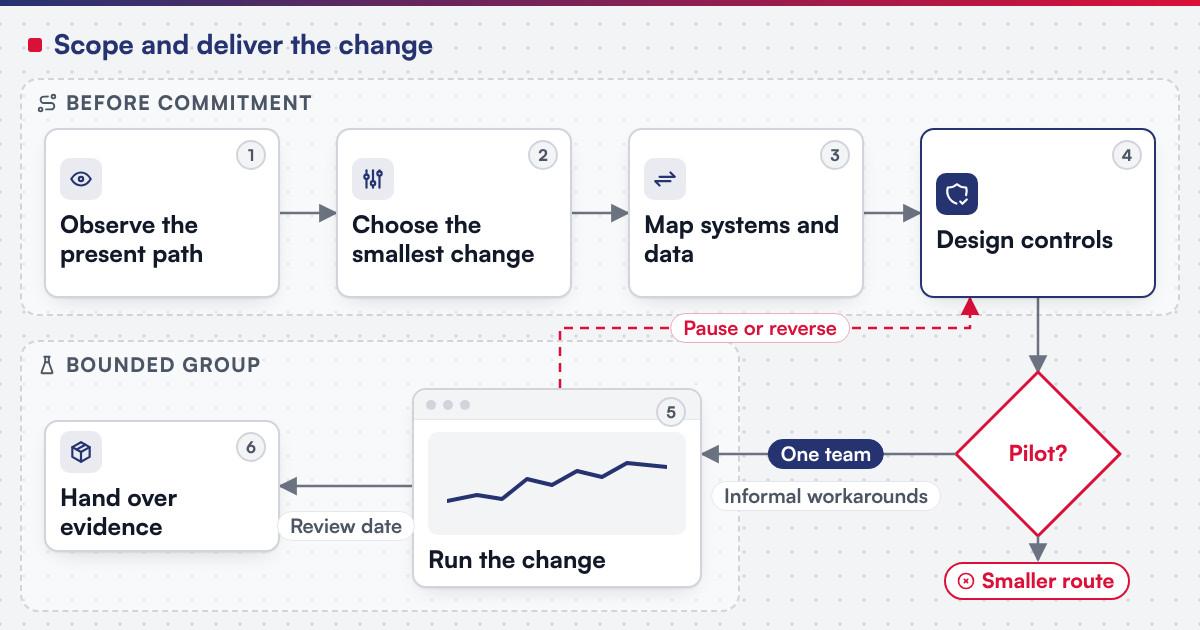 (opens the full-size diagram in a new tab)
What goes wrong, and who acts?
-
The workflow encodes an unresolved policy argument
- Early signal
- Teams dispute test results rather than defects
- Who acts
- Process owner decides the rule
-
An integration duplicates or drops records
- Early signal
- Counts differ between systems at month end
- Who acts
- Integration owner runs reconciliation
-
AI routes a case where nobody sees it
- Early signal
- Cases age without an owner in the queue
- Who acts
- Queue owner sets a time-out and fallback
-
Users build a workaround around the new path
- Early signal
- Spreadsheets or side chats reappear
- Who acts
- Process owner reviews the reason
-
The new interface hides an approval
- Early signal
- Approvals disappear from the audit trail
- Who acts
- Compliance or finance approver
-
Nobody can pause the change
- Early signal
- A fault continues through a weekend
- Who acts
- Named operator with a documented off switch
Which questions should you ask a supplier?
-
Which of our cases will you test against?
A named case set, including failures, agreed before the build
-
Why this route and not a smaller one?
The rule or interface change considered first, and why it falls short
-
Who owns each integration failure?
A named owner, a retry or queue rule, and a reconciliation report
-
Where does a person decide?
Specific review points tied to impact, with the screen reviewers will use
-
How do we pause or reverse it?
A documented switch, the previous path, and who may use it
-
What do we receive at handover?
Runbook, credentials, case set, known limits and change route
-
Which model runs the AI step, and can we change it?
A reasoned choice with the replacement path stated
-
What delivered work is closest to ours?
A specific record with its scope, and a plain statement of the gaps
Plan the next step for your project
Common questions
Map the process first. Automation copies whatever rules it is given, including unclear or duplicated ones, and makes them harder to see. When the owner, the data rights and the acceptance cases are clear, automation becomes a smaller and safer decision.
No. Many workflows need a clearer rule, a better handoff or a reliable integration instead. AI earns its place where a bounded judgement, such as classifying a message or flagging content, can be tested against real cases and reviewed by a person when it is uncertain.
Only where the impact of an error is low and reversal is easy. High-impact decisions such as refunds, account changes or published content keep an explicit control point.
It depends on the scope. As reference points, Netbase delivered the ACT Printing ordering flow in about 20 to 25 working days and the WhatsApp chatbot over 4-8 weeks. Treat them as sizes of bounded scopes, not as an estimate for yours.
Prepare a written trigger-to-outcome map, the named owner, a sample of real cases including failures, the systems involved and who holds their access. Those four items let a supplier propose a bounded scope rather than a generic transformation programme.
How this guide is sourced
Every statement about Netbase on this page maps to a registered claim backed by attested company facts, listed under Sources, and appears only in the wording the register approves. The route comparison, failure modes and supplier questions come from how Netbase teams scope workflow projects; the distributor example is hypothetical. Nothing here comes from a benchmark or survey.
What the records show and what they do not, stated once: the ordering flow, classifieds and chatbot records document delivered scope, and none of them publishes an operating result, a saving or an accuracy figure. Your own baseline and pilot are the only evidence of an outcome for your workflow. The methodology explains how published records are reviewed.
Start with one repeated decision
Submit a project with the workflow, its owner, the systems it touches and the point where it fails today. OutsourcingVN is Netbase's own outsourcing-services platform, and the first conversation decides whether a process change, an integration, a product scope or an AI Workflow Blueprint assessment is the honest next step.
Work behind this guide

Netbase delivered a bilingual classifieds marketplace, in English and Nepali, with paid ads, search, messaging, payments and an AI filter that flags offensive content into an administrator review queue. The client is not named, and no traffic, accuracy or commercial result is claimed.
Keep Reading
Netbase designed and built an AI chatbot on WhatsApp Business that handles intents and conversation flows and keeps lead and customer data in step with the client's CRM, delivered in milestones from prototype to knowledge transfer.
Keep Reading
Netbase upgraded the existing online store of ACT Printing, a custom apparel and print shop, with a guided, mobile-first ordering flow, built and tested on staging over about 20 to 25 working days.
Keep ReadingRelated services and solutions
 AI workflow blueprint: decide where automation belongs before you build
A paid two-to-four-week project that ends in a scope you can approve, change or stop.
Learn More