

Data platform readiness: check ownership and quality before you build
A data platform is ready to build when each dataset it needs has a named owner, a known quality level, an agreed access rule and a reliable way out of its source system. A readiness assessment checks those four things for the few decisions the platform must support, and turns every gap into scoped work.
Submit a project Assess a workflow firstReviewed by Huy Nguyen (David), CEO · Updated 2 Oct 2026 · 10 min read

OutsourcingVN is operated by Netbase JSC, which scopes and builds data and workflow systems, so we have an interest in your decision. The checks apply whoever builds the platform. This guide is for CTOs, data and operations owners, and finance leads asked to fund a warehouse, reporting layer or AI initiative.
What this guide covers
- Which decision is the platform for?
- Who owns each dataset?
- How good is the data, measured how?
- Can the platform get the data out, safely?
- How do you run the assessment?
- A worked scenario: a distributor that wants margin reporting
- What has Netbase delivered around business data?
- Which questions should you ask a supplier?
- What failure modes should you watch for?
- Common questions
- How this guide is sourced
- Bring your decisions and a data sample
Which decision is the platform for?
Start with three to five decisions the business wants to make faster or with more confidence: which products to reorder, which customers are at risk, where margin leaks between order and invoice. Each decision names the data it needs, how fresh that data must be, and who acts on the answer.
Without that list, a platform project collects everything it can reach and then struggles to show value. With it, the assessment has a boundary. A dataset that no listed decision uses can wait for a later phase, however interesting it looks.
Who owns each dataset?
Ownership is the first gap most assessments find. For every dataset in scope, record the system of record, the business owner who decides what a field means, the technical owner who keeps the feed running, and what happens when two systems disagree.
Customer records are the usual test case. Sales, support, billing and the web store each hold a version. If nobody has decided which one wins for address, status or credit terms, a platform will faithfully reproduce the conflict in every report. Deciding that rule is business work, not engineering work, and no tool makes the decision for you.
How good is the data, measured how?
The UK Government Data Quality Framework, published in December 2020, uses six dimensions adopted from DAMA UK: completeness, uniqueness, consistency, timeliness, validity and accuracy. They make a practical checklist because each can be profiled on a sample before any build.
-
Completeness
- What to profile
- Share of records with required fields filled
- Typical finding
- Product categories blank on older items
-
Uniqueness
- What to profile
- Duplicate customers or products across sources
- Typical finding
- The same customer under three spellings
-
Consistency
- What to profile
- Values that contradict across systems
- Typical finding
- Order status "shipped" with no dispatch record
-
Timeliness
- What to profile
- Delay between event and availability
- Typical finding
- Stock updated overnight, sales hourly
-
Validity
- What to profile
- Values outside expected range or format
- Typical finding
- Dates stored as free text
-
Accuracy
- What to profile
- Agreement with reality, checked on a sample
- Typical finding
- Unit costs not updated after supplier changes
Profile first and set thresholds per decision. A demand forecast can tolerate some missing categories; an invoice reconciliation cannot tolerate duplicate customers.
Can the platform get the data out, safely?
| Readiness area | Ready when | Not ready when | First fix |
|---|---|---|---|
| Extraction | A documented API or export exists, with change tracking | Data is copied from screens or spreadsheets by hand | Build or document one reliable feed |
| Identity | Shared keys link customers, products and orders across systems | Records are matched by name | Agree a master key and a matching rule |
| Access | Roles and data classes are defined; personal data is mapped | Everyone reads everything, or nobody knows what is personal | Classify data and define roles |
| History | Changes are kept or can be reconstructed | Only the current state exists | Start capturing history now |
| Ownership | Each dataset has a business and technical owner | Owners are "IT" or unknown | Name owners before design |
| AI use | Training or retrieval sources are approved and dated | Any available document is fair game | Build a source register |
For AI use cases, the NIST AI Risk Management Framework (released January 2023) groups its practices into four functions: govern, map, measure and manage. Readiness work sits mostly in map and govern: knowing which data feeds a model or retrieval index, who approved it, and how it will be checked. The RAG context engineering guide covers source registers for retrieval in detail, and the embeddings and semantic search guide covers the neighbouring decision of ranking or matching records rather than grounding an answer; the large language models page covers the integration patterns a readiness-checked platform ultimately feeds, and the RAG vs fine-tuning guide decides which lever to pull once the data itself is ready.
Readiness feeds two different builds. A single retrieval workflow, such as the AI knowledge assistant solution, can be scoped once this assessment says the sources are ready. Where a second or third workflow will need the same governed pipelines, retrieval index and evaluation store, data and AI platform engineering builds that shared foundation instead of a one-off copy per workflow.
How do you run the assessment?
-
List the decisions
Three to five, each with the data, freshness and owner it needs.
-
Inventory sources
For each dataset: system of record, owner, extraction route, volume range and personal-data content.
-
Profile a sample
Measure the six quality dimensions on real extracts, not on descriptions of the data.
-
Test one feed end to end
Move one dataset from source to a staging store and reconcile totals against the source.
-
Map access and obligations
Classify data, define roles, and record which privacy obligations your advisers say apply.
-
Write the gap list and first phase
Each gap becomes an owned task; the first phase covers one decision end to end.
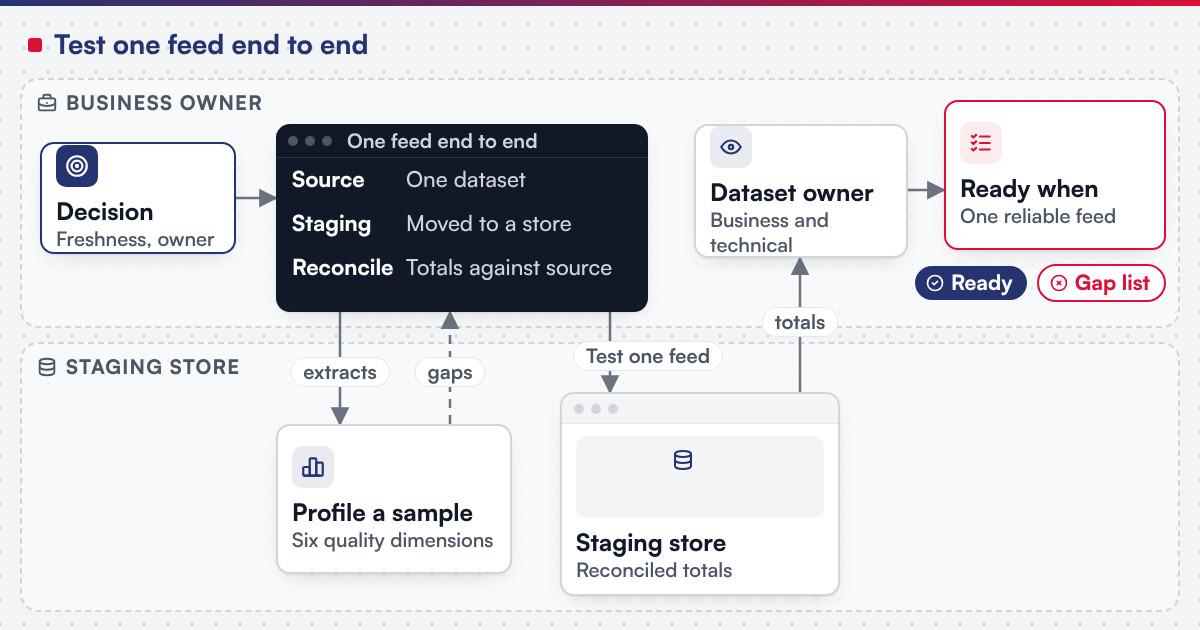 (opens the full-size diagram in a new tab)
A worked scenario: a distributor that wants margin reporting
A distributor wants weekly margin by customer and product line. Orders sit in an ERP, customer discount agreements in spreadsheets, freight costs in a carrier portal, and returns in a support desk. The scenario is illustrative and describes no client.
Profiling shows many older order lines with no product category, customers duplicated between the ERP and the support desk, and freight costs available only as monthly PDF invoices. The assessment ranks the gaps: agree the customer master in the ERP, backfill categories for the top-selling lines, and request a freight export from the carrier. The spreadsheet discount agreements stay out of phase one because no owner will commit to maintaining it.
Phase one delivers margin before freight for the top product lines, reconciled to finance totals each week. Freight joins in phase two once the export exists. The distributor gets a trustworthy partial answer in weeks instead of an unreliable complete one in months. Where the gaps sit in order capture or back-office processes, the ERP and back-office operations and order and payment operations workflows show where a system fix belongs, and document and approval workflows covers data that arrives on paper or PDF.
What has Netbase delivered around business data?
- ERP work, delivered with a local partner. Working with a local Odoo implementation partner, Netbase has consulted on and customized Odoo in Vietnam for retail store chains, a food and beverage franchise chain, manufacturers, trading and distribution companies and other organisations that are not named.
- ERP integration and upgrade experience. Netbase's ERP experience covers e-commerce integration with ERP by API synchronisation of product catalogues, inventory, orders and customer data, and a Vtiger CRM to ERP upgrade, with modules including finance and accounting, inventory, sales orders, CRM and reporting.
- A long-running SaaS platform. Since 2020 Netbase has worked as offshore development and managing partner on a multi-tenant cloud ERP SaaS for a US client that is not named. Its retail phase 2 was planned work when the profile was written and is not presented as delivered.
- Anonymised AI delivery. Netbase has delivered anonymised client AI projects including retrieval-based knowledge assistants, document AI and MLOps pipelines.
Netbase's compliance practices are GDPR alignment for data privacy in Europe, HIPAA-aligned methodologies for healthcare data handling, and CCPA compliance for clients with U.S. customer bases; these are practices, and a client's own legal position stays with its advisers. The data security guide covers contract and access controls. Security practices include secure code review and version control, role-based access control, MFA for admin dashboards, contributors under NDA, and NDAs and DPAs on request.
Plan the next step for your project
Which questions should you ask a supplier?
-
Which decisions will phase one support?
Named decisions with owners, not a list of tables
-
How will you measure data quality?
Profiling on real extracts against agreed dimensions and thresholds
-
How do you resolve conflicting records?
A written master-data rule approved by the business owner
-
How is personal data handled in the platform?
Classification, role-based access and deletion paths
-
What reconciles the platform to the source?
Automated totals checks against finance or source reports
-
Who runs feeds after handover?
Named technical owners, runbooks and alerting
What failure modes should you watch for?
-
Platform before decisions
- Early signal
- Scope described as "all our data"
- Correction
- Return to three to five named decisions
-
Silent quality problems
- Early signal
- Reports disagree with finance totals
- Correction
- Add reconciliation checks to every load
-
Ownerless master data
- Early signal
- Duplicates reappear after cleansing
- Correction
- Name an owner and a matching rule
-
Manual feeds in production
- Early signal
- A person exports a spreadsheet weekly
- Correction
- Replace with an API or scheduled export before go-live
-
AI trained on unapproved sources
- Early signal
- Nobody can say where an answer came from
- Correction
- Build and enforce a source register
Common questions
Not always. A bounded AI workflow can read from one well-owned source. A warehouse earns its place when several decisions need the same reconciled data from multiple systems.
For a handful of decisions and sources, usually a few weeks, most of it spent profiling real extracts and agreeing ownership. The length depends on access to systems and owners more than on data volume.
Some cleansing belongs in the pipeline, but errors created at data entry return with every load. Fix the capture process in the source system where you can, and use the platform to measure quality rather than hide it.
Scheduled exports, database replicas or change-data-capture tools can work, each with trade-offs in freshness and support. The assessment should test one route end to end before the design depends on it.
Data gaps often come from the workflow that creates the data. The business workflow transformation guide covers choosing which workflow to change first.
How this guide is sourced
Statements about Netbase map to approved claims backed by attested company facts listed under Sources, in their registered wording. The quality dimensions come from the UK Government Data Quality Framework and the four functions from the NIST AI Risk Management Framework, both dated below. The distributor scenario and its figures are illustrative. The related records here are ERP, integration, SaaS and anonymised AI work; data platform work is offered through a scoped assessment, and no measured client outcome is published. See the methodology for how claims are reviewed.
Bring your decisions and a data sample
A first conversation goes furthest with the decisions you want to support, a list of source systems and owners, and a sample extract. Submit a project with them. When the workflow itself is still unclear, an AI Workflow Blueprint is the assessment route, and the other guides cover adjacent choices. OutsourcingVN is operated by Netbase JSC and is Netbase's own outsourcing-services platform.
Work behind this guide

This record covers phase-one scope for agency SMEs; the client and product are not named, and no usage or business result is claimed.
Keep Reading
Working with a local Odoo implementation partner, Netbase has consulted on and customised Odoo in Vietnam for a range of organisations, none of which is named.
Keep ReadingRelated services and solutions
 AI workflow blueprint: decide where automation belongs before you build
A paid two-to-four-week project that ends in a scope you can approve, change or stop.
Learn More