

RAG context engineering: make source authority visible
Retrieval-augmented generation works when four things are decided before any build: which source owns each fact, who may see each document, how the assistant must behave when evidence is missing or conflicting, and which test questions prove it. Context engineering is the design that enforces those decisions in ingestion, retrieval and prompting.
Submit a project Assess a workflow firstReviewed by Huy Nguyen (David), CEO · Updated 2 Oct 2026 · 11 min read

OutsourcingVN is operated by Netbase JSC, which scopes and builds retrieval assistants, so we have an interest in your decision. The method applies whoever builds yours. This guide is for CTOs, knowledge owners and support or operations leads who want an assistant to answer from company documents without leaking or inventing.
Where the underlying data is not yet ready, start with the data platform readiness assessment; once several workflows need the same governed sources, retrieval index and evaluation store, data and AI platform engineering builds that shared foundation rather than a one-off copy per workflow. The neighbouring decision of ranking or matching records instead of grounding an answer is covered in the embeddings and semantic search guide.
What this guide covers
- Which source is the truth for each answer?
- Which retrieval architecture fits?
- How do you build the evaluation pack?
- A worked example: one HR policy question
- How do you handle injection and tool access?
- What has Netbase delivered in this area?
- Which questions should you ask a supplier?
- What failure modes should you watch for?
- Common questions
- How this guide is sourced
- Bring a source register and real questions
Which source is the truth for each answer?
For each kind of question the assistant will answer, name the system or document that owns the fact, its owner, how it is updated, who may read it, and how long it is kept. A policy PDF, a support ticket, a wiki page and a customer record carry different authority. When two disagree, a person must already have decided which one wins; retrieval cannot settle that on its own.
The practical output is a source register: one row per collection with owner, authority rank, effective-date field, access group and refresh trigger. Everything later in the build reads from it. Ingestion attaches its fields to every chunk as metadata, retrieval filters on them, and the answer contract uses them to decide whether to cite, warn about age or escalate.
Which retrieval architecture fits?
| Architecture | Fits when | What must be proved |
|---|---|---|
| Curated collection with vector and keyword search | A bounded set of owned documents answers most questions | Chunking keeps tables and headings intact; hybrid search beats either alone on your questions |
| Live read-only connector to a system of record | Facts change daily and the source must stay authoritative | Per-user permissions applied at query time; tenant boundary; audit trail |
| Long-context prompting without an index | The document set is small and read in full per request | Operating cost and latency at real document lengths; no lost facts mid-context |
| Fine-tuning a model on the corpus | Style or format must change, not facts | That facts are still retrieved, since fine-tuned knowledge goes stale and cannot be cited |
| Human research queue | Evidence is thin or the consequence is high | Escalation owner and response time |
Most buyer projects end up with the first or second row, often both. Hybrid retrieval, combining keyword matching with embeddings and then reranking the top results, usually handles product codes, names and exact phrases better than embeddings alone. Chunk along document structure (sections, clauses, table rows) rather than fixed character counts, and store the source, section, version and access group with each chunk so an answer can cite precisely.
How do you build the evaluation pack?
-
Inventory authoritative sources
Record owner, version, access group, update trigger and whether content may be shown to each user type.
-
Write questions and counterexamples
Include single-source questions, conflicting sources, missing information, stale content and requests outside the user's role.
-
Specify the answer contract
Decide when the assistant must cite, ask a clarifying question, state that evidence is missing, or route to a person.
-
Measure retrieval and answer separately
Check whether the right passage appears in the top results, then whether the answer is supported by the passages it cites.
-
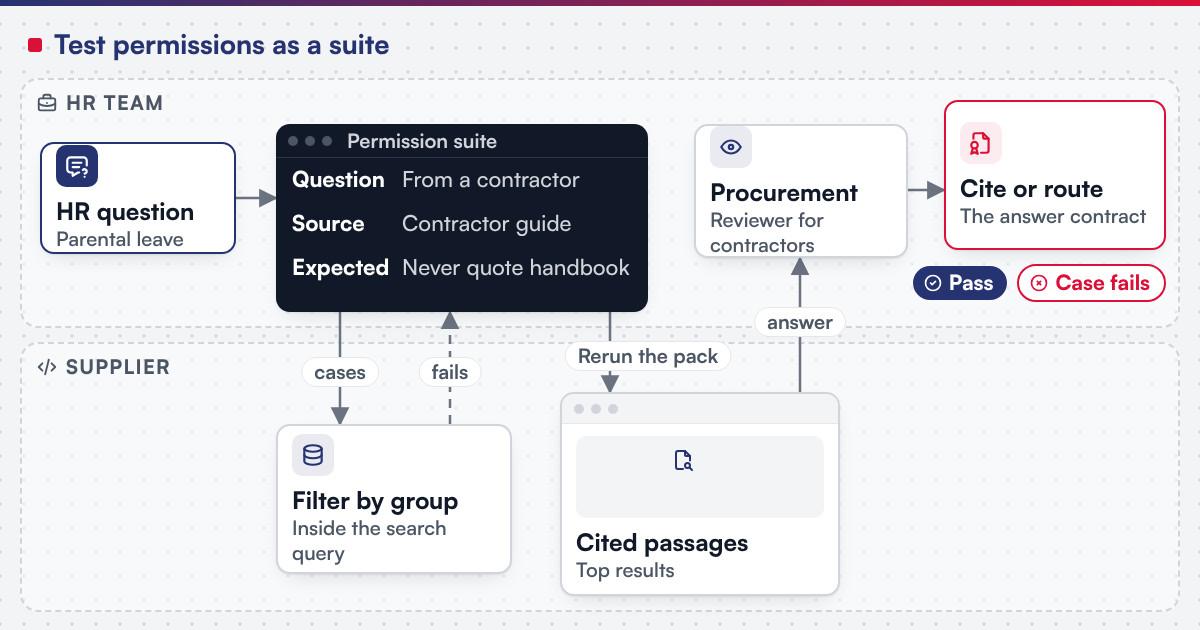
Test permissions as their own suite
Use separate users, tenants and document classes. A good answer for an authorised user proves nothing about a denied one.
-
Rerun on every change
A new connector, parser, chunking rule, ranking change or prompt revision reruns the pack before release. The evaluation and testing guide covers thresholds and regression sets.
 (opens the full-size diagram in a new tab)
A worked example: one HR policy question
An HR team wants an assistant for staff questions. The source register lists the employee handbook (owner: HR policy lead, effective-dated, all staff), country addenda (owner: country HR, visible to that country's staff) and a contractor guide (owner: procurement, contractors only).
-
"How many days of parental leave do I get?" from an employee
- Authoritative source
- Current handbook plus the employee's country addendum
- Expected behaviour
- Answer citing both, addendum wins where they differ
- Reviewer
- HR policy lead
-
Same question from a contractor
- Authoritative source
- Contractor guide
- Expected behaviour
- Answer from the contractor guide only; never quote the employee handbook
- Reviewer
- Procurement
-
"What was the leave rule last year?"
- Authoritative source
- Superseded handbook version
- Expected behaviour
- State that the rule changed, cite the effective date, route history questions to HR
- Reviewer
- HR policy lead
-
A question no document covers
- Authoritative source
- None
- Expected behaviour
- Say evidence is missing and offer the HR contact route
- Reviewer
- HR operations
During testing, the contractor case fails: the assistant quotes the employee handbook. The cause is that permissions were applied after retrieval, so handbook passages reached the prompt. The fix is to filter by access group inside the search query itself. The rerun passes, and the permission suite now includes that case permanently.
How do you handle injection and tool access?
Retrieved text is data, not instruction. OWASP documents indirect prompt injection through webpages, files and other external content, and notes that retrieval does not remove the risk. Keep system instructions separate from retrieved passages, mark passages as quoted material in the prompt, restrict tools to the minimum, validate structured outputs in code, and require approval for any action that writes or sends.
Some retrieval products, RAGFlow among them, can expose search as a Model Context Protocol server. That is convenient for agents, and it widens the question to token handling, scopes, consent and revocation for every connected client. A document that tells the model to reveal data is hostile input and must never become an instruction to the application.
What has Netbase delivered in this area?
Because Netbase works with commercial and open-source AI models chosen per project, the embedding model, reranker and answer model can each be swapped without rebuilding the source register. Netbase applies the ISO/IEC 42001 AI management system framework to its own AI delivery practice, which governs how its teams run projects rather than any client system. A single retrieval-based AI knowledge assistant is often the first workflow built on a source register like this one.
-
In delivered work
Retrieval-based knowledge assistants
Netbase has delivered anonymised client AI projects including retrieval-based knowledge assistants, document AI and MLOps pipelines.
-
In delivered work
A conversational assistant synced to a CRM
Netbase built a WhatsApp Business AI chatbot with intent and conversation-flow handling, an LLM API (GPT-4 in the stack) and CRM synchronisation for lead capture, customer data and workflow automation.
-
Knowledge bases as structured content, not retrieval AI
Phase 1 of a multi-tenant cloud ERP SaaS (2020-2023) includes a knowledge base module; its phase 2 was planned work, not delivered. Netbase also deploys a help desk with a knowledge base, ticket workflows and support reporting.
-
Available capability
MCP-connected retrieval for agents
Exposing retrieval to agents through MCP servers is offered through a scoped assessment.
Which questions should you ask a supplier?
-
Where are permissions enforced?
Inside the retrieval query, from the user's identity, before passages reach the model
-
How do you chunk our documents?
By structure, with tables and headings kept whole, tested on our worst documents
-
How do deletions and updates propagate?
Event- or schedule-driven re-indexing, with deleted content removed from the index
-
How do you measure retrieval quality?
Labelled questions with the correct passage, checked in the top results
-
How do you check the answer is supported?
A groundedness check of each claim against the cited passages
-
What does the assistant do with no evidence?
A defined "not found" response and an escalation route
-
How is injected content handled?
Passages isolated from instructions, tools allowlisted, writes approved
-
Who owns the source register after handover?
Named source owners and a technical owner for ingestion
What failure modes should you watch for?
-
Permission leak
- Early signal
- A user sees a citation from a document outside their group
- Who acts
- Security owner disables the collection and fixes filtering
-
Stale answer
- Early signal
- Citations point to superseded versions
- Who acts
- Source owner fixes the effective-date field; technical owner re-indexes
-
Broken parsing
- Early signal
- Tables or scanned pages return garbled text
- Who acts
- Technical owner changes the parser; see the document AI guide
-
Plausible but unsupported citation
- Early signal
- Reviewer finds the cited passage does not say it
- Who acts
- Workflow owner tightens the answer contract
-
Duplicate documents with different dates
- Early signal
- Two answers to one question
- Who acts
- Source owner removes or ranks the duplicate
-
Instruction in a document followed
- Early signal
- Unexpected tool call or disclosure
- Who acts
- Security owner quarantines the source
Plan the next step for your project
Common questions
A citation lets a reviewer inspect the evidence, but the passage can be stale, incomplete or misread. Pair citations with a groundedness check that compares each statement with the cited text, and with effective dates shown to the user, so a reader can judge the answer rather than trust it.
Index only material with an owner, an audience and an update path. Ungoverned material adds conflicting answers and exposure without improving coverage. Start with the collections that answer the most frequent questions, and add others when their owners are named.
Fine-tuning changes how a model writes and formats, not reliably what it knows. Facts learned in training go stale and cannot be cited. For answers that must track current documents, retrieval stays necessary; fine-tuning can sit on top when tone or structure matters. The RAG vs fine-tuning guide compares the two levers directly, including when to combine them.
When the answer changes a record, carries a material consequence, lacks authoritative evidence or touches sensitive data. For customer-facing assistants, the customer support automation pattern routes those cases to staff with the retrieved evidence attached.
Yes, if the answer contract and permission checks sit in the retrieval service rather than in each channel. The speech interface guide covers the extra checks a spoken channel needs, such as confirming what was heard before answering.
How this guide is sourced
Statements about Netbase map to approved claims backed by attested company facts listed under Sources, in their registered wording. External guidance comes from OWASP's prompt injection entry, NIST's generative AI profile and RAGFlow's MCP documentation, each dated below. The HR example is illustrative and describes no client. The knowledge base modules listed above are content-management delivery, not retrieval AI. This page does not assess the rights to use your documents or the fitness of any product. See the methodology for how claims are reviewed.
Bring a source register and real questions
A first conversation goes furthest with a draft source register and twenty or so real questions, including a few that should be refused. Submit a project with them, or read the emerging technology adoption guide, the production inference assessment and the other guides first. An AI Workflow Blueprint is the assessment route when source authority is still unclear. OutsourcingVN is operated by Netbase JSC and is Netbase's own outsourcing-services platform.
Work behind this guide

This record covers phase-one scope for agency SMEs; the client and product are not named, and no usage or business result is claimed.
Keep Reading
The client, sector, region and CRM product are not named, and no conversation volume or business result is claimed.
Keep ReadingRelated services and solutions
 AI workflow blueprint: decide where automation belongs before you build
A paid two-to-four-week project that ends in a scope you can approve, change or stop.
Learn More