

Production AI inference: assess the operating case
A production inference assessment settles four things before rollout: the workload (request types, arrival pattern and deadline), the serving route (hosted API, managed endpoint, self-hosted engine or batch), the acceptance cases every output must pass, and the owner who can pause or roll back the service. Measure your own traffic; borrowed benchmarks decide nothing.
Submit a project Assess a workflow firstReviewed by Huy Nguyen (David), CEO · Updated 6 Oct 2026 · 10 min read

OutsourcingVN is operated by Netbase JSC, which scopes and builds AI services of this kind, so we have an interest in your decision. The assessment method below applies whoever runs it. It is written for CTOs, platform owners and product leads deciding whether a model that works in a demo can carry live traffic.
Once the operating case is settled, Cloud Platform and DevOps Engineering builds the repeatable infrastructure, GPU or queue capacity and observability the workload runs on, often on AWS, the cloud Netbase's own delivered platform work already runs on. The reliability and incident readiness guide covers what happens when it fails in production, and the data security and compliance guide covers the access and data-location questions a hosted or self-hosted route raises.
What this guide covers
- What exactly is the workload?
- Which serving route fits?
- How do you run a bounded assessment?
- A worked example: one model, two workloads
- What has Netbase delivered around inference?
- Which questions should you ask a supplier?
- What failure modes should you watch for?
- Common questions
- How this guide is sourced
- Bring the workload description
What exactly is the workload?
Write the workload down before anyone names a platform. The description needs: input types and their size range, how requests arrive (steady, bursty, overnight batch), the longest useful wait for an answer, what happens downstream if the answer is late or wrong, the data classification, the model and prompt version, and the fallback when inference is unavailable.
Two numbers shape almost every later choice. The first is the deadline: a customer-facing chat needs the first words back quickly and can stream the rest, while an overnight document queue only needs to finish before the morning shift. The second is context length. Long prompts, long retrieved passages and long outputs consume memory on the serving hardware, reduce how many requests can be batched together, and raise the operating cost of each request. A workload that looks cheap on short test prompts can behave very differently once real documents are attached, which is why the retrieval guide and the multimodal document guide feed directly into sizing.
Which serving route fits?
| Route | Fits when | What you must prove |
|---|---|---|
| Hosted model API | Data may leave your environment under contract, and volume is moderate | Rate limits, data-retention terms, model deprecation notice, outage fallback |
| Managed endpoint in your cloud account | Data must stay in your account but you do not want to run GPUs | Region, access roles, autoscaling behaviour, version pinning |
| Self-hosted serving engine | Volume is steady, data is sensitive, or you need a specific open model | GPU capacity at peak, patching owner, batching and memory limits, rollback |
| Batch processing | Results can wait and be reviewed before use | Queue ownership, retry policy, idempotency, sampling for review |
| No inference service | Review effort or error consequence outweighs the benefit | A recorded decision and the alternative workflow |
Self-hosted engines such as vLLM expose an OpenAI-compatible HTTP interface and batch concurrent requests continuously, which is why they are a common choice when a team wants to run open models on its own hardware. Their documentation describes configuration, not your throughput. Only a load test with your prompts, context lengths and concurrency tells you how many GPUs the peak needs. The model selection guide covers how to keep the model choice reversible.
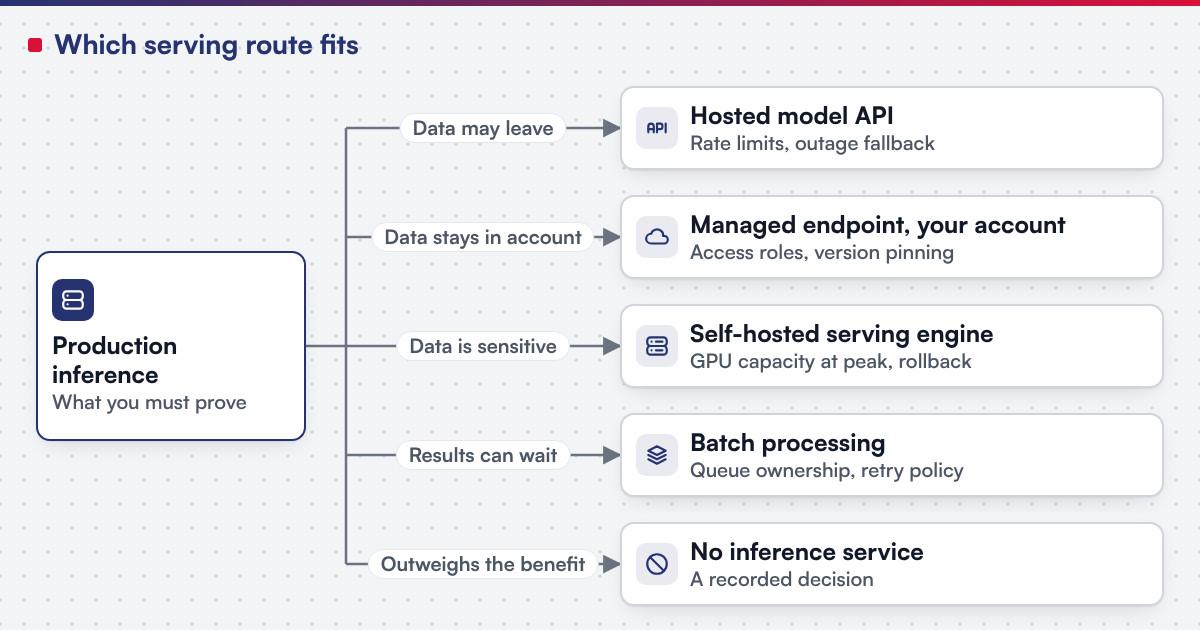 (opens the full-size diagram in a new tab)
How do you run a bounded assessment?
-
Freeze a representative case set
Include ordinary, long, malformed, ambiguous and sensitive inputs, labelled with the expected action rather than ideal wording. The evaluation and testing guide covers building one.
-
Load-test with real shapes
Replay realistic prompt and output lengths at expected and peak concurrency. Record time to first token, full response time at high percentiles, error rate and queue depth.
-
Instrument the boundary
Log request ID, model and prompt version, token counts, latency, error class, retry outcome and reviewer decision, without storing content that must not be retained.
-
Break it on purpose
Remove a dependency, exceed the context limit, trigger a rate limit, rotate a credential in a test environment and confirm each fallback path works.
-
Stage the rollout
Run in shadow mode beside the current process, then route a small share of live traffic behind a feature flag, with the previous model version ready to restore.
-
Decide with owners present
The product owner accepts the behaviour, the platform owner accepts operations, and the data or risk owner accepts the boundary.
A worked example: one model, two workloads
A logistics company wants one model for two jobs: extracting fields from overnight delivery documents, and answering customer questions about shipment status in a web chat.
Walked through the table, the document job lands on batch processing. Its deadline is the 6 a.m. shift, so it can use a larger model, retry failures and send a sample of outputs to a reviewer before records update. The owner is the operations manager, and the key proof is idempotency: a retried document must never create a second record.
The chat job lands on a hosted API or managed endpoint. Its deadline is seconds, so the test measures time to first token under peak evening concurrency, and the acceptance cases include a customer asking about someone else's shipment (refuse), a tracking number that does not exist (say so, do not invent a status), and a complaint (hand to staff). The owner is the customer service lead. When the provider rate-limits, the chat shows a "we will reply by email" state instead of an error.
Same model family, two different routes, owners and acceptance rules. Treating them as one "AI platform" decision would have sized the chat for batch economics or the batch for chat latency.
What has Netbase delivered around inference?
Model choice stays open: Netbase works with commercial and open-source AI models chosen per project, so the serving route follows the workload rather than a supplier preference. Internally, Netbase applies the ISO/IEC 42001 AI management system framework to its own AI delivery practice.
-
In delivered work
A hosted LLM API inside a live chatbot
Netbase built a WhatsApp Business AI chatbot with intent and conversation-flow handling, an LLM API (GPT-4 in the stack) and CRM synchronisation, delivered in milestones from design and prototype to knowledge transfer and 30 days of support over 4-8 weeks.
-
In delivered work
MLOps pipelines
Netbase has delivered anonymised client AI projects including retrieval-based knowledge assistants, document AI and MLOps pipelines.
-
Available capability
Self-hosted serving on your infrastructure
Running open models on an engine such as vLLM inside your environment is offered through a scoped assessment and sized on your own load test.
Which questions should you ask a supplier?
-
How will you size the peak?
A load test on our prompt and context shapes, not a vendor benchmark
-
What happens when the provider rate-limits or fails?
A named fallback state the user sees, and who is alerted
-
How are model versions pinned and changed?
Explicit version IDs, a rerun of the case set before any upgrade, a rollback path
-
How are retries kept safe?
Idempotency keys on any action that writes or sends
-
What do you log, and what do you not?
IDs, versions, token counts and latency; content only where retention is approved
-
Who patches and monitors the serving stack?
A named owner, a patch cadence and an on-call route
-
How does operating cost scale with context length?
A worked estimate from our real input sizes
-
What is the smallest rollout step?
Shadow mode or a small traffic share behind a flag
What failure modes should you watch for?
-
Context overflow or silent truncation
- Early signal
- Answers ignore the end of long inputs
- Who acts
- Platform owner caps input size and alerts
-
Rate limiting at peak
- Early signal
- Rising 429 responses and queue depth
- Who acts
- Platform owner enables fallback or adds capacity
-
Output format drift after a model update
- Early signal
- Parser errors downstream
- Who acts
- Technical owner pins the version and reruns cases
-
Duplicate actions from retries
- Early signal
- Two records or messages for one request
- Who acts
- Technical owner adds idempotency keys
-
GPU memory exhaustion
- Early signal
- Out-of-memory restarts under long prompts
- Who acts
- Platform owner lowers batch limits or scales out
-
Provider retires a model version
- Early signal
- Deprecation notice with a date
- Who acts
- Product owner schedules re-evaluation early
Plan the next step for your project
Common questions
Only after its assumptions, ownership, monitoring and acceptance evidence are reviewed as a production change. A prototype usually runs on clean inputs at low concurrency and answers a narrower question. Treat promotion as a new release with a load test, a rollback path and a named operator; the AI proof of concept to production guide walks through that whole promotion gate.
Set a workflow deadline and an acceptance rule first, then measure the chosen route against them on representative cases at realistic concurrency. Another organisation's benchmark reflects its prompts, hardware and traffic. Your target should come from what the user or downstream process can tolerate.
It depends on volume, utilisation and staff time. Self-hosting pays off when steady traffic keeps GPUs busy and the team can operate them; spiky or low traffic usually favours a hosted or managed route. Compare both on your measured load, including monitoring and patching effort.
The workflow owner owns the business decision; named technical and risk owners own the agreed controls. The model is never the accountable party. Write down who can pause the service and who investigates a complaint before live traffic starts.
Rerun the case set whenever the model, prompt, retrieval sources or serving configuration change, and on a fixed schedule even when nothing obvious has changed, because input patterns drift. Keep the previous results so the comparison is visible.
How this guide is sourced
Statements about Netbase map to approved claims backed by attested company facts listed under Sources, in their registered wording. External guidance comes from the vLLM serving documentation and NIST's generative AI profile, each dated below. The worked example is illustrative and describes no client. Self-hosted serving appears here as a growth capability, offered through a scoped assessment and sized on your own load test. This page does not estimate capacity, availability or cost for your workload. See the methodology for how claims are reviewed.
Bring the workload description
Start with the workload sheet from this guide, a small approved case set and the deadline your users actually tolerate, then submit a project. The emerging technology adoption guide, the edge deployment assessment and the other guides cover neighbouring decisions, and an AI Workflow Blueprint is the assessment route when the workload is still unclear. OutsourcingVN is operated by Netbase JSC and is Netbase's own outsourcing-services platform.
Work behind this guide

Netbase designed and built an AI chatbot on WhatsApp Business that handles intents and conversation flows and keeps lead and customer data in step with the client's CRM, delivered in milestones from prototype to knowledge transfer.
Keep ReadingRelated services and solutions
 AI workflow blueprint: decide where automation belongs before you build
A paid two-to-four-week project that ends in a scope you can approve, change or stop.
Learn More