
Edge AI: assess the field operating case
An edge AI assessment decides whether a model can run on a device in the field and still be useful when the network drops, the device ages and the model changes. Settle four things first: what the output decides, how the device behaves offline, how models are updated and rolled back, and who owns each device until retirement.
Submit a project Assess a workflow firstReviewed by Huy Nguyen (David), CEO · Updated 6 Oct 2026 · 10 min read

OutsourcingVN is operated by Netbase JSC, which scopes and builds field and mobile software, so we have an interest in your decision. The method applies whoever builds yours. This guide is for CTOs, product leads and operations owners considering inference on phones, tablets, cameras, gateways or embedded modules in warehouses, plants, vehicles or field sites.
Where the decision favours cloud rather than device inference, Cloud Platform and DevOps Engineering builds that hosting and GPU capacity, with the reliability and incident readiness guide covering how the running service is monitored and recovered. Device credentials, remote wipe and site access raise the same questions as the data security and compliance guide works through for any outsourced system.
What this guide covers
- Why run the model on the device at all?
- Which operating pattern fits?
- What changes when the model leaves the data centre?
- How do you build a bounded field assessment?
- A worked example: connection lost mid-inspection
- What has Netbase delivered for field workflows?
- Which questions should you ask a supplier?
- What failure modes should you watch for?
- Common questions
- How this guide is sourced
- Bring the field conditions
Why run the model on the device at all?
There are four good reasons to put inference at the edge, and a proposal should name which one applies. The network is unreliable where the work happens. The answer is needed faster than a round trip allows, such as a camera rejecting a part on a moving line. The raw data should not leave the site, such as video of people. Or sending everything to the cloud would be too heavy, such as continuous high-resolution video. If none applies, a connected service with local capture is simpler to run and update; the production inference assessment covers that route.
Edge also changes what "deployment" means. A cloud model has one copy to patch. A fleet has hundreds of copies on devices of different ages, some offline for days, some in places nobody can reach quickly. Most of the cost and risk of edge AI sits in that lifecycle, not in the model.
Which operating pattern fits?
| Pattern | Fits when | Evidence needed before a decision |
|---|---|---|
| On-device inference, results synced later | Decisions are needed offline and can be reviewed afterwards | Offline accuracy on real inputs, sync conflict rules, local storage limits |
| Local capture, cloud inference | Connectivity is usually present and delay is tolerable | Queue behaviour during outages, upload recovery, privacy review |
| Split model: small on device, large in cloud | The device filters and the cloud confirms | Agreement rate between the two, and who resolves disagreements |
| Store-and-forward for human review | Inputs can wait for a person and no model is needed on site | Retention rule, review ownership, exception route |
| No edge component | Fleet ownership outweighs the benefit | A recorded reason and the alternative workflow |
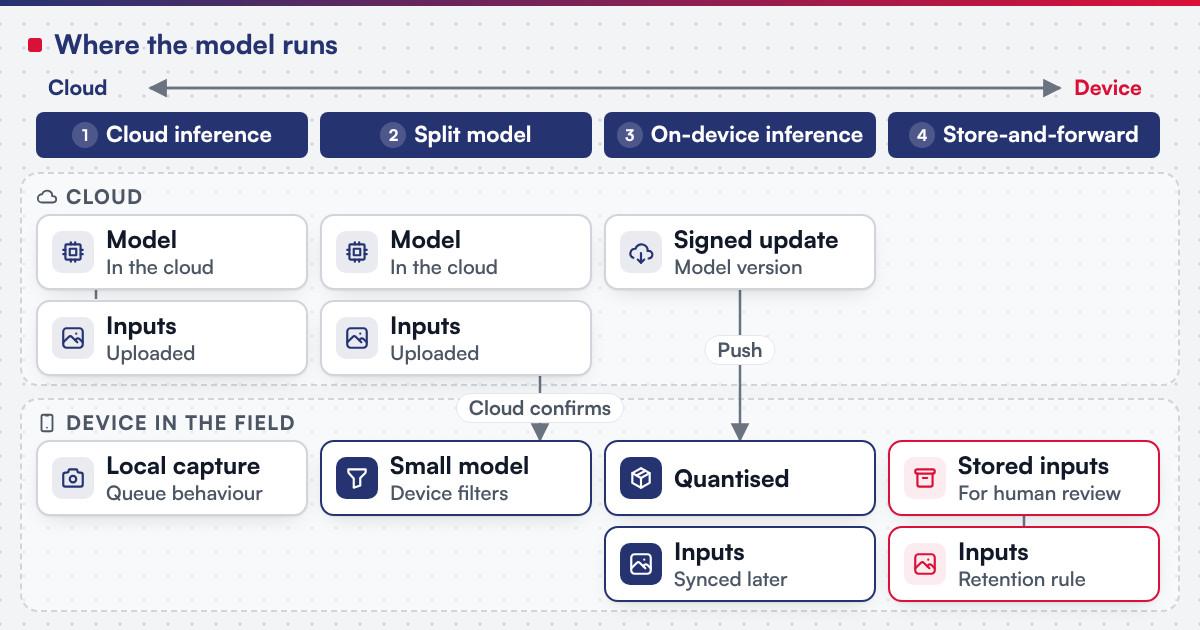 (opens the full-size diagram in a new tab)
What changes when the model leaves the data centre?
The model usually has to shrink. Teams export it to a portable format such as ONNX and run it with a runtime matched to the hardware: ONNX Runtime with a hardware-specific execution provider, a vendor inference engine on a GPU module, or the phone's neural accelerator. Quantising weights to lower precision makes the model smaller and faster, and can change its answers on hard cases. ONNX Runtime's own documentation leaves validation of accuracy and performance to the user, so every conversion needs the case set rerun on the target device, not on a developer laptop.
The device class sets the limits. A phone offers a camera, an accelerator and a familiar update channel through app stores. A GPU module suits multiple camera streams but needs cooling and power. An industrial gateway sits on a site network and needs remote management. Heat, battery drain and storage also matter: a model that runs well for ten minutes can slow down once the device warms up in a hot vehicle.
How do you build a bounded field assessment?
-
Map real conditions
Record lighting, noise, motion, temperature, connectivity gaps and device age at the actual sites, and collect inputs under those conditions.
-
Test on the target hardware
Run the converted, quantised model on the real device and compare its results with the full model on the same cases.
-
Set the local-data rule
Decide what stays on the device, for how long, who can retrieve it, and what happens to data on a lost or retired unit.
-
Exercise updates and recovery
Push a signed update, a deliberately failed update and a rollback in a controlled environment. Confirm the device reports its model version.
-
Test offline end to end
Disconnect mid-task, restart the device, fill the storage and reconnect. Check that nothing is lost or duplicated.
-
Decide with owners
The workflow owner accepts the use, the fleet owner accepts maintenance, and the security owner accepts device identity and network access.
A worked example: connection lost mid-inspection
A manufacturer gives quality inspectors a tablet running a defect-detection model for incoming parts. An inspector photographs a batch in a loading bay where the network drops.
The tablet keeps working: the model flags two parts as possible cracks, and each result is stored locally with the photo, timestamp, device ID and model version. The screen shows "saved offline, will sync" rather than an error. The inspector marks one flag as confirmed and leaves the other for review. When the tablet reconnects, the queue uploads in order with an idempotency key per record, so a retried upload does not create a second inspection.
On the server, a larger model rescores a sample of offline results. It disagrees on the unconfirmed flag, which lands in the quality engineer's review queue with both results side by side. The quality engineer decides; the fleet owner sees in telemetry that this tablet is two model versions behind and schedules the update. The manufacturing and field service page covers where workflows like this sit in a wider operation, and the same offline-capture and fleet-update pattern applies to substation and depot devices in energy and utilities.
What has Netbase delivered for field workflows?
Edge projects often need a small open model rather than a hosted one, and Netbase works with commercial and open-source AI models chosen per project. Netbase applies the ISO/IEC 42001 AI management system framework to its own AI delivery practice, covering how its teams work rather than a client's devices.
-
Offline field capture with a head-office review queue, without AI
For Dey Page, a multi-state business directory in Nigeria, Netbase built a location-confirmed badge verified in the field with geotagged photos, identity capture, offline sync, a head-office review queue and an audit trail, on a 12-week web and mobile plan. Field capture runs in the mobile web app, and no model is involved.
-
Available capability
On-device inference
Converting, quantising and validating models for phones, tablets and gateways is offered through a scoped assessment on your hardware.
-
Available capability
Fleet updates and rollback
Signed model updates, version reporting and staged rollout across a device fleet are offered on the same assessment basis.
Which questions should you ask a supplier?
-
Why does this need to run on the device?
One named reason: connectivity, latency, privacy or data volume
-
How will you validate the converted model?
The case set rerun on the target device, compared with the full model
-
How are updates signed, staged and rolled back?
Signed artefacts, a small first wave, automatic rollback on failure
-
How does each device prove its identity?
Per-device credentials that can be revoked, not a shared key
-
What happens offline?
A local queue, visible status, idempotent sync and conflict rules
-
What telemetry comes back?
Model version, health, error counts and sampled inputs where permitted
-
What happens at end of life?
Credential revocation, data wipe and a recorded retirement
-
Who owns the fleet after handover?
A named fleet owner with a support route and update schedule
What failure modes should you watch for?
-
Quantised model misses hard cases
- Early signal
- Disagreement with cloud rescoring rises
- Who acts
- Technical owner retests and adjusts precision
-
Version sprawl across the fleet
- Early signal
- Telemetry shows several model versions in use
- Who acts
- Fleet owner forces staged updates
-
Duplicate or lost records after sync
- Early signal
- Counts differ between device and server
- Who acts
- Technical owner fixes idempotency and queue handling
-
Thermal slowdown
- Early signal
- Inference time grows during shifts
- Who acts
- Fleet owner changes hardware or duty cycle
-
Shared or leaked device credential
- Early signal
- Unknown device IDs in logs
- Who acts
- Security owner revokes and reissues credentials
-
Retired device keeps data
- Early signal
- Lost unit not wiped
- Who acts
- Fleet owner triggers remote wipe and records it
Plan the next step for your project
Common questions
For a single decision close to the sensor it usually is, because there is no network round trip. It can be slower overall when a small device runs a large model or overheats. Measure end-to-end time on the target hardware at real sites before assuming the edge route wins.
Yes, if updates are staged, signed and resumable, and each device reports its version when it reconnects. Plan for devices that stay behind for weeks, and decide whether an outdated model may keep running or must stop making suggestions until it updates.
Process them on the device, send only results or anonymised crops, and set a local retention rule with automatic deletion. Where sampled images are needed for quality checks, get the data owner's approval for which images leave the site and who can see them.
NIST SP 800-213 lists device cybersecurity capabilities to consider, such as identity, configuration, data protection and update support. It frames the conversation; your security owner still decides which controls your environment requires based on its own risk assessment.
Often, for inspection, capture and guidance tasks where a person holds the device anyway. Phones bring cameras, accelerators and an app-store update channel. Dedicated hardware wins for fixed cameras, continuous streams and harsh sites. The multimodal document guide covers phone-captured documents specifically.
How this guide is sourced
Statements about Netbase map to approved claims backed by attested company facts listed under Sources, in their registered wording. External guidance comes from the ONNX Runtime documentation and NIST SP 800-213, each dated below. The inspection example is illustrative and describes no client. The Dey Page field workflow above is offline capture without AI, and no launch or usage claim is made for it. This page does not replace your security owner's device assessment. See the methodology for how claims are reviewed.
Bring the field conditions
A first conversation goes furthest with a description of the sites, the devices you already own, the decision the model would support and some real inputs captured there. Submit a project with those, or read the emerging technology adoption guide, the robotics software feasibility guide and the other guides first; an AI Workflow Blueprint is the assessment route when the operating case is still open. OutsourcingVN is operated by Netbase JSC and is Netbase's own outsourcing-services platform.
Work behind this guide

This record reports built scope on a 12-week web and mobile plan.
Keep ReadingRelated services and solutions
 AI workflow blueprint: decide where automation belongs before you build
A paid two-to-four-week project that ends in a scope you can approve, change or stop.
Learn More