

Laravel marketplace development: planning a multi-vendor build
A Laravel marketplace works when a custom build is justified over a plugin or SaaS, vendor onboarding and approval run through an administrator back office, every order splits and pays out across vendors under the operator's own rules, and the API behind it serves search, queues and a buyer's mobile app. Scope the record ownership first, then the rest.
Submit a project See the RB Marketplace recordReviewed by Huy Nguyen (David), CEO · Updated 22 Oct 2026 · 10 min read

OutsourcingVN is operated by Netbase JSC. This guide plans the marketplace build once Laravel is the chosen framework on the Laravel platform page; the operations workflow a marketplace runs day to day, on any stack, is planned on marketplace and classifieds operations.
Contents
- When does a custom Laravel marketplace beat a plugin or SaaS?
- How does a Laravel marketplace split vendor, buyer and operator roles?
- How should the first release be built?
- Worked scenario: a regional marketplace's first vendor cohort
- What has Netbase built on Laravel for marketplaces?
- Where does AI fit in a Laravel marketplace?
- What should you check before committing to the stack?
- What goes wrong in a Laravel marketplace build?
- Which questions should you ask a marketplace supplier?
- How this guide is sourced and where it stops
- Common questions
- Plan your marketplace's first release
When does a custom Laravel marketplace beat a plugin or SaaS?
A marketplace plugin or a SaaS platform covers a standard catalogue, cart and a single commission rule out of the box; a custom Laravel build earns its cost once the rules stop fitting that shape: a payout schedule that varies by vendor, an approval workflow with its own verification steps, an order that splits across more than one vendor's fulfilment, or an API that has to serve a mobile app or a third-party integration the plugin was never built to expose. Custom build versus SaaS covers that decision in general; this page plans the Laravel-specific build once a catalogue-and-checkout marketplace is the answer. Where the transaction is a request and a negotiated quote rather than a catalogue checkout, marketplace matching and quotation scopes that workflow instead.
How does a Laravel marketplace split vendor, buyer and operator roles?
Six roles carry a marketplace: who owns the catalogue and stock, who places and pays for an order, who the commission and payout rules answer to, how search finds a listing across every vendor, who approves a vendor before it lists, and who the mobile app's API ultimately serves.
| Marketplace record | Usual owner | Why |
|---|---|---|
| Vendor catalogue and stock | Vendor | The vendor maintains its own listings and quantities |
| Buyer order | Captured by the platform | The platform splits one order across the vendors it touches |
| Commission and payout | Operator | Payout and commission rules are the operator's own policy |
| Search index | Operator | The platform indexes every vendor's catalogue into one search |
| Vendor approval | Operator | An administrator approves a vendor before it can list |
| Mobile app API | Operator | The same API serving the storefront serves the buyer's app |
A vendor's catalogue update syncs into the platform's search index on its own schedule, separate from the order and payout path that runs per transaction.
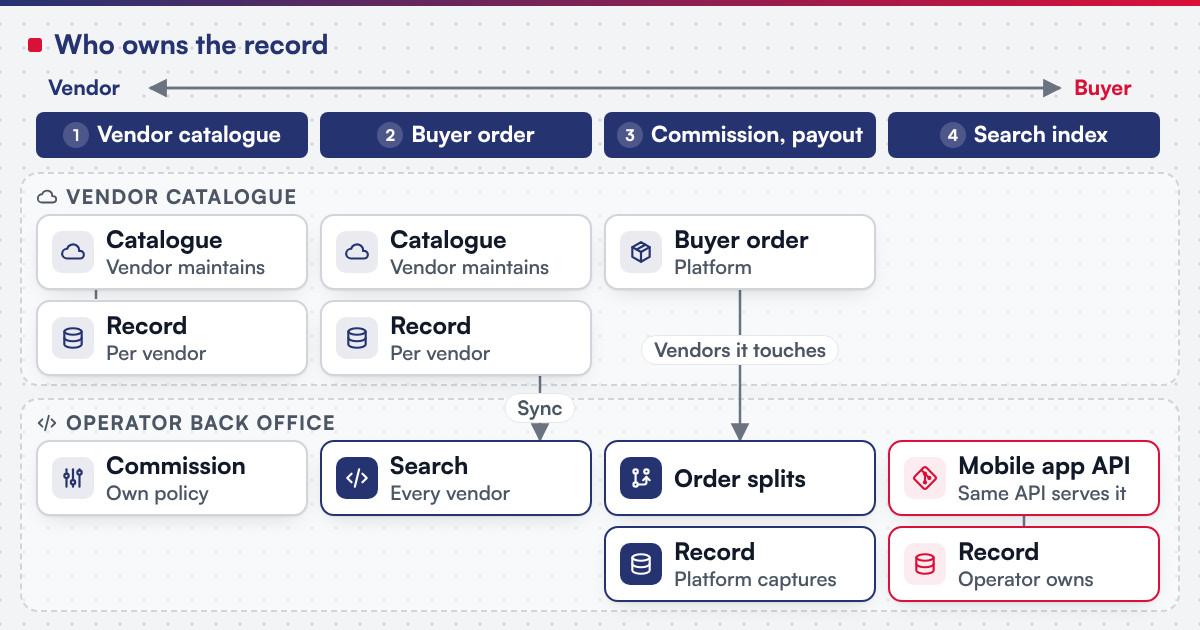 (opens the full-size diagram in a new tab)
How should the first release be built?
-
Blueprint vendor onboarding and approval
Decide what a vendor submits and who approves it before a catalogue goes live.
-
Build the per-vendor catalogue and stock model
, so one vendor's quantity never oversells another's listing.
-
Build order splitting and fulfilment
An order touching two vendors creates two fulfilment records, each tracked to its own vendor.
-
Configure commission and payout as the operator's own rules
, not a hardcoded constant, so a policy change needs no release.
-
Wire search and queues
A search index serves listings across every vendor, and queued jobs carry payout runs and notifications off the request path.
-
Scope the mobile app API and the administrator back office
, deciding which endpoints each one calls once the storefront API is stable.
-
Rehearse the cutover and launch
Load real vendor, catalogue and order data, rehearse a split order end to end, then launch.
Worked scenario: a regional marketplace's first vendor cohort
A hypothetical regional marketplace operator onboards its first twenty vendors before opening search to the public. Vendor registration captures a business detail and a payout account, and an administrator approves each vendor before its catalogue goes live. A buyer's order touching two vendors' listings splits into two fulfilment records at checkout, each tracked and paid out against the operator's own commission rule once it is marked delivered. The catalogue's search index rebuilds nightly rather than per edit, since the vendor count does not yet justify a live index update. A queued job sends the weekly payout batch and flags any vendor whose payout fails validation for a person to resolve before the run completes.
What has Netbase built on Laravel for marketplaces?
For RB Marketplace, Netbase built an English-first multi-vendor marketplace for West Africa on Laravel: a buyer storefront with search and filters, wishlist, cart, coupons and checkout; vendor registration with administrator approval, store profiles, product and inventory management, order fulfilment and tracking updates, earnings, commission deductions and payout requests; administrator controls for vendor approval, product moderation, commission, payouts, campaigns and analytics; a customer REST API with device tokens and notifications; transactional email with SPF and DKIM; and 90 days of post-launch support. Its customer shopping app runs on the same API: Android, with iOS in the extended scope, with push notifications for order updates, flash sales, back-in-stock and cost-reduction alerts, Google, Facebook and Apple sign-in, a persistent cart with coupons, checkout through a secure web view and order tracking; see the RB Marketplace record. Separately, for a founder who is not named, Netbase delivered a bilingual English and Nepali classifieds platform: requirements, design, a Laravel backend with REST APIs, OTP accounts, paid ads, search, ratings, messaging, classified event ticket ads, a blog and forum, payments, multi-language SEO and AWS deployment.
See the classifieds platform record
Plan the next step for your project
Where does AI fit in a Laravel marketplace?
The categories that pay off first on a marketplace are vendor-listing enrichment drafted from a submitted description for a moderator to check, a support assistant that answers order-status and payout questions before a human ticket opens, and a moderation queue that flags a listing or a message for a person to decide rather than approving or blocking it outright. None of it replaces the approval, commission and payout rules this guide plans. Custom product engineering scopes where an AI feature belongs against where an approval or a search-ranking rule already does the job.
What should you check before committing to the stack?
Laravel's own queue documentation describes moving time-intensive tasks to a queue so the application "can respond to web requests with blazing speed," with Horizon as "a beautiful dashboard and configuration system for your Redis powered queues," the mechanism behind a payout run, a bulk notification or a search-index rebuild that should not block a checkout request. Its Scout documentation describes a built-in database engine that uses MySQL or PostgreSQL full-text indexes to search an existing database, with Algolia, Meilisearch and Typesense available as drivers once a catalogue needs typo tolerance or faceted filtering at real scale; the relational store behind vendor, catalogue and order records is typically MySQL or PostgreSQL, chosen the way any Laravel application chooses its primary database. Its Sanctum documentation describes "a featherweight authentication system for SPAs (single page applications), mobile applications, and simple, token based APIs," the layer behind the token a vendor dashboard, a buyer account and a mobile app each authenticate with. Laravel's own release notes state that for all Laravel releases bug fixes are provided for 18 months and security fixes for 2 years, and list the supported PHP range per version: 8.2 to 8.5 for Laravel 12 and 8.3 to 8.5 for Laravel 13, released in the first quarter of 2026. Confirm before scoping a build:
- Which records a marketplace plugin or SaaS already covers, and which commission, approval or split rule it cannot model.
- Which Scout driver the catalogue needs: the built-in database engine, or Algolia, Meilisearch or Typesense for typo tolerance and faceted filtering at real scale.
- Which queue backend carries payout runs, notifications and index rebuilds without blocking a buyer's checkout.
- Which Laravel major version is in scope, and its PHP floor, checked against the current release notes rather than an older tutorial.
What goes wrong in a Laravel marketplace build?
- Vendor approval treated as a formality. Without a real review queue, a store approves an unverifiable vendor in minutes and inherits its problems later.
- Commission and payout rules hardcoded instead of configured. A change in the operator's own policy then needs a code release rather than a settings change.
- Search bolted on after the catalogue takes shape. Choosing a Scout driver late means reindexing a live catalogue under load instead of at launch.
- A split order recorded as a single order. A return or a partial refund then has nowhere clean to attach once two vendors are involved.
Which questions should you ask a marketplace supplier?
- Which approval and verification steps does a vendor go through before its catalogue goes live?
- Where do commission and payout rules live, and can the operator change them without a release?
- Who owns the storefront API a companion app will call, and is that app scoped as mobile app development once the marketplace API is stable?
- How is scope fixed? Most Netbase projects are agreed as fixed-scope contracts after discovery, with milestone-based arrangements also available.
How this guide is sourced and where it stops
The Laravel facts are read from Laravel's own documentation on the dates cited. Netbase's evidence covers a named multi-vendor marketplace and its shopping app, and a separate classifieds platform; the build sequence and the worked scenario are editorial planning guidance for a marketplace build.
Common questions
Usually, up to a point: most plugins model a flat commission and a single approval step; a commission that varies by category, a multi-step approval or an order that splits across vendors usually needs custom logic.
Scout for search, either its built-in database engine or a driver such as Algolia, Meilisearch or Typesense, and the queue system with Horizon as its dashboard for payout runs, notifications and reindexing.
Yes, when they are configured as the operator's own data rather than hardcoded; that is the point of treating them as rules rather than constants.
Yes: the companion app calls the same API the web storefront uses, so building it once that API is stable avoids rebuilding it against a moving target.
For custom development the client owns the IP created for it; Netbase productized modules and products are licensed, not transferred.
The RB Marketplace record, whose marketplace and shopping app are described in the chapter on what Netbase has built on Laravel, with the classifieds platform record beside it.
Plan your marketplace's first release
Bring your vendor count, your commission and payout rules, and whether a mobile app is in scope for release one or a later phase, and a person will map them onto the sequence above. Custom product engineering scopes the marketplace itself, and marketplace and classifieds operations covers the day-to-day workflow once it launches.
OutsourcingVN is Netbase's own outsourcing-services platform. Submit a project with your vendor model and API requirements, and a person will reply with the fit.
Work behind this guide

Netbase delivered a bilingual classifieds marketplace, in English and Nepali, with paid ads, search, messaging, payments and an AI filter that flags offensive content into an administrator review queue. The client is not named, and no traffic, accuracy or commercial result is claimed.
Keep Reading
This record sets out what was delivered on each side, what deliberately stayed in the web panel, and what the project documents do not support.
Keep ReadingRelated services and solutions
 Custom product engineering for a bounded release outcome
One defined release of your product, built to named outcomes and handed over with acceptance evidence.
Learn More