

Multi-vendor marketplace build costs: the drivers behind a quote
The cost of building a multi-vendor marketplace is driven by five things more than by page count: how vendors are onboarded and verified, how money is split and paid out, how search works across every seller, how listings are moderated, and how many systems the marketplace must connect to. Scope each driver explicitly and quotes become comparable.
Submit a project Read the ecommerce outsourcing guideReviewed by Huy Nguyen (David), CEO · Updated 13 Nov 2026 · 8 min read

This guide is for founders and CTOs preparing a marketplace brief for outside suppliers. OutsourcingVN is operated by Netbase JSC, which builds marketplaces, so it is written by a supplier with an interest in your project. It deliberately quotes no figure: a number without a scope behind it cannot be compared with another supplier's. It is a spoke of the ecommerce development outsourcing guide, and the commerce and operations solutions hub covers the workflows a marketplace runs once it is live.
Contents
- Why does a marketplace cost more than a single store?
- Which five drivers decide the cost?
- Which scope choices move the estimate most?
- How do you scope a first release that can be quoted?
- Which Netbase marketplace work is closest?
- Where does AI change marketplace effort?
- What makes marketplace estimates unreliable?
- Common questions
- Bring your seller model and money rules
Why does a marketplace cost more than a single store?
A single store has one seller, one catalogue owner and one bank account. A marketplace has many of each. Stripe's marketplace guide describes the model: a marketplace provides a single storefront that offers products and services from many sellers; customers pay the marketplace, and the marketplace then pays the sellers. Every part of that sentence becomes software: a vendor side, an operator side and a money flow between them.
Responsibility moves too. Stripe's guide states that the marketplace platform is responsible for covering the negative balances of its connected accounts, which means refunds, disputes and failed payouts need rules and screens, not just a checkout. The Laravel marketplace development guide plans those parts as a build; this page explains why each one weighs on the estimate.
Which five drivers decide the cost?
Each driver can be scoped small or large. The table shows what pushes it each way.
| Driver | Smaller scope | Larger scope |
|---|---|---|
| Vendor onboarding | One seller type, manual approval | Several seller types, document checks, verification by country |
| Payouts | One commission rule, scheduled payouts | Rules per category or seller, holds, refunds, disputes |
| Search | Database full-text search | Faceted filters, typo tolerance, geo or vector search |
| Moderation | Operator reviews new listings | Rules, automated flags, appeals and audit trail |
| Integrations | Payment provider and email | ERP, carriers, tax, marketing, mobile app API |
Vendor onboarding. The work grows with the number of seller types and the countries they come from. Stripe's verification documentation describes the information connected accounts must provide as depending on their business, location and requested capabilities, so a marketplace that onboards sellers in several countries carries several onboarding paths. A payment provider's hosted onboarding reduces the forms the team builds; it does not remove the operator's own approval step.
Payouts. One flat commission paid on a schedule is the small case. Per-category rules, payout holds until delivery, partial refunds on a split order and dispute handling each add logic, tests and operator screens.
Search. Laravel Scout's documentation shows the range: Scout ships with a built-in database engine that uses MySQL / PostgreSQL full-text indexes, and also includes drivers for Algolia, Meilisearch, Typesense and Turbopuffer when you need features like typo tolerance, faceted filtering, vector search, or geo-search at massive scale. The jump from the first to the second is a cost step: an index to keep in sync, a service to run and relevance to tune.
Moderation. A marketplace where the operator approves each listing by hand needs a queue and a decision log. Automated flags, appeals and reasons shown to the seller add rules and screens on top. The marketplace and classifieds operations page describes the day-to-day workflow these tools support.
Integrations. Each external system adds a connector, error handling and a test plan. A companion shopping app adds an API the web storefront may not have needed; mobile commerce apps covers that layer.
Which scope choices move the estimate most?
Three choices shift a marketplace estimate further than any feature list:
- Platform route. A marketplace plugin on WooCommerce covers a standard catalogue and a simple commission; the WooCommerce platform page and the Magento vs WooCommerce comparison describe where those platforms fit. Varied payout rules, multi-step vendor approval or split fulfilment usually move the build to a custom application.
- Transaction shape. A catalogue checkout and a request-for-quote marketplace are different products; the marketplace matching and quotation guide scopes the second.
- Release one versus later. Every driver can start in its smaller form and grow once real sellers and buyers show where the effort pays.
How do you scope a first release that can be quoted?
-
Name the seller types and countries
List who sells, from where, and what each must submit before listing.
-
Write the money rules
Commission basis, payout timing, holds, refunds and who absorbs a dispute, as rules rather than examples.
-
Choose the search level
Database search for release one, or a dedicated engine from the start, with the reason written down.
-
Define moderation
What is reviewed, by whom, how fast, and what the seller sees when a listing is rejected.
-
List every integration
Payment provider, email, tax, carriers, ERP and any app API, each marked release one or later.
-
Write acceptance scenarios
A test vendor registers, is approved, lists, receives a split order and is paid out; an operator moderates and refunds.
-
Send the same pack to every supplier
Quotes built on the same scope and scenarios can be compared line by line.
Most Netbase projects are agreed as fixed-scope contracts after discovery; milestone-based arrangements are also available. The fixed-scope vs milestone contracts guide explains when each fits a marketplace, and the total software delivery cost guide covers running costs after launch.
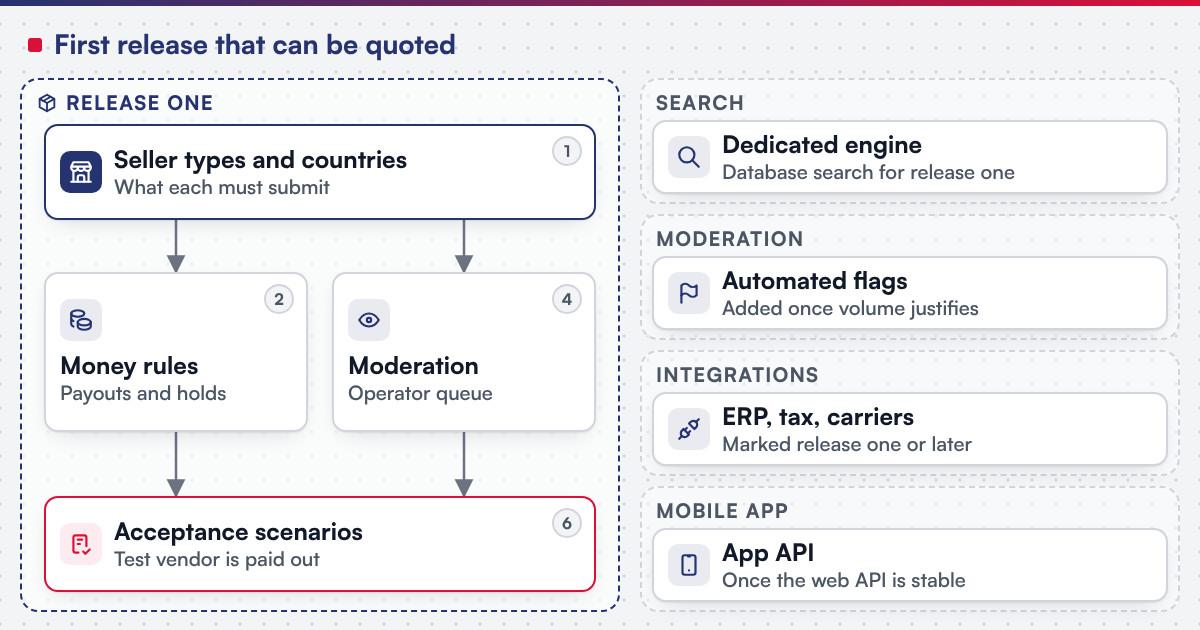 (opens the full-size diagram in a new tab)
Which Netbase marketplace work is closest?
For RB Marketplace, an English-first multi-vendor marketplace for West Africa, Netbase built the platform on Laravel with vendor registration under administrator approval, store profiles, order fulfilment and tracking, earnings, commission deductions and payout requests, plus administrator controls for vendor approval, product moderation, commission, payouts, campaigns and analytics. The RB Marketplace record lists the full scope, including the customer REST API.
For a founder who is not named, Netbase delivered a bilingual English and Nepali classifieds platform with a Laravel backend, REST APIs, OTP accounts, search, ratings, messaging, payments and multi-language SEO; the classifieds platform record describes it.
Plan the next step for your project
Where does AI change marketplace effort?
AI shifts effort inside the drivers rather than removing them. A model can pre-check a vendor's submitted details for a person to approve, draft listing enrichment from a seller's description, flag a listing or message for a moderator, and answer routine order-status questions before a ticket reaches the operator. Each of those still needs a review queue, a decision log and acceptance tests, so it belongs in the scope as a feature with its own scenarios.
What makes marketplace estimates unreliable?
- Money rules left as examples. "Sellers get paid weekly" leaves holds, refunds and disputes undefined, and each one surfaces later as a change request.
- Search chosen late. Moving from database search to a dedicated engine after launch means reindexing a live catalogue.
- Moderation assumed to be free. Someone has to review listings; the tools for that person are part of the build.
- Integrations counted, not described. "Connect to our ERP" can mean one feed or ten; each needs a named direction, frequency and owner.
Common questions
Because a figure depends on the scope behind it. Two quotes are comparable only when both answer the same seller, money, search, moderation and integration choices.
Often for a standard catalogue and a single commission rule. Once payout rules vary or vendor approval has several steps, custom work on a plugin can exceed a purpose-built release one.
Yes. A first release can run on an operator queue and a decision log, with automated flags added once listing volume justifies them.
Yes. It adds an API, push notifications and app releases; building it once the web marketplace's API is stable avoids rework.
The seven-step scope pack above: seller types, money rules, search level, moderation, integrations, acceptance scenarios and the release-one boundary.
Talk to Huy Nguyen (David), Founder and CEO of Netbase JSC: message him on WhatsApp at +84 937 869 689 or email project@netbasejsc.com. You can also send your brief through the project request form. Say which workflow or system the project concerns and what has to stay unchanged; the first step is a discovery conversation, and scope and milestones are agreed after it.
Bring your seller model and money rules
E-commerce development scopes marketplace builds alongside single stores, and the headless vs traditional e-commerce guide helps when the storefront must be decoupled from the platform. OutsourcingVN is Netbase's own outsourcing-services platform. Submit a project with your seller types, payout rules and integration list, and a person will reply with what discovery would need to settle first.
Work behind this guide

Netbase delivered a bilingual classifieds marketplace, in English and Nepali, with paid ads, search, messaging, payments and an AI filter that flags offensive content into an administrator review queue.
Keep Reading
For RB Marketplace, Netbase built an English-first multi-vendor marketplace for West Africa on Laravel, then built the customer shopping app on that marketplace's own API.
Keep ReadingRelated services and solutions
 E-commerce development, built, extended or replatformed as a project
A store built, extended or replatformed on Magento, WooCommerce or headless, as scoped milestones.
Learn More