

Headless or traditional e-commerce: choosing the architecture
Choose a traditional, coupled storefront when one commerce platform can own catalogue, checkout and presentation together behind a single release. Choose a headless, API-first architecture when several channels, an independent release cycle or a specific front-end framework matter more than running one system. Most stores start coupled and decouple only the part that needs to move on its own.
Submit a project Compare Magento and WooCommerceReviewed by Huy Nguyen (David), CEO · Updated 18 Oct 2026 · 10 min read

OutsourcingVN is operated by Netbase JSC, which builds commerce projects on both the coupled and the headless route and earns its revenue from the engineering either one needs, so this comparison is not neutral by default; it is written to hold up anyway. For custom development the client owns the IP created for it; Netbase productized modules and products are licensed, not transferred, so a headless build that reuses a Netbase module still leaves you holding everything built around it.
Contents
- What exactly is being compared?
- How do the two architectures compare?
- How do you decide?
- Worked scenario: a subscription retailer adding a mobile app
- What do Netbase records show about each route?
- Which questions should you ask a vendor or supplier?
- What goes wrong with each route?
- How this guide is sourced and where it stops
- Common questions
- Choose the architecture before the platform
What exactly is being compared?
A traditional, coupled commerce platform renders its own storefront: Magento, WooCommerce or another cart owns the catalogue, checkout, theme and every page a shopper sees, from one codebase and one release. A headless, API-first architecture splits that in two: the commerce engine still owns catalogue, pricing and checkout, but a separate front end, commonly built in Next.js, calls its API and renders every page itself, on its own schedule.
Magento and WooCommerce can run either way: coupled out of the box with their own themes, or as the commerce engine behind a headless front end. Choosing between Magento and WooCommerce themselves, rather than this architecture, is the Magento vs WooCommerce guide's question; this page assumes a platform is already chosen, or nearly so, and asks only whether to couple it to its own storefront or decouple the two.
How do the two architectures compare?
Score your own project against six criteria, and treat the middle two columns as real options, not a forced choice between two extremes.
| Criterion | Coupled storefront | Coupled with an API layer | Headless via platform SDK | Headless independent front end |
|---|---|---|---|---|
| Content needs | Content and commerce templates share one admin screen | A decoupled theme adds API calls for selected content | The platform's own SDK still shapes most templates | Content can live anywhere; the front end decides |
| Channels served | One storefront, one release | One storefront, a few API-served widgets | One front end, built from the platform's SDK | Many front ends can call the same API |
| Team skills needed | One platform skill set | Platform skills plus a light API layer | Platform skills plus the SDK's own front-end tooling | A separate front-end team and framework, such as Next.js |
| Extensions and plugins | Extensions change the storefront directly | Extensions must expose an effect through the API first | Only extensions the SDK itself supports carry over cleanly | Every extension's effect must reach the API before any front end sees it |
| Operations | One deployment to release and monitor | Two light deployments, still close together | Two deployments, one of them vendor-managed | Two independent deployments, each with its own on-call |
| Total effort | Lowest for one brand, one channel | A step up, still close to the platform's own cost | Moderate; most of the ceiling is still the SDK's | Highest upfront; pays off once channels or releases multiply |
A coupled storefront keeps every theme setting inside the platform's own admin screens, limited to the options the platform exposes. An API layer added on top calls the platform's API for the parts that need it, without a full rebuild. The platform's own SDK gives a managed front end that still has to be customised, with the front end's customisations and the data behind them hosted outside the commerce platform itself even though the platform supplies the SDK. A fully independent front end holds its own code, and that code and its data are fully yours to run, on your own release cycle.
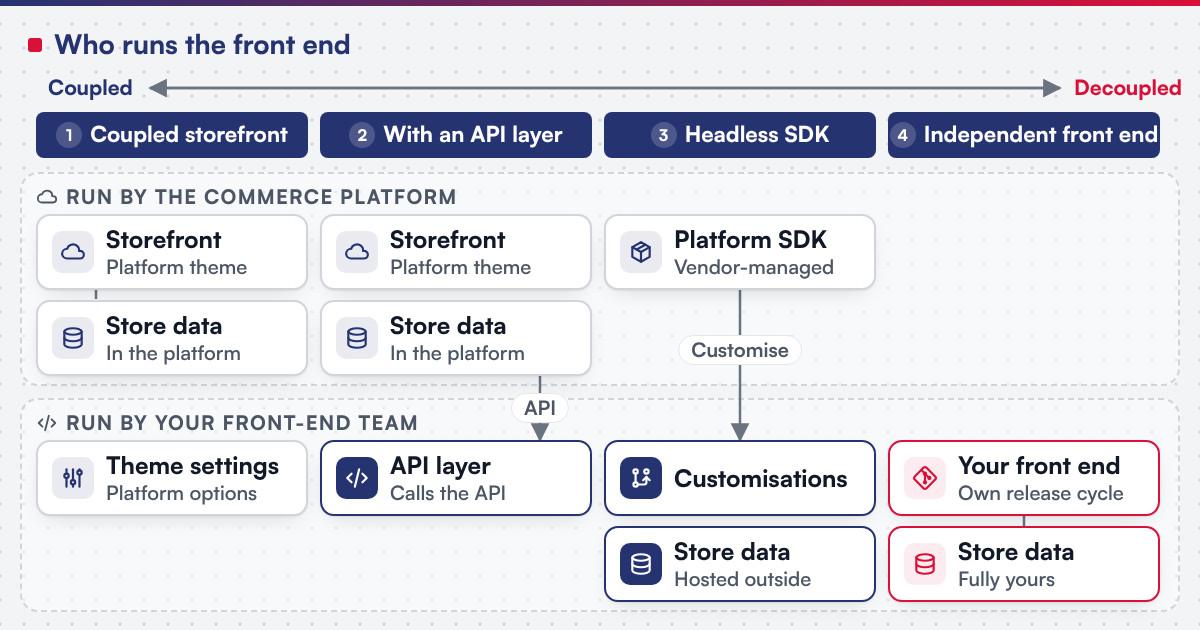 (opens the full-size diagram in a new tab)
How do you decide?
-
List every channel you must serve now or within a year
A single storefront, a marketplace feed, a mobile app or a kiosk each change the answer.
-
Check who owns front-end skills today
A headless build needs a front-end team comfortable with a framework such as Next.js, not only the commerce platform's own templates.
-
Count how many extensions you actually use
Each one has to expose its effect through the API before a headless front end can use it; a long plugin list makes headless more expensive to reach.
-
Decide whether releases must be independent
Coupling keeps one release train; headless lets the front end ship on its own schedule, at the cost of running two systems.
-
Add up the total effort over the life of the store
, not the first release, using the e-commerce platform modernization checklist to inventory what a move would touch.
-
Choose, and write down the trigger that would reverse it
A new channel or a stalled release cadence are the usual ones.
Worked scenario: a subscription retailer adding a mobile app
A hypothetical subscription retailer runs a single coupled storefront today and wants to add a companion mobile app within the year, without rebuilding checkout. Mobile commerce apps scopes the app itself; this guide decides what the storefront underneath it should look like first.
- Milestone one keeps the storefront coupled and adds a documented API surface for the parts the app will need: catalogue, cart and order status.
- Milestone two builds the app against that API, independent of the storefront's own release train.
- Milestone three revisits the storefront itself only if a second channel or a redesign makes full decoupling worth its own front-end team.
The retailer never goes fully headless; it adds just enough API surface for the one new channel it actually needs, and keeps the reversal trigger written down.
What do Netbase records show about each route?
On the headless side, the clearest delivered example is the reward-shop platform for a Dubai-based loyalty and rewards company that is not named, built under an NDA: a Next.js storefront calls a Magento 2 Open Source engine that still owns the hybrid points-and-cash checkout and multi-vendor routing, delivered across four phases over 3.5 to 4.5 months. See the loyalty reward shop record.
A third pattern sidesteps the packaged choice entirely: building a custom commerce foundation instead of coupling to, or decoupling from, Magento or WooCommerce. Deyar Printing & Advertising's bilingual web-to-print platform runs its designer, pricing engine and print-ready PDF pipeline on a Laravel headless-commerce foundation built specifically for it; see the bilingual platform record.
On the coupled side, Netztech's Magento 1 to Magento 2 migration, 35 working days across 11 extensions, shows the operating cost of staying coupled to one platform's own release cycle: the whole extension list has to move with the core, because nothing runs behind a separate API. Reusing Netbase's own productised modules on any of these routes can cut development time by up to 60%, an upper bound tied to module reuse rather than a typical result on any one project.
Which questions should you ask a vendor or supplier?
- For either route: who owns the API contract once a front end is split out, and how is a breaking change on either side communicated?
- For a headless build: which parts of checkout, pricing and promotions stay in the commerce engine, and which move to the front end?
- For a coupled build: if a second channel arrives later, is an API layer realistic to add, or does it mean a rebuild?
- For either route: how many extensions or plugins does the current store depend on, and which would need to expose themselves through an API?
- For a build supplier: who owns the code? For custom development the client owns the IP created for it; Netbase productized modules and products are licensed, not transferred.
What goes wrong with each route?
- Going headless for a channel that never arrives. Two deployments and two on-call rotations, paid for before the second channel exists.
- Treating the API as an afterthought. A contract written after the front-end team has already started tends to be rewritten once, expensively.
- Staying coupled past the point several channels are live. Every new channel gets bolted onto a storefront that was never built to serve more than one.
- Comparing routes on first-release cost only. A coupled build looks cheaper until the second channel or the first independent release is actually needed.
- Assuming an extension carries over unchanged. The Netztech migration above shows why: each one is re-proven, not assumed.
How this guide is sourced and where it stops
The architecture definitions and the criteria are editorial guidance, not a vendor claim. Netbase's evidence covers a delivered headless reward-shop platform, a bilingual platform built on a custom headless-commerce foundation, and a Magento migration that stayed on one coupled platform. No client, figure or partner is named beyond the linked records, and the durations above are the project's own, not a general benchmark.
Plan the next step for your project
Common questions
No. A coupled storefront usually reaches a first release faster, because there is one system to stand up rather than two with a contract between them.
Yes, and it is a common path. Keep the extension list small and the API surface documented from the start, so a later split has less to untangle.
No. The commerce engine, whether Magento or WooCommerce, still owns catalogue, pricing and checkout; headless commerce only changes who renders the page.
Coupled, for one brand and one channel. Headless costs more in deployments and coordination, and that cost is worth paying only once more than one channel or an independent release schedule is actually needed.
No. Mobile commerce apps is one reason to add an API layer, not the only one; a second storefront brand or a redesign on its own schedule can justify it too.
Yes. Both can sit behind a separate front end; the Magento vs WooCommerce guide compares the platforms themselves once the architecture question above is settled.
That move is covered separately by the Magento to WooCommerce migration guide, which assumes the platform choice is already made and plans the catalogue, extension and cutover work; a store leaving Shopify for WooCommerce instead uses the Shopify to WooCommerce migration guide.
Choose the architecture before the platform
Bring your channel list, your front-end skills and your extension count to a brief. E-commerce development scopes a new build, an extension or a full replatform on either architecture, and legacy application modernization is usually the cheaper path when an existing coupled store only needs an API layer added rather than a full rebuild.
OutsourcingVN is Netbase's own outsourcing-services platform. Submit a project with your channel list and extension count, and a person will reply with the architecture that fits.
Work behind this guide

Netbase scoped and built a bilingual web-to-print platform, Arabic right-to-left and English, for Deyar Printing & Advertising, a printing, packaging, signage and fleet-branding company in Riyadh, Saudi Arabia.
Keep Reading
Netbase delivered a headless multi-store reward shop platform for a Dubai-based loyalty and rewards technology company: each client programme gets its own branded shop, shoppers pay with points and cash, and orders route to the right supplier.
Keep Reading
What this record reports instead is a duration and a scope, both attested.
Keep ReadingRelated services and solutions
 Legacy application modernization, one bounded capability at a time
The code is assessed first, then one bounded capability moves at a time, with a way back.
Learn More
 E-commerce development, built, extended or replatformed as a project
A store built, extended or replatformed on Magento, WooCommerce or headless, as scoped milestones.
Learn More