

Planning a Shopify to WooCommerce migration
Moving from Shopify to WooCommerce trades a managed, hosted platform for one you own: export and remap the catalogue, customers and orders, replace each Shopify app with a WooCommerce plugin or a small build, rebuild the fixed Shopify URLs as redirects, and re-set payments, tax and checkout before a rehearsed cutover.
Submit a project See e-commerce developmentReviewed by Huy Nguyen (David), CEO · Updated 18 Oct 2026 · 12 min read

OutsourcingVN is operated by Netbase JSC, which builds and maintains stores on WooCommerce and earns its revenue from the engineering a move like this needs, so this guide names that conflict upfront. The platform choice itself is covered by the Magento vs WooCommerce guide; a store running Magento rather than Shopify uses the Magento to WooCommerce migration guide instead, which assumes a self-hosted Magento source, not Shopify's hosted one. A store that also wants to decouple its front end once it lands on WooCommerce starts with headless vs traditional e-commerce next.
Contents
- When does owning the platform pay off?
- How do you export and map Shopify data to WooCommerce?
- Which Shopify apps have a WooCommerce plugin equivalent?
- How do you keep URLs and search intact?
- Re-set payments, tax and checkout
- The Shopify to WooCommerce migration pipeline
- Worked scenario: a mid-size home goods store leaving Shopify
- Where does AI fit in a Shopify to WooCommerce migration?
- What should you check in Shopify's and WooCommerce's own documentation?
- What has Netbase delivered on WooCommerce and WordPress?
- Which questions should you ask a migration vendor?
- What goes wrong in a Shopify to WooCommerce migration?
- How this guide is sourced and where it stops
- Common questions
- Bring your catalogue and your app list to the decision
When does owning the platform pay off?
Whether WooCommerce itself fits your catalogue is decided on the WooCommerce platform page; this guide assumes WooCommerce is already chosen and plans the specific move off Shopify, a managed, hosted platform, onto software installed on a WordPress site. Score the current store against five signals before committing.
| Signal | Stay on Shopify | Move to WooCommerce |
|---|---|---|
| Hosting and ownership | Happy to leave hosting and updates to Shopify | Want to own the server, the data and every setting |
| App dependence | A short, actively maintained app list earning its cost | A long or expensive app list better replaced with owned code |
| Content and commerce together | Commerce-only, with little editorial content | Content-heavy, or WordPress already runs the business |
| Developer access | Comfortable inside Shopify's own theme and app model | A team that wants direct server, database and code access |
| Reason for looking | None; the platform is doing its job | App costs or hosting control, not a missing feature |
A store that values Shopify's managed checkout and update cycle more than owning the stack usually stays; one that wants to stop paying for apps a WordPress plugin already covers, or wants full control of its hosting and code, is the one this guide is for.
How do you export and map Shopify data to WooCommerce?
Shopify's own export tool generates a product CSV; delivery depends on size, since Shopify sends the file to a browser download under 100 variants per product and emails it otherwise. The export excludes product images: Shopify's own documentation states that "the product images are generated only if they remain viewable on a publicly accessible website," so the old store stays live and public until every image is re-hosted on WooCommerce. WooCommerce's own CSV importer takes a variable parent row and one variation row per option combination, a different shape from Shopify's flat variant rows that needs a field-by-field map. Customer records and order history move the same way, matched field by field before any file is generated, following the discipline legacy data migration planning sets out for any data move. A store syncing through an API instead of a one-off export reads products, customers and orders from Shopify's REST Admin API, which Shopify's own documentation lists as legacy since 1 October 2024 and caps at 40 requests per app per store per minute, returning a 429 response with a Retry-After header once that limit is hit — a ceiling a bulk export script paces itself against.
Which Shopify apps have a WooCommerce plugin equivalent?
An app installed on Shopify runs inside Shopify's own platform; there is no file to copy when the store leaves. Every app in active use needs a named WooCommerce plugin equivalent, checked individually: a reviews app, a subscriptions app, a loyalty-points app and any app built specifically for the catalogue each get their own line. Some map cleanly to an existing plugin, some need a small custom plugin, and a few have no honest equivalent and must be scoped as new work before the cutover date is set, not discovered after it.
How do you keep URLs and search intact?
Shopify's own documentation is explicit that its paths cannot be changed: its URL redirect guide states that "/products, /collections, /collections/all" are fixed paths that cannot be redirected away from, and every product and collection URL on a Shopify store sits under one of these fixed prefixes. WooCommerce carries no equivalent restriction: its own permalink settings let a product's base sit under /product/, the shop page's own slug, or a custom base, so the redirect map translates every Shopify product and collection handle under its fixed /products/ or /collections/ path to whatever base WooCommerce adopts, one tested redirect per old URL. Getting this list wrong loses the search ranking the store already earned; the e-commerce platform modernization checklist is the wider inventory a move like this should run against first.
Re-set payments, tax and checkout
Shopify's own documentation describes Shopify Payments as a processor built into the Shopify platform itself, so a Shopify Payments account does not travel to a new platform; WooCommerce needs its own payment extension installed and signed up, such as WooCommerce's own WooPayments, before the new store can take an order. Tax rules and shipping zones are re-created inside WooCommerce rather than exported, since the two platforms calculate checkout differently enough that a straight copy usually produces the wrong total somewhere.
The Shopify to WooCommerce migration pipeline
A rehearsed cutover on a staging copy catches the mapping, app-match and tax errors a live dry run cannot afford to find.
-
Inventory the Shopify catalogue, customers and orders
List every product, variant, customer record and order status, and every app that touches each one.
-
Export and map fields to WooCommerce
Turn the Shopify product CSV, customer list and order history into WooCommerce's schema, naming every mismatch first.
-
Match every app to a plugin
List every Shopify app in active use, match each to its closest WooCommerce plugin, and flag any with no honest equivalent.
-
Rehearse the migration on a staging copy
Run the full catalogue, customer and order load against a staging store, re-host every image, test the redirect map, and rehearse the rollback path back to Shopify.
-
Decide go or no-go on the cutover
Catalogue counts, tax calculations, the redirect map and a full checkout run gate the decision; anything unresolved is a no-go, not a guess.
-
Cut over to the WooCommerce store
Point the domain at the new, live site, then watch orders, redirects, tax and payment routes through the verification window.
-
Verify and close out the migration
Confirm every record reconciles against the old Shopify store, then close it on a written decision, not a date picked in advance.
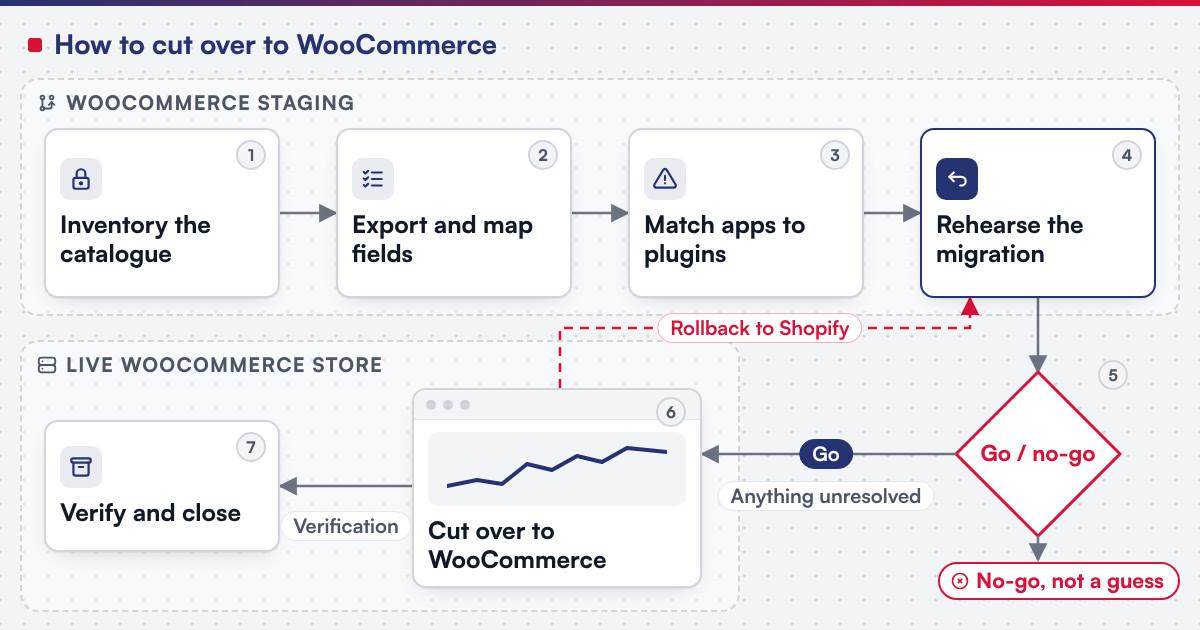 (opens the full-size diagram in a new tab)
Worked scenario: a mid-size home goods store leaving Shopify
A hypothetical home goods retailer runs 800 products on Shopify with a dozen apps and a content-heavy blog already on a separate WordPress install.
- Milestone one inventories the catalogue and apps, exports the data, and maps every field to WooCommerce's schema.
- Milestone two rehearses the full load on a staging store merged into the existing WordPress install, re-hosts every image, and matches ten of the twelve apps to plugins, flagging two for a small custom build.
- Milestone three builds the two custom-plugin gaps, tests the redirect map against Shopify's fixed paths, and rehearses the cutover again before the go/no-go decision.
The retailer's existing WordPress content and its dozen paid apps are the signals that make the move worth making; a store happy with Shopify's managed hosting would usually stay.
Where does AI fit in a Shopify to WooCommerce migration?
The clearest AI use on a migration like this sits on the mapping and testing side: reading an unfamiliar app's settings export, drafting a first-pass field map between Shopify's and WooCommerce's schemas, and generating candidate test orders that exercise tax and shipping edge cases for a person to check. Netbase's delivery lifecycle: discovery and strategic alignment; team assembly and architecture planning; agile execution with outcome-based milestones; modular components; training and rollout; ongoing support. None of that assistance decides a field mapping, approves an app match or signs off the cutover.
What should you check in Shopify's and WooCommerce's own documentation?
Confirm before scoping a build:
- Which export path the catalogue takes. Shopify's own documentation warns that "sorting your CSV file in a spreadsheet program can cause product variants or image URLs to become disassociated," so the file is mapped as delivered, not re-sorted by hand.
- Whether a bulk export or sync uses the REST Admin API, capped at 40 requests per app per store per minute with a 429 response once that limit is hit.
- Which WooCommerce product base the new store will use, since a default
/product/base, the shop page's own slug, or a custom base each decide the redirect map's target. - Which payment extension replaces the old checkout, confirmed and signed up before the cutover window.
What has Netbase delivered on WooCommerce and WordPress?
PrintLeo, an e-commerce and advertising company, runs the CMSmart WordPress Printshop package with its online design plugin, delivered by Netbase; see the PrintLeo record. Indieprint, a Melbourne digital paper and apparel printer, installed the Netbase WooCommerce online designer on two domains; design errors fell 28% and production turnaround improved 15%. Netbase's representative web-to-print roster on WooCommerce and WordPress spans print businesses in Singapore, France, the Netherlands and South Korea, by industry and country only. On migration discipline, the clearest evidence is the Netztech engagement: a Magento 1 to Magento 2 migration delivered in 35 working days across 11 extensions; see the Netztech migration record. That same field-by-field, app-by-app discipline applies to a Shopify move, since nothing on the target platform behaves the same way by default.
Plan the next step for your project
Which questions should you ask a migration vendor?
- How will every Shopify app be matched to a plugin, and what happens to the ones with no match?
- Who reconciles the catalogue, customer and order counts after the rehearsal, and against what source?
- How is the redirect map tested against Shopify's own fixed URL paths before cutover?
- What is the rollback plan if parity fails? Most Netbase projects are fixed-scope contracts agreed after discovery, and the rollback decision is scoped as part of it.
What goes wrong in a Shopify to WooCommerce migration?
- Assuming an app has an obvious plugin equivalent. Some do; others need a small custom build, and a few have no honest match at all.
- Forgetting that product images do not export. A catalogue migrated without re-hosting every image breaks silently once the old Shopify store goes offline.
- Treating the redirect map as optional. Shopify's fixed URL paths earned search ranking the new store loses the day a redirect is missing.
- Re-testing payments after cutover instead of before. A new payment extension needs its sign-up and test order completed on staging, not the first live sale.
How this guide is sourced and where it stops
The export, API and URL facts come from Shopify's and WooCommerce's own documentation on the dates cited. Netbase's evidence covers WordPress and WooCommerce delivery work and a named Magento migration as a separate record of migration discipline; the steps above are editorial guidance drawn from that practice, not a duration claim for a Shopify move.
Common questions
No. Shopify's own export excludes them, so every image is re-hosted on WooCommerce, and the old store stays live and public until that is done.
Each one is matched to a plugin, replaced with a small custom build, or dropped as a deliberate decision; none carries over automatically.
The prefix does, since Shopify's /products/ and /collections/ paths are fixed and WooCommerce's are not; a tested redirect for every old URL keeps the change invisible to a shopper or a search engine.
No. Shopify Payments is built into the Shopify platform, so a new payment extension is installed and signed up inside WooCommerce first.
It depends on catalogue size, the number of apps that need a custom build and how many rehearsals the go/no-go gate needs; the timeline is fixed in discovery, once the app match and the field map are known.
Yes; a stable catalogue lets checkout, tax and redirect testing start before every historical order is reconciled.
Bring your catalogue and your app list to the decision
E-commerce development scopes a Shopify to WooCommerce migration as a project, with the app match, the export and mapping, the rehearsal and the cutover staged as separate milestones, and the software release readiness checklist covers the go/no-go gate for the cutover window. Bring your catalogue size, your app list and your team's WordPress experience, and submit a project; a person will reply with the fit. OutsourcingVN is Netbase's own outsourcing-services platform.
Work behind this guide

No business result was recorded for this project, so none is published.
Keep Reading
The delivered scope on record for this project is short, so this record is short too, and it does not stretch what the source says.
Keep ReadingRelated services and solutions
 E-commerce development, built, extended or replatformed as a project
A store built, extended or replatformed on Magento, WooCommerce or headless, as scoped milestones.
Learn More