

Ecommerce development outsourcing: WooCommerce, Shopify and marketplaces
Outsourcing ecommerce development means handing one scoped commerce outcome to an outside team: a WooCommerce store, custom apps around a Shopify store, or a multi-vendor marketplace. Pick the route from your catalogue, sellers and integrations, fix scope after discovery, review working increments weekly, and accept the build on checkout, data and handover tests.
Submit a project Browse commerce solutionsReviewed by Huy Nguyen (David), CEO · Updated 13 Nov 2026 · 10 min read

This guide is for CTOs and founders in the US, Europe and elsewhere who want a commerce build delivered quickly and at a predictable cost, and who are weighing an AI-native team in Vietnam. OutsourcingVN is operated by Netbase JSC, which builds commerce stores and marketplaces and earns its revenue from that work, so read it as a supplier's guide. The commerce and operations solutions hub lists the workflows behind each route, and e-commerce development is the service that takes the build on.
Contents
- Which ecommerce route fits your business?
- What does an outsourced ecommerce engagement include?
- What decides cost and delivery speed?
- How is an outsourced ecommerce build delivered?
- What should acceptance cover for a store or marketplace?
- Which Netbase commerce work is closest?
- Where does AI change ecommerce delivery?
- Which questions should you ask an ecommerce development supplier?
- How this guide is sourced
- Common questions
- Bring your store, sellers and integrations
Which ecommerce route fits your business?
Start from the shape of the business, not from a platform preference. The table compares the five routes buyers most often outsource.
| Route | Fits when | What the team builds | Read next |
|---|---|---|---|
| WooCommerce store | Content-led catalogue, a team already on WordPress | Theme, plugins, checkout, integrations | WooCommerce team guide |
| Shopify custom work | The store stays on Shopify | Custom apps, integrations, data sync | Shopify to WooCommerce guide |
| Multi-vendor marketplace | Many sellers, one storefront | Vendor onboarding, payouts, moderation | Marketplace cost drivers |
| Headless storefront | Front end must move faster than the back end | Decoupled front end on a commerce API | Headless vs traditional |
| Platform migration | The current platform no longer fits | Data mapping, redirects, rehearsed cutover | Magento to WooCommerce |
Where the choice is still between two platforms, the Magento vs WooCommerce comparison covers catalogue size, B2B needs and hosting, and the WooCommerce platform page describes where WooCommerce fits as the destination.
A Shopify store usually stays on Shopify and gains custom work around it. Shopify's app distribution documentation separates public apps, installed on multiple Shopify stores, from custom distribution, installed on a single Shopify store or a small set of related stores. Most outsourced Shopify work is the second kind: a private app that syncs orders, stock or customer data with the systems behind the store. When the store is leaving Shopify instead, the migration guide linked in the table plans that move.
What does an outsourced ecommerce engagement include?
A commerce engagement is more than a theme. Each of these workstreams should appear in the proposal with a named deliverable:
- Discovery and catalogue model. Products, variants, attributes, customer groups and the order states the business actually uses, written down before any build.
- Checkout, tax and payment set-up. Payment gateways, tax rules and shipping zones configured and tested with real order scenarios, not copied from the old store.
- Integrations. ERP, inventory, shipping carriers, marketing tools and, on a marketplace, the payout provider, each with error handling and logging.
- Data migration. Catalogue, customers and order history mapped field by field, with counts reconciled after every rehearsal.
- Performance and security baseline. Hosting checked against the platform's own requirements, admin access controlled, backups and updates scheduled.
- Handover. Code in your repository, an admin guide, a runbook for releases and a named support window.
A marketplace adds three workstreams a single store does not need: vendor onboarding and verification, payouts to sellers and moderation of listings. Stripe's marketplace guide describes the model plainly: a marketplace provides a single storefront that offers products and services from many sellers, customers pay the marketplace, and the marketplace then pays the sellers. That money flow is why a marketplace estimate looks different from a store estimate.
What decides cost and delivery speed?
Cost follows scope, and scope follows a handful of drivers that a buyer controls more than they expect. The number of integrations usually outweighs the number of pages. The volume and cleanliness of data to migrate decide how many rehearsals the cutover needs. Every plugin or extension that must be replaced, rewritten or kept compatible adds review and test work. On a marketplace, each extra seller type, payout rule or moderation step adds logic on both the vendor and the operator side. The marketplace cost drivers guide breaks those down without quoting a figure, because a figure without a scope is a guess.
Speed comes from cadence and from engineering practice. Netbase delivers remote-first from Hanoi in Agile increments with weekly reviews, using AI-assisted engineering under human review. The Hanoi working day shares the European morning and ends around breakfast time on the US East Coast; the time-zone collaboration guide turns that into a review schedule with written hand-offs. On commercial terms, most Netbase projects are agreed as fixed-scope contracts after discovery; milestone-based arrangements are also available.
How is an outsourced ecommerce build delivered?
-
Discovery
Catalogue, customers, orders, integrations and the outcome the store must reach are written down, with the acceptance tests drafted alongside.
-
Route and architecture
The platform route is confirmed in writing, and every plugin, extension or custom app is listed with its owner.
-
First increment
A working storefront with the real catalogue model runs on staging, reviewed in the first weekly call.
-
Integration increments
Payment, tax, shipping and back-office connectors are added one at a time, each with its own test orders.
-
Rehearsed migration
Data loads run on staging until counts reconcile and a full checkout passes every agreed scenario.
-
Launch and support
The store goes live behind a go or no-go decision, then runs through an agreed support window with a named owner.
Netbase's delivery lifecycle: discovery and strategic alignment; team assembly and architecture planning; agile execution with outcome-based milestones; modular components; training and rollout; ongoing support. The six steps above apply it to a commerce build.
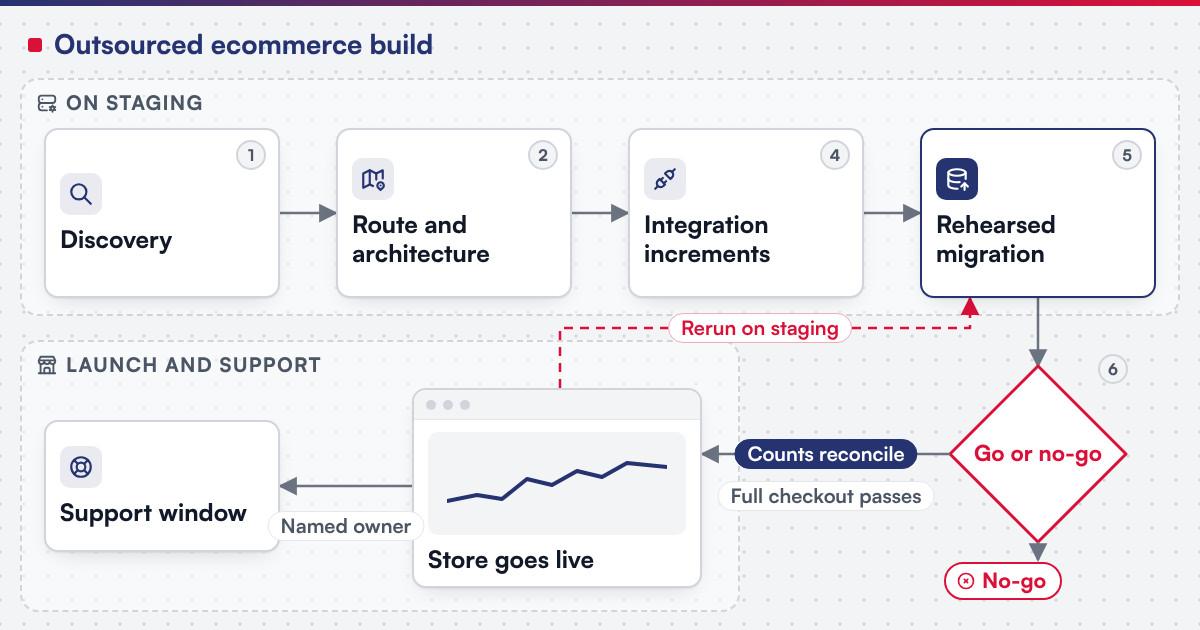 (opens the full-size diagram in a new tab)
What should acceptance cover for a store or marketplace?
Accept a commerce build on evidence a buyer can rerun. Catalogue counts match the source by product, variant and category. Checkout produces the right total across the tax, shipping and discount scenarios agreed in discovery, with every payment gateway tested in its sandbox. Every old URL redirects to its new address. Integrations retry and log failures instead of losing orders silently. On a marketplace, a test vendor can register, be approved, list a product, receive a split order and request a payout, and an operator can moderate a listing end to end.
Hosting belongs in acceptance too. WooCommerce's server requirements currently list WordPress 6.9 or greater, PHP 8.3 or greater, MySQL 8.0 or greater or MariaDB 10.6 or greater, HTTPS support and a 256 MB memory limit; a build accepted on an older stack inherits a problem on day one.
Which Netbase commerce work is closest?
Representative commerce projects for clients that are not named include web-to-print stores with online design tools for print businesses in Singapore, France, the Netherlands and South Korea, built on WooCommerce and WordPress with Angular JS or Vue.js and PDF generation; the web-to-print stores record describes them.
Indieprint, a Melbourne digital paper and apparel printer, installed the Netbase WooCommerce online designer on two domains; design errors fell 28% and production turnaround improved 15%.
For RB Marketplace, Netbase built an English-first multi-vendor marketplace for West Africa on Laravel, with vendor registration under administrator approval, commission deductions, payout requests, product moderation and a customer REST API; the RB Marketplace record sets out the full scope. The Laravel marketplace development guide plans a build of that kind.
Plan the next step for your project
Where does AI change ecommerce delivery?
AI shortens the slow, repetitive parts of a commerce project when a person still checks the output. A model can draft a first field map between an old catalogue and a new one, read an unfamiliar plugin's settings and summarise what it changes, generate candidate test orders that exercise tax and discount edge cases, and draft product copy or attribute clean-up for a merchandiser to approve. On a marketplace, it can flag a listing or a vendor document for a moderator instead of approving or rejecting it alone. None of that replaces the acceptance tests above; it gets a team to them sooner.
Which questions should you ask an ecommerce development supplier?
-
Which route fits our store, and why not the others?
A reasoned choice against catalogue, sellers and integrations
-
What is in scope, and what is a change request?
A written scope with deliverables per workstream
-
How will you prove checkout and tax are correct?
Agreed test scenarios run in the gateway sandbox
-
How is data migration rehearsed?
Repeated staging loads with reconciled counts
-
What do we own at the end?
Code, configuration and runbook in our repository
-
How often will we see working software?
A weekly review of a running increment
How this guide is sourced
Platform facts come from WooCommerce's server requirements, Shopify's app distribution documentation and Stripe's marketplace guide, opened on 2026-11-13. Netbase statements are approved claim-register entries, reviewed as the methodology describes. The routes, workstreams and delivery steps are editorial guidance for planning a commerce build.
Common questions
It depends on integrations, data volume and, on a marketplace, the seller rules. Discovery produces an estimate per increment, and the first increment runs on staging before any live connection is added.
Yes, as custom apps and integrations around the store; if the store is moving off Shopify, the migration is scoped as its own project.
A plugin covers a standard catalogue and a single commission rule; varied payout rules, multi-step vendor approval or split fulfilment usually justify a custom build.
Not always. Many stores gain more from fixing checkout, integrations and data quality on the current platform than from a migration.
A running increment on staging, the test results against the agreed scenarios and the decisions needed before the next increment.
Give both the same written scope, integration list and acceptance tests; quotes built on different assumptions cannot be compared.
Talk to Huy Nguyen (David), Founder and CEO of Netbase JSC: message him on WhatsApp at +84 937 869 689 or email project@netbasejsc.com. You can also send your brief through the project request form. Say which workflow or system the project concerns and what has to stay unchanged; the first step is a discovery conversation, and scope and milestones are agreed after it.
Bring your store, sellers and integrations
A commerce engagement goes faster when the catalogue, the integration list and the acceptance tests exist before the first call. OutsourcingVN is Netbase's own outsourcing-services platform. Submit a project with your platform, catalogue size, seller model and the systems the store must talk to, and a person will reply with the route that fits and what discovery would check first.
Work behind this guide

This record sets out what was delivered on each side and what deliberately stayed in the web panel.
Keep Reading
The stores run on WooCommerce and WordPress, with a design tool in Angular JS or Vue.js and PDF generation for production files.
Keep ReadingRelated services and solutions
 E-commerce development, built, extended or replatformed as a project
A store built, extended or replatformed on Magento, WooCommerce or headless, as scoped milestones.
Learn More