

WooCommerce development team in Vietnam: roles, cadence, handover
A WooCommerce development team engagement from Vietnam gives you a small, named group that builds and changes your store in weekly increments: a delivery lead, WordPress and WooCommerce developers, a front-end developer and QA. You approve scope after discovery, review a running staging store every week and accept the work on checkout, plugin and handover tests.
Submit a project Read the ecommerce outsourcing guideReviewed by Huy Nguyen (David), CEO · Updated 13 Nov 2026 · 8 min read

This guide is for CTOs, founders and ecommerce leads who already run WooCommerce, or have chosen it, and want an outside team to carry the build. OutsourcingVN is operated by Netbase JSC, which builds WooCommerce stores and plugins, so the guide comes from a supplier; the structure below applies whoever you hire. It is a spoke of the ecommerce development outsourcing guide, which compares WooCommerce with Shopify and marketplace routes, and the commerce and operations solutions hub lists the workflows a store usually connects to.
Contents
- When is a dedicated WooCommerce team the right buy?
- Who is on a WooCommerce development team?
- How does a WooCommerce team engagement run week to week?
- What should the team check on plugins and order storage?
- How is WooCommerce work accepted?
- What must the handover contain?
- Which Netbase WordPress work is closest?
- Where does AI help a WooCommerce team?
- Common questions
- Start with the backlog you have
When is a dedicated WooCommerce team the right buy?
A team fits when the store has a backlog, not a single fix: a redesign plus new checkout logic, a run of custom plugins, an ERP integration or a migration onto WooCommerce. A one-off theme change rarely needs one. If the platform itself is still open, settle it first with the Magento vs WooCommerce comparison or the headless vs traditional e-commerce guide; the WooCommerce platform page describes where WooCommerce fits once it is chosen.
Two engagement shapes are common. A project team takes a fixed scope, such as a store rebuild or a migration, and closes when it is accepted. A standing team works through a prioritised backlog month by month, the model dedicated development teams describes. Most stores start with a project and move to a standing team once the first release is live.
Who is on a WooCommerce development team?
Roles matter more than headcount. The table lists the roles a WooCommerce engagement usually needs and when each one earns its place.
| Role | Owns | Fits when |
|---|---|---|
| Delivery lead | Scope, weekly review, risks and change requests | Always |
| WooCommerce developer | Checkout, product types, hooks and custom plugins | Always |
| WordPress developer | Theme, blocks, editorial workflow and performance | Content-led store |
| Front-end developer | Templates, accessibility, mobile layout | Redesign in scope |
| Integration developer | ERP, shipping, payment and marketing connectors | Systems behind the store |
| QA engineer | Test orders, regression runs and release checks | Always |
On a small store one person may hold two roles; the delivery lead and QA should never be the same person who wrote the code under test. When the store must sync stock, orders and customers with an ERP, the WooCommerce and Odoo integration guide covers that connector.
How does a WooCommerce team engagement run week to week?
Netbase delivers remote-first from Hanoi in Agile increments with weekly reviews, using AI-assisted engineering under human review. For a WooCommerce store, a typical week looks like this:
-
Plan
The delivery lead confirms the week's backlog items against the agreed scope and flags anything that would be a change request.
-
Build on staging
Developers work on a staging copy of the store, never on production, with every change in version control.
-
Test
QA runs the agreed test orders, the regression set and a plugin compatibility check on each change.
-
Review
You see the running staging store in a weekly call and accept, reject or reprioritise each item.
-
Release
Accepted changes go to production in a planned window, with a backup taken and a rollback path ready.
-
Report
A short written note records what shipped, what moved and what is blocked, so nothing depends on memory.
Time zones shape step 4. The Hanoi day shares the European morning; teams on the US East Coast usually take an early call, and West Coast teams rely on written hand-offs. The Vietnam software outsourcing guide covers the wider checks before choosing a Vietnam supplier.
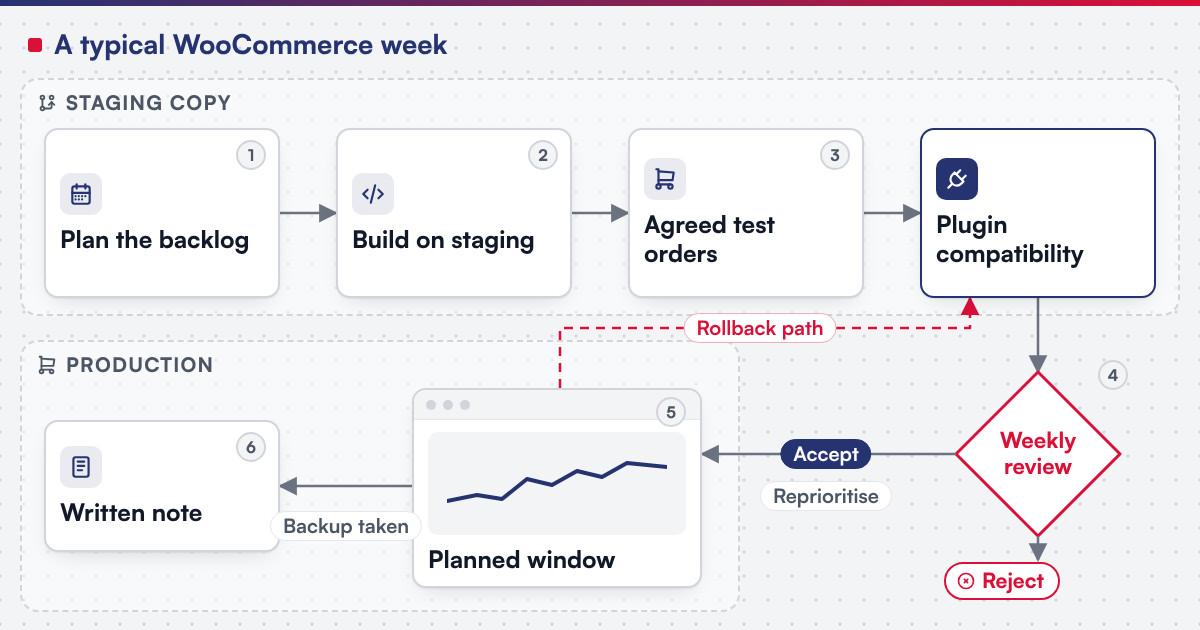 (opens the full-size diagram in a new tab)
What should the team check on plugins and order storage?
Plugins are where WooCommerce stores break. Every plugin in use should be listed with its purpose, its owner and whether it is still maintained, and every custom plugin should follow a shared standard. The WordPress Coding Standards describe their purpose as creating a baseline for collaboration and review across WordPress, from core code to themes to plugins; asking for code that follows them is a fair, checkable requirement in a contract.
Order storage is the second check. WooCommerce's developer documentation says that from WooCommerce 8.2, released in October 2023, High-Performance Order Storage (HPOS) is enabled by default for new installations, moving orders out of WordPress post types into custom tables. The same page notes that it is up to extension developers to add support for HPOS. A team should confirm every plugin that touches orders is compatible before a migration or an upgrade, and write custom plugins against the order tables from the start.
Hosting is the third. WooCommerce's server requirements currently list WordPress 6.9 or greater, PHP 8.3 or greater, MySQL 8.0 or greater or MariaDB 10.6 or greater, HTTPS support and a 256 MB memory limit.
How is WooCommerce work accepted?
Acceptance is written before the build and rerun before every release. For a WooCommerce store it usually covers:
- Checkout totals. The agreed tax, shipping, coupon and currency scenarios produce the expected total, with each gateway tested in its sandbox.
- Catalogue and orders. Product, variant and order counts match the source after any import, and order emails fire for each status.
- Plugins. Every plugin on the list is active, updated and compatible with order storage, with no unexplained errors in the log.
- Performance. Key pages load within the budget agreed in discovery on the production host.
- Redirects. Every changed URL redirects to its new address.
The software acceptance criteria guide shows how to write those tests so both sides read them the same way.
What must the handover contain?
A WooCommerce handover is complete when your own team, or a different supplier, could carry on without the original developers. That means the theme and custom plugins in your repository with history, the plugin list with licences in your name, staging and production access transferred, a runbook for updates and releases, and the test set used for acceptance. For custom development the client owns the IP created for it; Netbase productized modules and products are licensed, not transferred. The handover and exit guide lists the wider checks for ending any outsourced engagement cleanly.
Which Netbase WordPress work is closest?
PrintLeo, an e-commerce and advertising company, runs the CMSmart WordPress Printshop package with its online design plugin, delivered by Netbase; the PrintLeo record describes it. It is the published example closest to a WordPress store with custom commerce plugins.
Plan the next step for your project
Where does AI help a WooCommerce team?
AI speeds up the reading and testing work around a store. A model can summarise what an unfamiliar plugin hooks into, draft unit tests for a custom plugin, propose test orders for tax and coupon edge cases, and draft product descriptions or attribute clean-up for a merchandiser to approve. A developer still reviews every line before it reaches staging, and QA still runs the acceptance set; the gain is a shorter path to a reviewable increment.
Common questions
Big enough to cover the roles the backlog needs. A common starting shape is a delivery lead, two developers and QA, with an integration developer added only while connectors are being built.
Changes are built and tested on staging and released to production in planned windows; direct edits on a live store are avoided because they bypass testing and version control.
Yes. The first step is an audit of the theme, plugins and hosting so the backlog starts from known risks.
Yes. The Magento to WooCommerce migration guide and the Shopify to WooCommerce migration guide plan those moves.
The handover list above is delivered, access is transferred and the repository stays yours.
Talk to Huy Nguyen (David), Founder and CEO of Netbase JSC: message him on WhatsApp at +84 937 869 689 or email project@netbasejsc.com. You can also send your brief through the project request form. Say which workflow or system the project concerns and what has to stay unchanged; the first step is a discovery conversation, and scope and milestones are agreed after it.
Start with the backlog you have
Bring the store URL, the plugin list, the integrations behind it and the next three things you want changed. E-commerce development scopes the work as a project or a standing team. OutsourcingVN is Netbase's own outsourcing-services platform. Submit a project and a person will reply with the team shape and what the first week would cover.
Work behind this guide

PrintLeo, an e-commerce and advertising company, runs the CMSmart WordPress Printshop package with its online design plugin, delivered by Netbase.
Keep ReadingRelated services and solutions
 E-commerce development, built, extended or replatformed as a project
A store built, extended or replatformed on Magento, WooCommerce or headless, as scoped milestones.
Learn More